How to Improve your Sleep

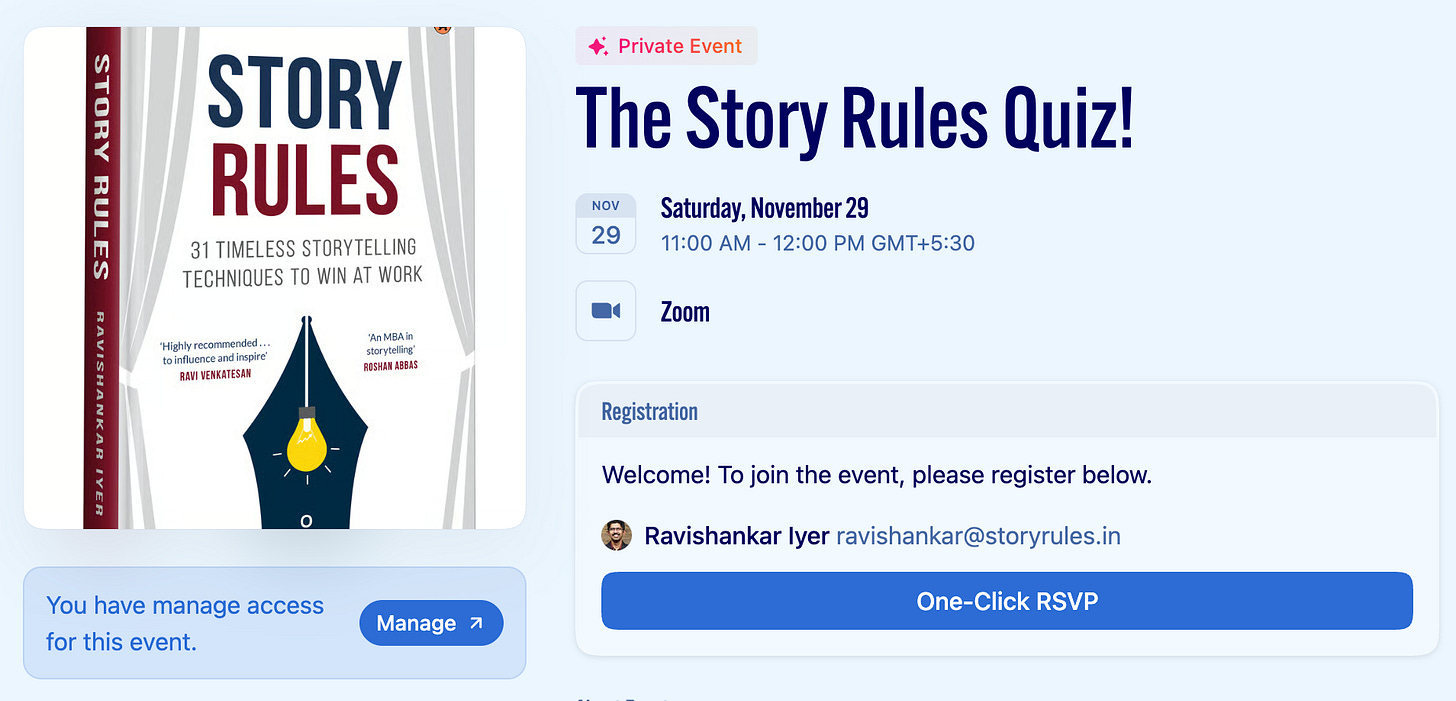
Final reminder! I’m doing a quiz on my book, ‘Story Rules’ for all those who have read it! It’s today (on 29-November) from 11 am to 12 pm. I’ve got a sneak peek into the questions by quizmaster Sanat Pai Raikar, and they are super cool!
Click on the image below to register if you haven’t already done so!
Last week I attended a concert by the peerless AR Rahman and shared a short video of the maestro Hariharan doing his magic!
This week was interesting from a travel pov, btw. Monday and Tuesday in Mumbai, Wednesday in Thiruvananthapuram, Thursday in Bangalore and Friday at Jaipur!
Had a very special evening in Jaipur with a book club called 2 Pages co-founded by the amazing Mohit Batra. Will write about it sometime soon.
And now, on to the newsletter.
Thanks for reading The Story Rules Newsletter! Subscribe for free to receive new posts and support my work.
Welcome to the one hundred and forty-fourth edition of ‘3-2-1 by Story Rules‘.
A newsletter recommending good examples of storytelling across:
- 3 tweets
- 2 articles, and
- 1 long-form content piece
Let’s dive in.
𝕏 3 Tweets of the week
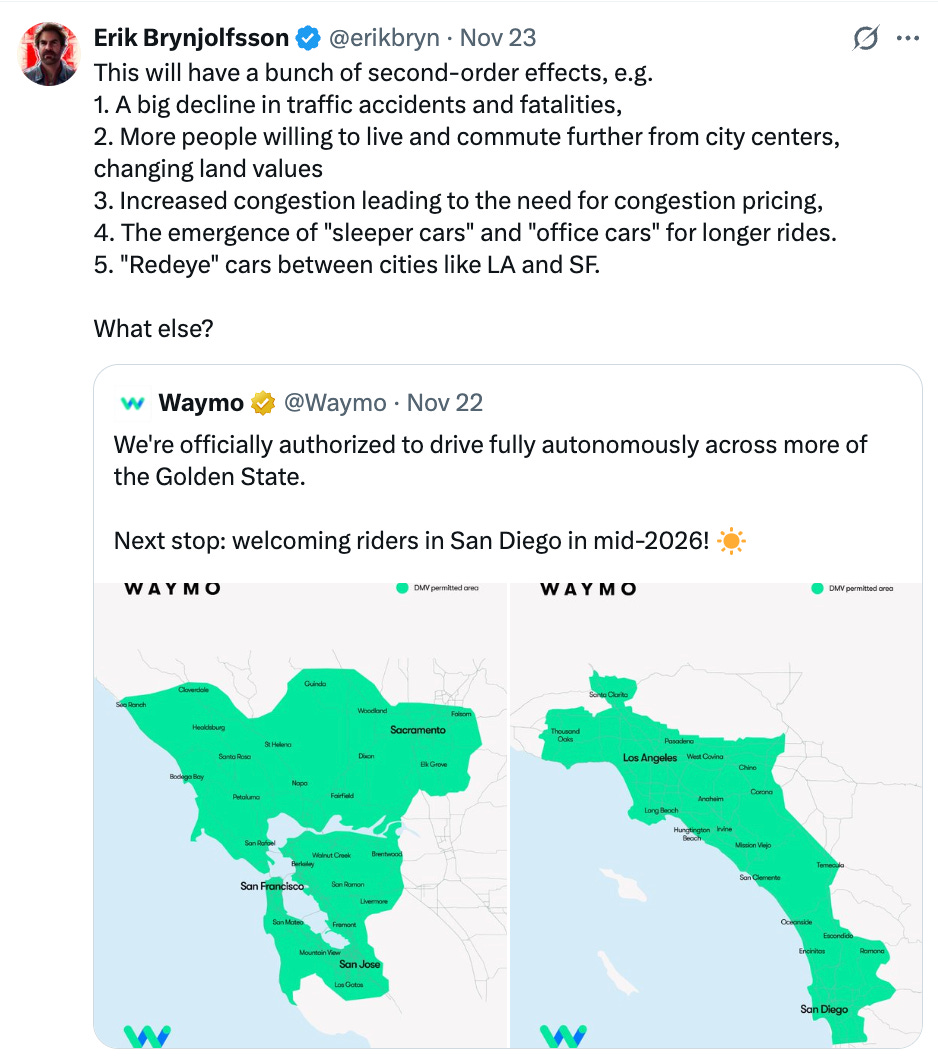
Great set of second-order effects of self-driving cars.
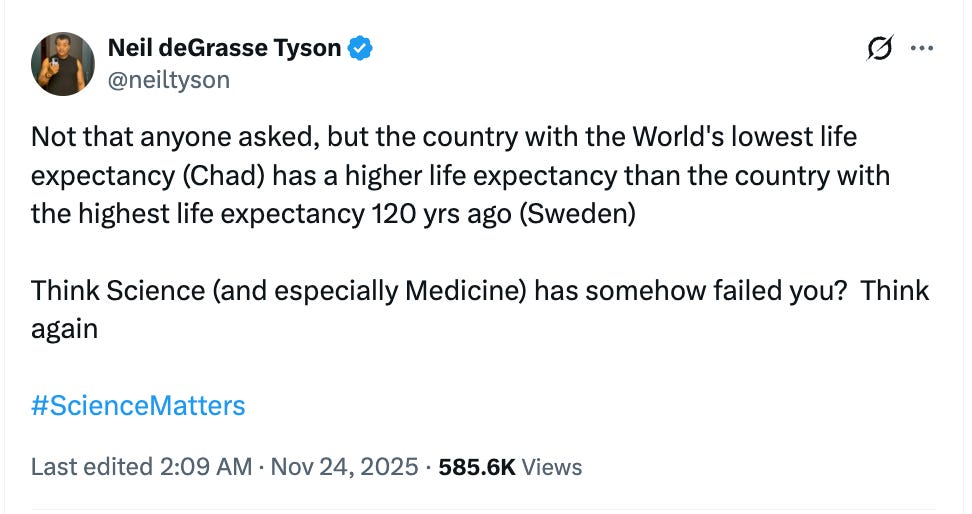
Fascinating contrast (use of norm-variance) over time!
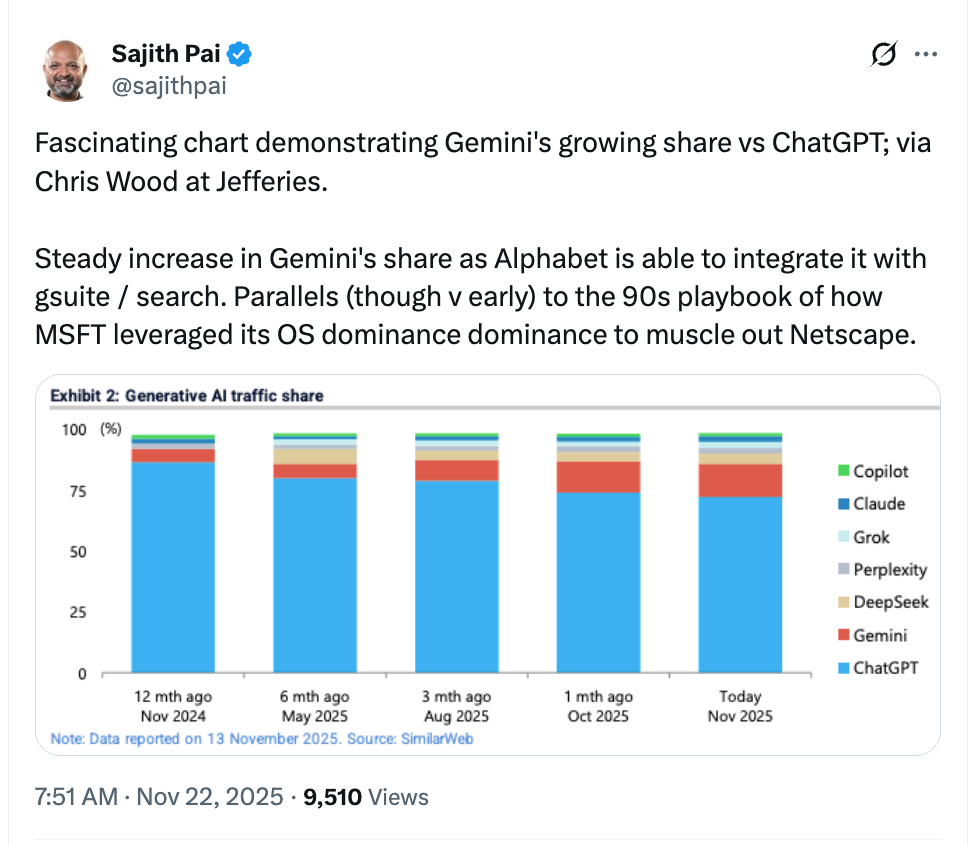
Interesting chart. Maybe time to start using Gemini more…
📄 2 Articles of the week
The Indian government passed some pretty substantive labour reforms. They didn’t get the deserved coverage in the news media. Gautam and Rishi try to redress that imbalance with a pretty bold statement (emphasis mine):
In a year marked by global economic uncertainty due to geopolitical tensions, wars, and tariff assaults amid the groundwork for creating a new world order, India closes a turbulent 2025 with its biggest structural reform since 1991.
The labour reforms would affect more enterprises than GST:
Such is the potential impact of the Codes that they overtake the Goods and Services Tax (GST) as the biggest structural reform in India. The GST applies to 12 million enterprises. The Codes potentially engage 63 million enterprises, of which only 1 million are in the formal sector.
Some useful data points (with good use of norm-variance) on the reduction in reporting requirements:
The 1,436 rules in the 29 laws have been reduced by 75 percent to 351 rules. In terms of reporting, the 181 forms have been cut by 60 percent to 73. Finally, the 84 registers for returns have been consolidated to eight, a fall of 90 percent. Most importantly, digitisation in record-keeping, filings, and registrations has become the central foundation of the new architecture.
How labour laws had accounted for just 1/7th of legal frameworks, but 50% to 70% of obligations and criminal liabilities:
Labour laws are one of the seven categories of legal frameworks that govern doing business in India. However, their quantitative burden was disproportionately large. They contributed almost half (47 percent) of all compliance obligations, with nearly seven out of 10, or 68 percent, of all criminal liabilities embedded into the country’s business laws.
A simple and clear conclusion:
The ball is now in the court of entrepreneurs. They may still face several problems. But labour and compliance are not among them. Anymore.
b. ‘An Ode to Stainless Steel’ by Raj Kunkolienkar
In this lovely piece, entrepreneur Raj Kunkolienkar writes an ode to the ubiquitous material: stainless steel.
I love how he sets the context about the pre-stainless-steel-era materials:
For most of human history, this didn’t exist. And life was significantly harder because of it.
Before 1913, storing food was a civilization-level crisis. Iron rusted. Your water container would leach rust into your drinking supply, turning it orange and metallic. You’d watch your pots decay in real-time, the metal eating itself from the inside out. Silver tarnished. Copper poisoned. Brass needed constant polishing or it turned green and toxic. Tin was soft and expensive. Gold was a joke for anything practical.
The story of the invention is fascinating and a common story of tinkering to find A, only to realise that you’ve stumbled upon B (which is more valuable):
Harry Brearley wasn’t trying to invent stainless steel. He was trying to solve gun barrel erosion.
It’s 1913. World War I is around the corner. The British Empire needs better weapons, and gun barrels are wearing out too quickly from the heat and friction of repeated firing. Brearley, working for a steel manufacturer, is testing alloy after alloy, trying to find something harder, something that lasts longer.He’s adding chromium to steel. Lots of it. 12%, 13%, 14%. The samples keep failing his tests—too brittle, wrong properties, not what the military needs. He tosses them into the scrap heap.
Weeks later, he walks past that heap.
Everything has rusted. The Sheffield rain and industrial smog have turned the rejected samples into corroded junk. Everything except the high-chromium samples. They’re sitting there, gleaming. Untouched.
This is the moment. Not the invention—the recognition.
If stainless steel were a human, it would be blushing (nopes, it can’t do that) hearing all this praise:
You can sterilize it infinitely. Boil it, autoclave it, blast it with UV, soak it in disinfectant—it doesn’t degrade. A steel surgical scalpel can be used, sterilized, and reused hundreds of times. Try that with anything else.
It’s formable. You can bend it, stamp it, weld it, spin it into complex shapes. This is why we have steel sinks, railings, and pressure cookers—you can’t make a pressure cooker out of iron; it would rust from the inside out within months.
It’s recyclable forever. Melt it down, reform it, and it’s as good as new. There’s stainless steel in circulation today that was first smelted in the 1950s, recycled four times, and is currently part of a Mumbai high-rise.
The Goldilocks material. Not too reactive, not too fragile, not too expensive. Just right for the ten thousand small problems civilization needs solved.
🎧 1 long-form listen of the week
a. Sleep expert Dr. Matthew Walker on the ‘Diary of a CEO’ podcast with Steven Bartlett
If you can ignore the click-baity headline on the YouTube video, this conversation is actually a very thoughtful (and useful) one on a topic that affects all of us: sleep.
Sleep is perhaps the most important physical activity we do:
Is there any major physiological system in your body or is there any operation of your mind that isn’t wonderfully enhanced by sleep when you get it or demonstrabably impaired when you don’t get enough? And the answer now seems to be no. There is no such system. Even down to the level of your DNA, your sleep and how you are sleeping or not sleeping will change the very DNA nucleic alphabet that spells out your daily health narrative. And we can see it all the way up to society. Sleep can change the fabric of society, can change how we interact with other people. It can change our belief systems. can change how lonely or sort of hypersocial we are…
Do you do catch-up sleeping during the weekend? Good! Your heart would thank you:
… they studied in this particular research paper over 90,000 individuals. And what they did was they essentially split them down into those individuals who were short sleeping during the week and then short sleeping at the weekend. And they compared them to those individuals who were short sleeping during the week, but then long sleeping at the weekend. They were doing catch-up sleep…. the people who were short sleeping during the week but long sleeping at the weekend, they had a 20% reduced cardiovascular disease risk relative to the people who were short sleeping during the week but also short sleeping at the weekend.
Now, to be clear, both of those groups had a higher cardiovascular disease risk than people who were sleeping sufficiently during the week and sleeping sufficiently during the weekend. So, I’m not saying that it’s a completely free lunch. But for the first time, we realized that at least one system, major organ system in your body is like the bank, which is that if your heart… at the weekend you can just keep putting credit back and your system doesn’t suffer as much for your heart.
If you are looking at devices before you sleep, it’s not the blue light that’s the issue—it’s the content:
… we’ve been taught this myth of the blue light effect from devices and it really is a myth. Michael Gretazar, this incredible Australian researcher started to say, ‘well, I can’t replicate these findings’. And what he was discovering is that it’s not the blue light that’s the problem. It’s a combination of first these devices that we use are attention capture devices and they are designed to fleece you of your attention economy and they do it ruthlessly well. They’ve spent tens of millions of dollars designing these products to do that. So what happens is that these devices become hugely activating and as a result they essentially will be a mute button on your sleepiness. So you could be there, you get into bed, it’s 11 p.m. You think, I am so tired. I was falling asleep on the the the couch watching television and then you get into bed, you start going onto social media and then you start doom scrolling and then you get into this what we call bed rotting where you just sit there and now you look at the clock and it’s no longer 11 p.m. It’s 1:00 a.m. and you’ve just done sleep procrastination. Now it turns out that it’s yes that that these are attention-grabbing devices that will mute your sleepiness, but you have to be of a certain personality type. He found not all of us are vulnerable to this sleep disruption of devices. You have to be someone who is perhaps neurotic, someone who has high impulsivity or someone who is perhaps high anxious. If you are of any of those kinds, you should be really careful about your use of technology in the bedroom
Walker busts the myth of magnesium supplements to help improve sleep (loved the Star Wars reference, emphasis mine!):
… if you’re suffering from sleep problems and you’re looking to supplements, you’re stepping over dollars to pick up pennies. Okay. What you need to do is think about the fundamentals. Regularity. Watch your caffeine intake. Make sure you’re not drinking too much alcohol. Get regular. Dim down half of the lights. Digital detox. Any one of those, but especially all of them combined are going to get you log orders of better sleep than reaching for the latest supplement bottle of whatever it is. The second thing to say is think about it from a logical standpoint. If there were really some supplement that promises to be the Shangri-la of all resplendent sleep at night, the drug companies would have been all over it decades ago. To put it in context, it took George Lucas, I think, about 30 years to amass something like 4 billion in revenue from the Star Wars franchise. It took Ambien 22 months. That’s how big a business sleep pharma is. Ambien is a sleep pill. Magnesium, if you dig into it, and I did a deep dive about three years ago because I kept hearing it too. The first thing to note is that most forms of magnesium, magnesium oxide or magnesium citrate, most of these forms of magnesium don’t cross the brain barrier and sleep is produced by your brain…
And that’s the problem with magnesium supplementation. If you’re magnesium normative, all you’re doing is creating probably expensive urine at that moment in time.
Highly recommend that you listen to the entire conversation.
That’s all from this week’s edition.
Photo by Diana Polekhina on Unsplash