
The #1 Business History Podcast

Nice to hit the #150th edition milestone. Hopefully can continue for much longer!
Latest video dropped—on the importance of labelling big ideas. (Chapter 4 from the book).
This week was a chill one. Reached back home on Sunday night after a wonderful trip to Delhi, Amritsar and Jaipur.
Delhi and Amritsar were with old friends and I’d written about the Amritsar food scene earlier.
Jaipur was to attend a 2-day alumni reunion with my IIM-A 2005 batchmates.
It was 2 days of amazing memories, fun conversations, scrumptious food, energetic performances (there was a talent night!), lots of pictures and videos, late-night guppa sessions fueled by endless cups of tea and piping hot plates of Maggi…
When we left, our hearts were full of incredible happy memories… and also sadness that the two days flew past so quickly!
Glad to have had the opportunity (and health!) to have attended the meet-up.
And now, on to the newsletter.
Thanks for reading The Story Rules Newsletter! Subscribe for free to receive new posts and support my work.
Welcome to the one hundred and fiftieth edition of ‘3-2-1 by Story Rules‘.
A newsletter recommending good examples of storytelling across:
- 3 tweets
- 2 articles, and
- 1 long-form content piece
Let’s dive in.
𝕏 3 Tweets of the week
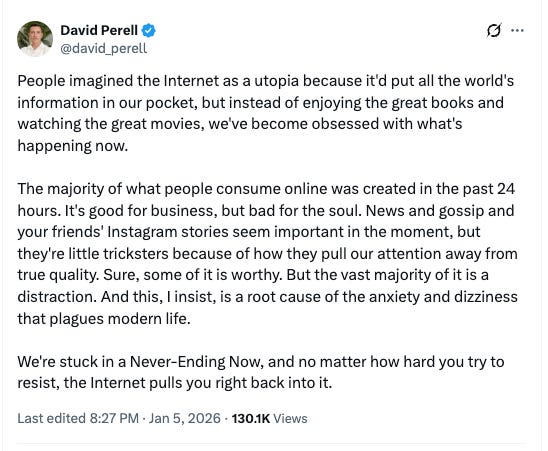
Insightful take by David. Tempting to get lost in the ‘never-ending now’ (great label)!
This year, I’m trying to read more canonical, timeless stuff, especially on philosophy. Have just started with ‘The Story of Philosophy’ by Will Durant and ‘The Upanishads’ by Eknath Eswaran.
Share recommendations if you have some!
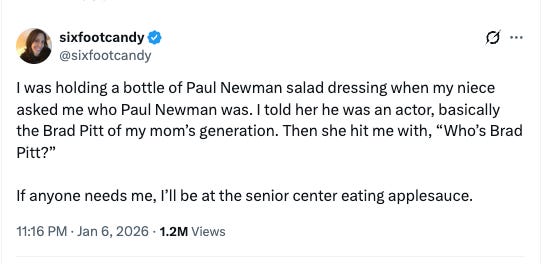
Haha, I feel you.
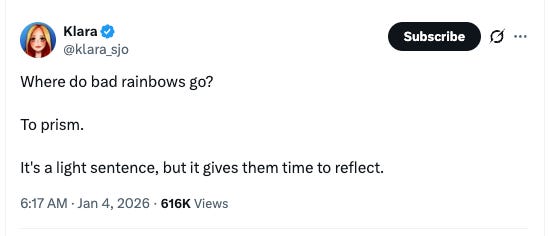
Haha, loved the clever wordplay
📄 2 Articles of the week
a. ‘That viral thoughtpiece you read? It was probably AI-generated’ by Deedy Das
Das opines that when it comes to writing, you shouldn’t use AI to generate it, without disclosing:
(When people say) ‘I still enjoyed reading it’ (it) is the information diet equivalent of ‘don’t care where it came from, the food tasted good!’ We might trust AI code because it’s a functional utility. We might be okay with AI video and image so long as we know it is AI. But when AI writing or art is being used without disclosure, to me it is a breach of trust.
He shares some AI-detection tools (check out the Wiki post):
I personally trust Pangram because it is the only one to be independently evaluated to have < 0.5% false positive and false negative rates. When it says something is 100% AI-generated, I have never seen a case where it isn’t. They give users 5 free tries. I highly recommend everyone try it [not sponsored]. If you still don’t trust detectors, familiarize yourself with Wikipedia’s ‘Signs of AI Writing’
An unfortunate trait of AI writing is to overuse contrasting statements like “It’s not X, it’s Y”:
I find it useful to search for all instances of ‘not’ in an article and read through how it’s used. If there’s a lot of ‘it’s not just X, it’s Y’, you can be sure you’re reading AI. There also certain words like ‘strategically / landscape / enduring’ that are telltale signs
In one of the chapters in my book (Called ‘Use Contrast’) I actually mention that folks should use these formats (“It’s not X, it’s Y”) to drive contrast. Here’s the extract:
Contrast relies on simple templates like ‘This is not X, but Y’, ‘This is X, but that is not X’, or ‘Till now, it was X, now it is Y’. Use them to craft your lines. Keep them short.
Man, AI’s overuse has totally undermined my advice.
b. ‘WhatsApp owns India!’ by Dharmesh Ba
In this insightful piece, Dharmesh delves into what makes WhatsApp so powerful and essential:
WhatsApp isn’t a product Indians use. It’s infrastructure Indians depend on.
Infrastructure is different from products. Products are things you choose. Infrastructure is what you assume exists. You don’t think about electricity until the power goes out. You don’t think about roads until they’re blocked.
India stopped thinking about WhatsApp years ago. It’s just… there. Assumed. Essential.
And it’s not just essential for personal communication. For many small businesses, WhatsApp is one of the main channels for lead gen, merchandising choices and sales. Dharmesh explains with a vivid example:
He (a cosmetic store owner in Nagpur) joined a vendor WhatsApp group – wholesalers who posted about new products arriving in the market. When something looked promising, he’d post the image to his WhatsApp status. Or he’d share it in a customer group he’d built over years.
Then he’d wait. If even two or three people asked for the price, he knew there was demand. He’d place an order before the product even touched his shelf.
He wasn’t using WhatsApp for communication and marketing alone but turned it into a just-in-time inventory system.
This was India’s answer to the Shopify + Stripe stack. Discovery happened on Instagram. Demand validation happened on WhatsApp Status. Payment happened on UPI.
But WhatsApp is not geared to support SME owners like these. Ideally they would like tools to automate their sales process, but it’s not easy, says Dharmesh:
Here’s a paradox: The businesses that most need WhatsApp automation are the ones least able to use it.
For instance, one of the most common patterns we’ve seen is business owners consistently updating their WhatsApp status each morning with details about the day’s fresh vegetables, sharing posts about new stock in their groups, and responding to customer inquiries within minutes. These actions have become almost daily rituals for entrepreneurs running their businesses on WhatsApp. Such simple automations today are not possible on the main WhatsApp mobile apps but only possible in their API version.
Can we expect Meta to work on solving these problems? No, says Dharmesh, given Meta’s incentives:
Here’s the uncomfortable truth: these aren’t problems Meta is trying to solve. They’re features of the system working as intended.
Meta is an advertising company; ads pay the bills.
Every product in their portfolio – Facebook, Instagram, Messenger, even Oculus – exists to collect data and sell ads. WhatsApp is the outlier. It’s a messaging tool that, in a different world, might have evolved like Telegram, Slack or Microsoft Teams: an open platform where developers build productivity tools, businesses customize workflows, and ecosystems flourish.
He then compares the WeChat model and how China avoided the deep dependence on a foreign app for such a crucial human need.
He ends with a call to action (loved the chiasmus in the first para):
WhatsApp solved India’s communication problem. Now India needs to solve WhatsApp’s incentive problem.
That doesn’t mean banning WhatsApp or building a clone. It means creating optionality – a messaging layer where WhatsApp is one choice among many, not the only one that works.
Surprisingly, Dharmesh doesn’t even mention Arratai once!
🎧 1 long-form read of the week
a. ‘10 Years of Acquired (with Michael Lewis)’ with David Rosenthal and Ben Gilbert
Acquired is a rare thing—in a sea of cookie-cutter interview-based podcasts, it stands out as a long-form narrative storytelling show, which dives deep into the history of iconic companies such as Google, NVidia, Costco, and yes, even the IPL.
They have interviewed Mark Zuckerberg, Jamie Dimon, Steve Ballmer and many other leaders… because of the niche and loyal following they have built.
In this episode, the hosts Ben and David sit with storyteller-extraordinaire, Michael Lewis and reflect on the lessons from their 10 year journey.
One lesson: instead of inundating your audience with content, make it scarce:
(Let’s start with) the NFL (National Football League). The product is scarce. you know, (As against) 162 baseball games a year… You pass a lot of time with it. But with the NFL, because the product is scarce and then they have very smartly cultivated that and engineered it to be more scarce, more of an event driven sport. That’s made all the difference. And to me, what we do is insane for the podcasting industry…completely insane. For the last three years, we’ve released 12 episodes and next year we’re going to do eight episodes for the whole year.
Imagine getting a call from Hollywood to convert one of your episodes to a show. And then refusing… because it is ‘too hard’. Ben and David talk about the too hard pile as a filter for refusing opportunities:
Ben and David: Warren (Buffett) and Charlie (Munger) had this thing. There was the yes pile, the no pile, and then the too hard.
It’s basically admitting that like our opportunity cost is so high like the the things that we say yes to are so awesome that it’s okay to say too hard to just a giant amount of things.
Lewis: So what’s an example of something that you… what’s too hard?
Ben and David: … we’ve had lots of opportunities to work with Hollywood… it keeps to this point they have thus always invariably ended up in the too hard pile
I was surprised to hear that that show is largely unscripted—there’s an element of improv to their performance!
Ben and David: Every episode now going into recording day feels like a high wire act because we haven’t fully scripted it out. I’m like I think this is going to come together. But like we had to add this thing called a production meeting about 6 months ago. One week before recording we are required to get together and agree on an episode structure but not share any details because we got so into this like improvisation thing that some of our episodes would sort of end and you’re like that had no flow to it.
Michael Lewis: Like you guys had two different ideas. You’re not taking risks if it doesn’t work sometimes… But it’s the difference between I mean, do you know how your heart sinks when someone gets up at a podium with a speech and they’re going to read their speech? The audience is waiting for you to get through this thing because they know nothing’s going to happen. Like whatever’s on that page, that’s what’s going to happen. Pre-announcing the score of the Super Bowl. And that if you get up and you just start talking, the audience also knows, oh my god, this could be a disaster… they don’t know where it’s going. Just having… just some of that has a huge effect on the way the audience responds to the performance.
Surely, if you are improvising, then there would be some portions which need to be cut and retold, since the final product has to be perfect… Ben and David do hundreds of retakes and edits to get the episode right:
Eight, nine hours of raw audio with dozens of retakes, sometimes hundreds of retakes. We produce each other as we go.
We cut ‘literally’ all the time. Literally. Totally. But the retakes though are a different thing. The retakes are ‘We didn’t say that clearly enough. We didn’t land the point’. I made a point where I wasn’t paying enough attention to what David was saying cuz I was like looking over at my notes and then I make the same point and he’s like, “Oh, I think you missed it. I just said that. Can you just say the last… thing as an…” and then we’ll move on. Or I explain something in twice the amount of time and David’s like getting bored. And he’s like, that was a real monologue. I think we got to keep the story moving. And I’m like, I agree. Uh when I wrote it in my notes, I was really excited about it, but now that we’re in the moment, I can feel that it’s slowing down the energy. So, let me take two minutes, let me retype some stuff and let me figure out if there’s a condensed way to say that so that it can flow seamlessly in the energy of the story.
That’s all from this week’s edition.
Photo by Diana Polekhina on Unsplash