The Story of The Whole Truth Brand

It’s been a slow week, and I’ve been working on a content writing plan.
Over the next few months, you can expect more regular writing from me on LinkedIn and X… and hopefully more videos on YouTube. Plus some special projects that I’m keen to work on. So much to do, there’s never enough time…
Wish me luck!
And now, on to the newsletter.
Thanks for reading The Story Rules Newsletter! Subscribe for free to receive new posts and support my work.
Welcome to the one hundred and fifty-fourth edition of ‘3-2-1 by Story Rules‘.
A newsletter recommending good examples of storytelling across:
- 3 tweets
- 2 articles, and
- 1 long-form content piece
Let’s dive in.
𝕏 3 Tweets of the week
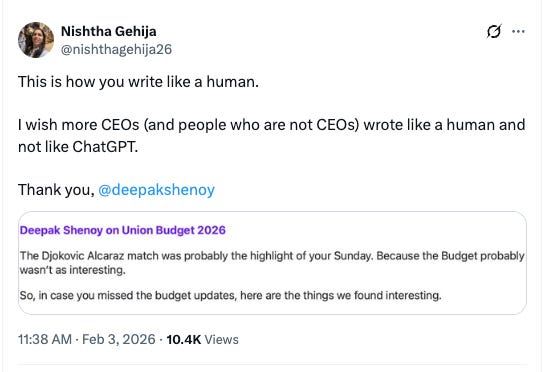
It’s getting fairly easy to identify when stuff is written by a human. Your audience will expect that if you are a senior leader. Don’t give them AI slop.
Btw, for another superb human take on the budget, check out Swanand Kelkar’s piece on Mint.
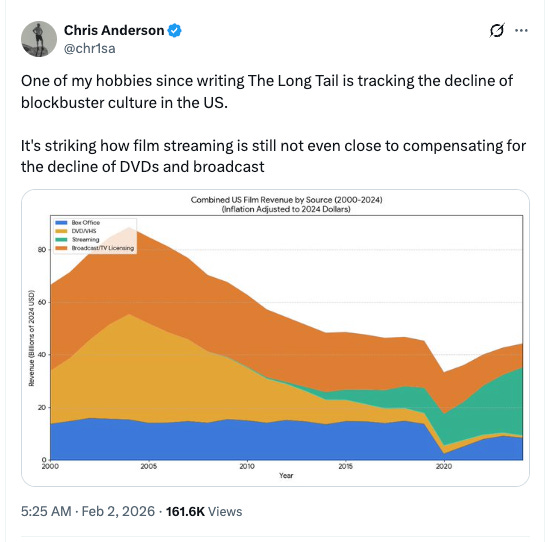
Interesting chart. Wonder what’s the reason for the steep fall in movie revenue.
Is it: (a) People just watching less movies, given explosion of short-form entertainment options? Or (b) The ‘price recovery per movie-hour’ is much lower in streaming vs theatres and DVDs?
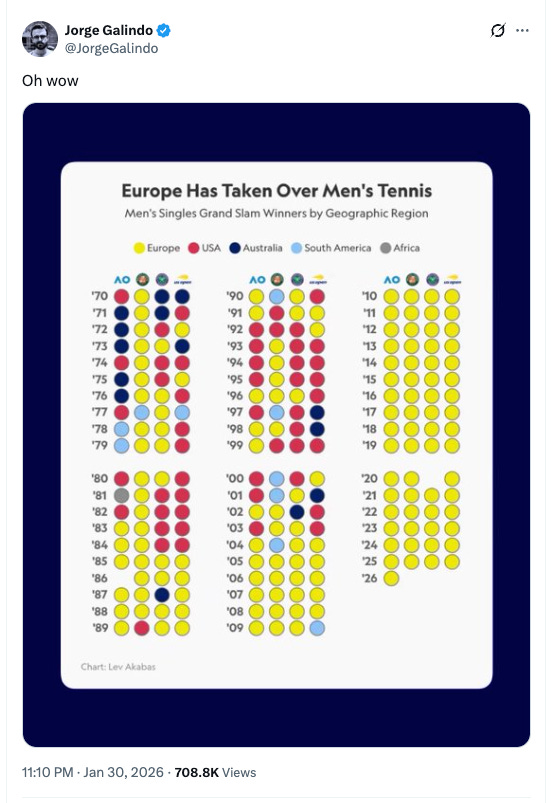
Superb visual and such a stunning stat. Wonder why the US fell back in men’s tennis…
📄 2 Articles of the week
India has been logging some smart achievements on the economic front in the last few months. The US Trade deal (on top of the EU one) seems to be a pivotal one, as the former CEA writes, with optimism:
Can one of the world’s most protectionist economies become one of its most open? Can a country that has consistently failed to exploit its vast pool of unskilled labour to build a strong manufacturing sector reverse that failure? The cheery answer today is: India might be about to make such a leap.
He summarises the deal (what), the rationale (why) and the key implication (what next):
India has just negotiated the mother and father of all free-trade agreements with the European Union and America, respectively. It is likely that the latter reflected the logic of competitive liberalisation: American business anxiously realising it would be at a competitive disadvantage in India after the EU agreement. Details on the American deal are still unclear but, even allowing for slippages, the two agreements could make India a near-open economy, with protection largely restricted to agriculture, and could open up markets for its low-skilled manufacturing exports
This could hopefully have positive implications on the export-oriented manufacturing sector, which is traditionally critical for low-skill employment generation:
With the two agreements, “China Plus One”—the business strategy of supplementing Chinese suppliers with those from at least one other country—is back on the table for India. The substantial disadvantage that India suffered in the European market relative to Vietnam, Bangladesh and other poorer countries (about 10% higher tariffs) will now be redressed.
Subramanian concludes with a strongly positive outlook for India:
But for now it deserves credit for recognising the stakes and negotiating these two agreements, the path to which has involved moderation of India’s self-regard, not to mention some humiliation. Along with other reforms recently implemented—to taxes, labour codes and the energy and insurance sectors—they hold the potential to transform India into a paragon of openness and a manufacturing powerhouse. Those would have been laughable propositions even a few months ago.
b. ‘The most important skill to learn in the next 10 years’ by Dan Koe
Koe makes a compelling point: Given the ruthless way in which AI is making multiple tasks (and skills, and companies, and industries!) irrelevant, he posits that the most important skill might actually be… your attitude:
The most important skill to learn that will be relevant now, in 10 years, and until you die is agency. Because if you can set your own life direction, do what is required to achieve it, and avoid the infinite number of temptations and distractions in today’s world, you will never be at risk of replacement (and if you do get replaced, it doesn’t matter, because you can quickly adapt).
(Btw, this reminded me of an old corporate saying, that my friends in P&G would say: “Hire for attitude, train for skills.”
Why is agency so rare? For one, society usually forces us to conform:
…around 50% of the population is at the conformist stage of development. Meaning half the population lacks the cognitive development for genuine agency.
Conformity stems from survival. Humans don’t only survive on the physical level like animals (reproducing genes), but on the psychological level (reproducing beliefs, ideas, and information).
If you work a job, you have a low degree of agency in that domain of life because if that job were to go away, your survival is at stake. So you must conform.
If you have hard-set beliefs that bind your identity to a specific religion or political party, you do not have a high degree of agency, because your ideas of good and bad originate from your culture, rather than personal scrutiny and discovery.
Agency requires iteration, and patience:
when we look at what actually makes people successful, it isn’t just acting toward a goal. Anyone can start a business, but that doesn’t mean they will reach any form of success. Most of them don’t, in fact, because they’re missing one critical piece of the puzzle:
If something doesn’t work, you reflect on the situation, make an adjustment, and try again, over and over until you reach your end destination.
Agency, then, in my opinion, is not only action, but an undying commitment to iteration. Learning and doing in unison. Making mistakes and correcting mistakes without being seduced back into a comforting conformity because “it’s not working.”
Yes, I’m talking to you, people who start writing and quit after 2 weeks.
Creators still have to be in the driver’s seat:
When you ask AI to make all of the decisions for you (in other words, you ask it to guess what works based on hundreds of thousands of opinions on the internet), there is no throughline. There is no theme. There is no personality. There is no vision. There is no context. That’s what creators are. Context creators, not content creators. The content is meaningless without context, and AI generations are the same.
📄 1 long-form read of the week
a. PMF Convo #21 – Shashank Mehta, The Whole Truth with Sajith Pai
Two of my favourite storytellers—Sajith Pai and Shashank Mehta—come together in this conversation to discuss the evolution of The Whole Truth brand (surely, you’ve tried their protein bars or chocolates by now!).
Shashank shares how the Whole Truth Foods mission is very personal to him because of his background:
I used to be a super fat kid. All of my teenage life I was going to be scared and I lost weight around the age of 19 dramatically, I stopped eating, started running through sheer willpower, lost a lot of weight. In 9-10 months, once I was done losing, I thought, hey, now I’m a thin guy, I can do whatever I want to do. And then in two years, it all came back. Then I lost it again. Then in two years, it came back again. Then by the time I was 26, I was doing the third round of 30 kgs of weight loss. The third time I educated myself, read up a lot, found my own thesis about food, fitness, nutrition, all of that, that led to me writing a blog called FITSHIT.
It’s amazing how he did the experimentation on the first protein bar himself at home:
About 7-8 months of at home tinkering and development. And I used to take a version of the bar every other week to my office, and my peers would be my guinea pigs. And they started saying, listen, this is amazing. We’ve never had a protein bar this tasty, but it was still crumbly. It was not shelf ready by a long shot, but it gave me clarity that this is possible.
Interesting insight from Shashank on why the big food companies were not solving the problem of high-quality food with pure ingredients:
Then the penny dropped that it’s not been done because no food company has applied this lens to food. And why haven’t they applied the lens? Because all the big food companies, even now, have so much penetration headroom left to go in this country, which is largely a poor country, which is largely a tier three rural country, that they’re not focused on solving for the urban, upper middle class to rich population, whose lives have completely changed. Your and my life are not on the farm anymore. They’re like a New York or a San Francisco guy’s life. But no one’s falling for us because even a Cadbury or a Unilever or anyone has so much penetration headroom left to go.
They’re focused on how I can make a five-rupee chocolate and put it in 10 lac more outlets? Which is a different task altogether. Once I got that articulation, I was like, shit, there is a business opportunity here also. That’s when Ikigai happened.
I liked this difference between mercenary and missionary founders:
… the difference between mercenary and missionary founders. One should be clear who you are. I am clearly missionary. I’m not a mercenary. I did not pick a gap in the market. Yeah, this is clearly mission led. And hence, I would say for missionary founders, more important than how big is the playing field that you pick, your badminton versus tennis. More important is, will you stick with what you’ve picked? Because if you stick with it long enough, you’ll find a larger playing ground somewhere down the line. More importantly, only if you pick something which you passionately, deeply feel needs to be solved, will you get to PPF (Product to Problem Fit)? Otherwise, you will not get to PPF.
Sajith Pai then adds some nuance with his own framework for the four types of founders:
Sajith: So, I have this framework that there are broadly four ways to arrive at the pick. What you’ve chosen is to pick from a point of personal pain. Okay, the other picks are personal experience. I’m working for Unilever. And I saw that for big companies, this problem is not solved. Say tracking, like retail sales, I am not getting the data etc.. So it’s not a personal pain per se but more from my personal experience. And I know that if I do this, Reckitt will buy, P&G will buy. And so that’s personal experience.
Third is, I would say prospecting, which is to go after the gap systematically. So today, if you’re going out, you’ll say AI, I’ll do AI or something like quick commerce. And the fourth is opportunism, which is like how this is big in the US, India main bhi aa sakta hai (this can be done for India too), let’s do Eleven Labs for India etc.
So, these are the four ways of picking. What you picked is pick via pain, so, this is my pain, I want to solve my problem.
Shashank makes a great distinction between the product and the brand’s common ethos, which allows them to extend the product lines
Then on this platform of countering half-truths, you can mount an infinite number of products. Because we are solving for trust, because we are rebuilding the world’s trust in food now, whichever category the trust is broken in, the brand can get applied to. That is what increases the TAM. Otherwise, when I started with protein bars, everyone told me, please do anything, we will fund you. Please don’t start in protein bars. It’s like a 200 crore category. Even if you get 100% of it, you will build a 200 crore business. Like why? And I was like, it’s not a protein bar company. It is a truth company. And I’m just starting with protein bars because I have a great product in my hand. And a bird in hand is worth two in the bush. But it will go to everything and it’s gone to everything. Like it’s under the same brand we sell chocolates and protein powders, unheard of. But because we are a truth company, we are not a chocolate or a protein powder company.
“if you can’t explain your brand on one page, then you don’t know your brand.”:
That’s where I wrote down the brand on a page. And this was all Unilever learning that we have this template of a brand doc called a Brand Key, which if you can’t explain your brand on one page, then you don’t know your brand. You know, what’s the insight? What’s the differentiator? What’s the value prop, etc.?
High-quality storytelling by two high-quality thinkers.
That’s all from this week’s edition.
Photo by Diana Polekhina on Unsplash