Aamir Khan on Storytelling

I shared a funny incident this week, in which our daughter taught us about the power of observation.
Btw, did you know that Feb-24th is the birthday of two stellar storytellers, Steve Jobs and Yuval Noah Harari?! Check the links to read posts sharing some storytelling examples by them.
And now, on to the newsletter.
Thanks for reading The Story Rules Newsletter! Subscribe for free to receive new posts and support my work.
Welcome to the one hundred and fifty-seventh edition of ‘3-2-1 by Story Rules‘.
A newsletter recommending good examples of storytelling across:
- 3 tweets
- 2 articles, and
- 1 long-form content piece
Let’s dive in.
𝕏 3 Tweets of the week
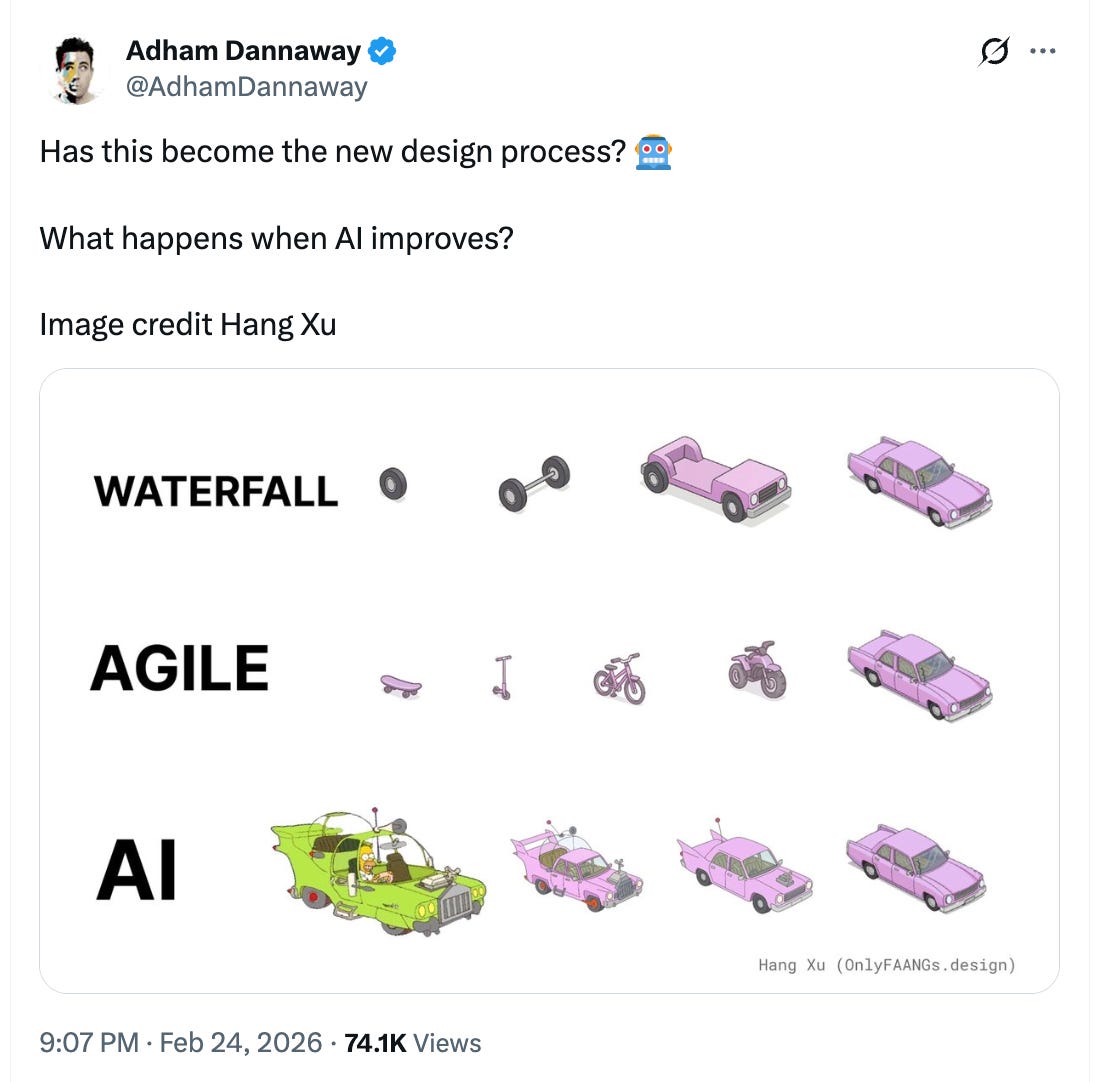
I don’t understand these terms (Waterfall, Agile), but I love a good visual analogy! Is it broadly accurate?
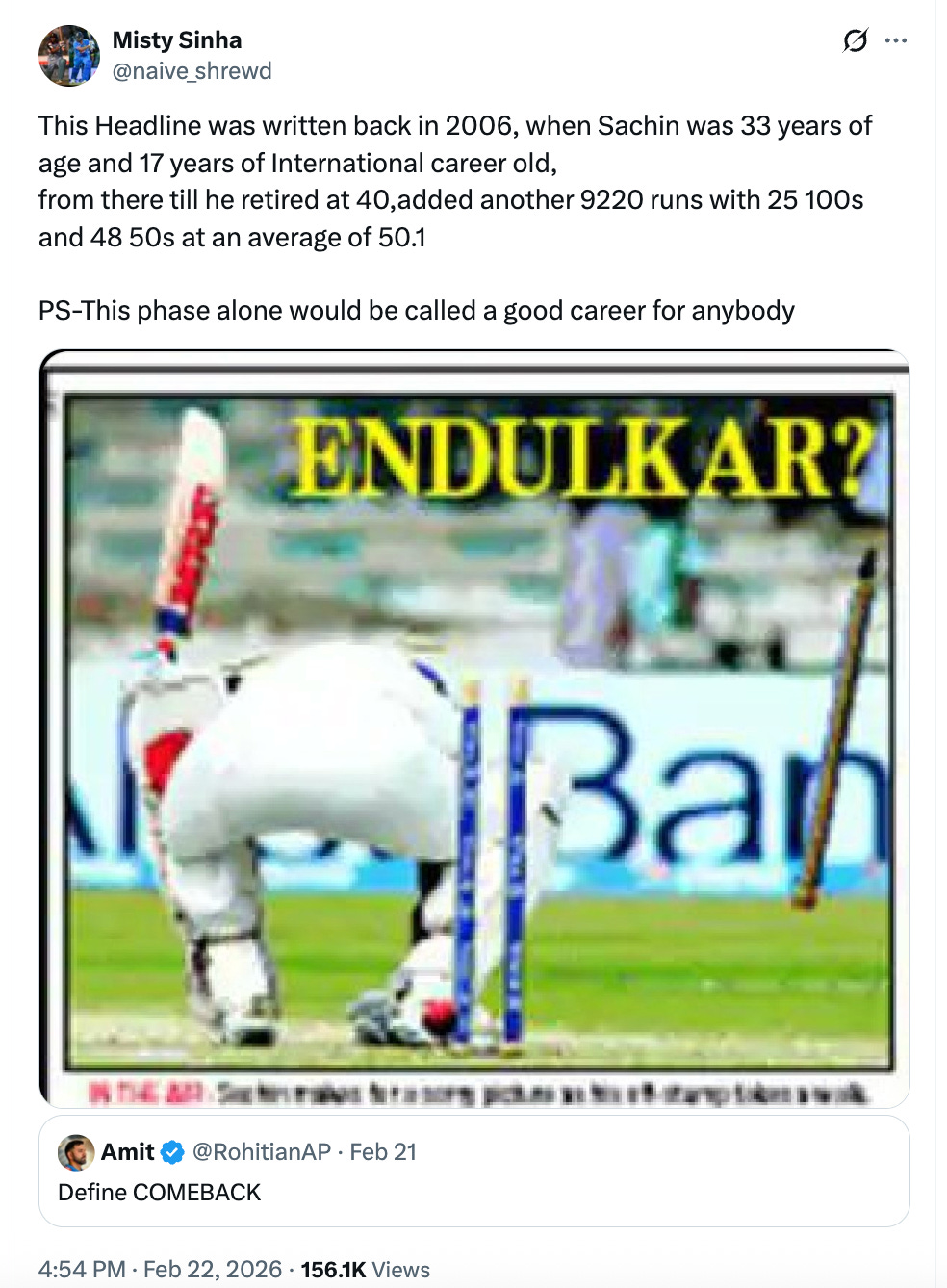
Superb contrast between the headline and the rest of Sachin’s career. Smart use of stats too!
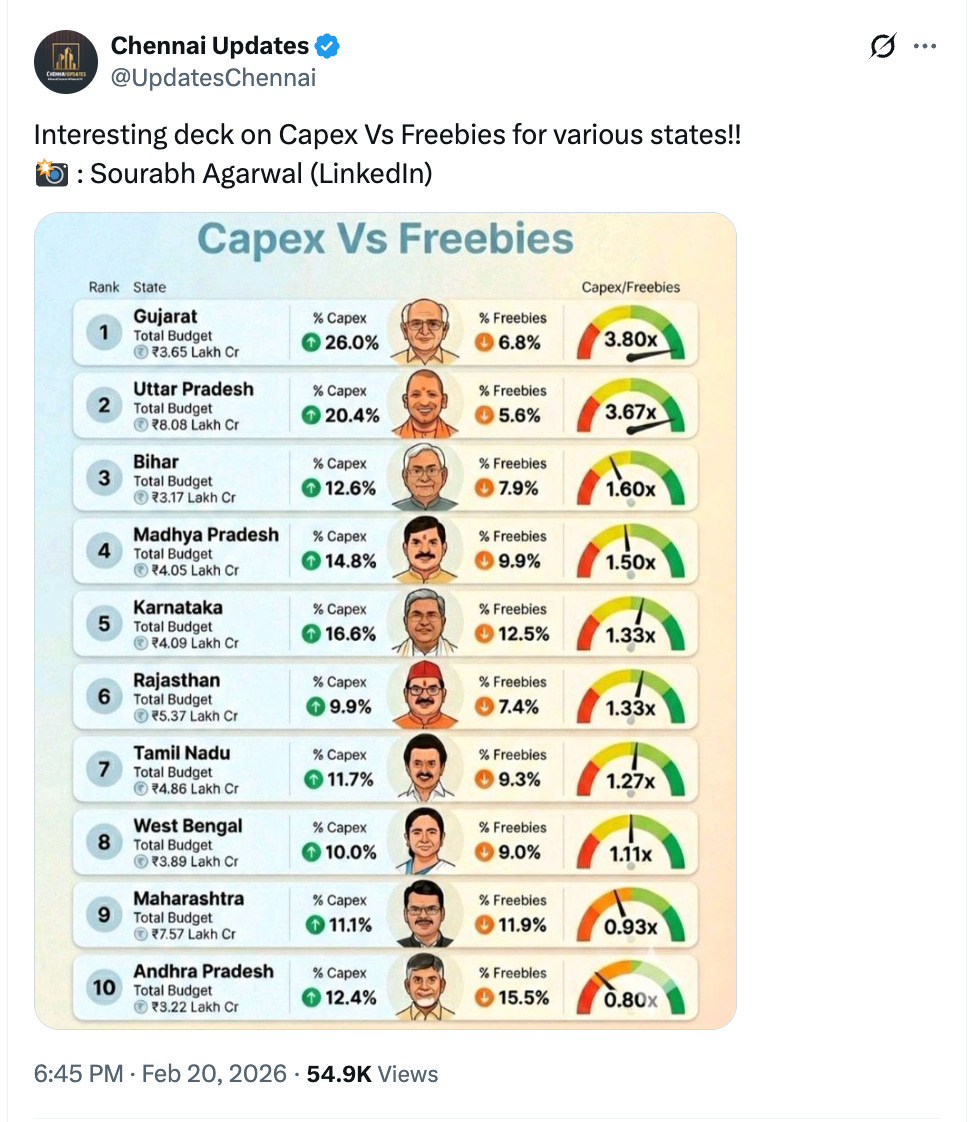
Great use of contrast again between capex and freebies to compare fiscal discipline across states.
📄 2 Articles of the week
a. ‘How will OpenAI compete?’ By Benedict Evans
Some high-quality thinking and analysis by Ben Evans on the strategic choices and imperatives faced by OpenAI.
Evans starts with a quick lay of the land in AI and a stark comparison with the dominance enjoyed by Google/ iOS/ Instagram:
half a dozen organisations that are currently shipping competitive frontier models, all with pretty-much equivalent capabilities. Every few weeks they leapfrog each other. There is variation within those capabilities, it’s possible to drop off the curve (Meta, for now) or fail to get onto it (Apple, Amazon, Microsoft, for now), or remain six months behind the frontier (China), or rely heavily on other people’s work (China, again) and all of this needs a lot of money (of which more below) but today there is no mechanic we know of for one company to get a lead that others in the field could never match. There is no equivalent of the network effects seen at everything from Windows to Google Search to iOS to Instagram, where market share was self-reinforcing and no amount of money and effort was enough for someone else to to break in or catch up.
Open AI has a LOT of users… but they don’t use it very often:
The one place where OpenAI does have a clear lead today is in the user base: it has 8-900m users. The trouble is, there’re only ‘weekly active’ users: the vast majority even of people who already know what this is and know how to use it have not made it a daily habit.
…
The data that OpenAI released in its ‘2025 wrapped’ promotion tells us that 80% of users sent less than 1,000 ‘messages’ in 2025. We don’t know how that changed in the year (it probably grew) but at face value that’s an average of less than three prompts per day, and many fewer individual chats. Usage is a mile wide but an inch deep.
There seems to be a gap in the model’s capabilities and how people are using them:
If people are only using this a couple of times a week at most, and can’t think of anything to do with it on the average day, it hasn’t changed their life. OpenAI itself admits the problem, talking about a ‘capability gap’ between what the models can do and what people do with them, which seems to me like a way to avoid saying that you don’t have clear product-market fit.
This is a great summary of Open AI’s situation:
So: you don’t know how you can make your core technology better than anyone else’s. You have a big user base but one that has limited engagement and seems really fragile. The key incumbents have more or less matched your technology and are leveraging their product and distribution advantages to come after the market. And, it looks like a lot of the value and leverage will come from new experiences that haven’t been invented yet, and you can’t invent all of those yourself. What do you do?
Evans then tries to make sense of Altman’s actions:
So, when Sam Altman says he’s raised $100bn or $200bn, and when he says he’d like OpenAI to be building a gigawatt of compute every week (implying something in the order of a trillion dollars of annual capex), it would be easy to laugh at this as ‘braggawatts’, and apparently people at TSMC once dismissed him as ‘podcast bro’, but he’s trying to create a self-fulfilling prophecy. He’s trying to get OpenAI, a company with no revenue three years ago, a seat at a table where you’ll probably need to spend couple of hundred billion dollars a year on infrastructure, through force of will. His force of will has turned out to be pretty powerful so far.
Evans ends on a thought-provoking note:
Maybe the word I’m really looking for is power. When I was at university, a long time ago now, my medieval history professor, Roger Lovatt, told me that power is the ability to make people do something that they don’t want to do, and that’s really the question here. Does OpenAI have the ability to get consumers, developers and enterprises to use its systems more than anybody else, regardless of what the system itself actually does?
b. ‘The flaws in Citrini’s research piece’ by Marcelo Lima
If you’ve not been living under a rock, you have probably gone through the Citrini Research AI-doomsday post that knocked off billions of dollars of market value from a range of stocks.
Lima refutes the ideas in the post with his arguments.
He addresses the lump of labour fallacy:
The lump of labor fallacy assumes that humans have a fixed checklist of problems to solve. But every time technology checks an item off the list, we invent another desire. Human desires are infinite.
A couple of examples on how people prefer humans for some tasks, even if the AI is better:
There’s an additional point on jobs: there are some jobs that will ALWAYS be done by humans. One example is sports. Your iPhone can beat Magnus Carlsen in chess but nobody cares, they want to watch humans playing chess, so chess today is a bigger sport than ever. One day robots will skate better than Alysa Liu but nobody will care, they’ll want to watch Alysa instead.
All the AI capex has to end up somewhere:
The piece assumes that the hundreds of billions of capex go into a black hole and vanish from the real economy. In reality, it is highly stimulative as all the money ends up with many white collar workers at fabs, utility companies, cooling system manufacturers, as well as with blue collar workers.
Lima believes that incumbents (including SaaS Software companies) can offer more value with AI to their clients:
… the more likely scenario is NOT that the price of software collapses; it’s that incumbents offer their customers so much more value within the existing seat price they already pay, it becomes financially irresponsible for the customer NOT to be a subscriber. This will INCREASE their incumbency.
Loved the way this line was framed:
The debate in tech is always, “Can the innovator get the distribution before the incumbent gets the innovation?” In this case, there is no question: the BEST incumbents already have the distribution AND the innovation. This allows them to widen their moats as they become even more essential and irreplaceable to their customers.
🎧 1 long-form listen of the week
a. Aamir Khan on the Indian Business Podcast
I’m a big fan of Aamir Khan’s movies and his thoughtful, almost obsessive approach to the craft of movie-making.
In this conversation, he shares some fascinating insights into the craft and commerce of movies.
He talks about his childhood experience listening to stories:
For me, learning cinema was like a gurukul. It happened in my house while I was growing up. My father was a producer, and my uncle was a director and producer. Films were constantly being made around us. As a child, you start absorbing things. I loved stories. Wherever I could get a story, I would listen.
A great way to improve your storytelling is to read, listen to and watch good stories. It improves your taste (and can help you prompt AI better!)
This portion, where Khan talks about the power of the one-sentence summary of your story, is music to my ears!:
My father used to say something that, at that time, I found very unreasonable. After a three-hour narration, he would tell the person narrating, “Tell me your story in one line. If you cannot tell it in one line, it won’t be a hit.” And I used to think — he just took three hours to narrate the story, and now you’re asking for one line? How is that possible? But later, when I started getting involved in filmmaking, I understood what that meant. What he was saying was — what is your premise? What are you trying to say?
He talks about how editing is critical for a movie’s success
Editing is the main thing. Absolutely the main thing. That’s where the film is really put together.
Khan shares a powerful example of the importance of editing. It’s a long excerpt, but worth reading in full!
Let me give you an example from Taare Zameen Par. One of the main themes was inclusion. My character, Nikumbh, talks about how there should be no special schools — all children should study together. During test screenings, audiences were saying at the end, “So basically you are trying to say that Ishaan should be in a special school.”
I was shocked. That’s not what I was trying to say. I kept wondering — why is this being communicated? Then I realized it was because of an edit. There is a sequence during the title track at Tulip School, where children with Down syndrome, cerebral palsy, autism are performing on annual day. Parents hug them emotionally. Nikumbh watches with tears in his eyes. We had a close-up of Nikumbh. Then we dissolved to a close-up of Ishaan’s face. Then we cut to show Ishaan alone at school — his parents hadn’t come to take him home for the weekend because his brother had a tennis match. Then we cut to the tennis match where the father scolds the brother harshly.
A friend told me — remove the dissolve from your face to Ishaan’s face. I disagreed. I explained that I was trying to show that there is no difference between Nikumbh and Ishaan — Nikumbh was dyslexic as a child too. He said, “That’s not what is coming across.”
So I tried changing it. Instead of dissolving to Ishaan, we cut from my close-up directly to the tennis match. Then later we cut to Ishaan being alone. After that change, I never got that reaction again. People were previously reading that Nikumbh was thinking Ishaan belongs in that special school. That’s not what I intended. But that’s what my editing was communicating. One small change shifted the entire perception.
He makes a critical point which applies to all of us:
… at the end of the day, cinema is communication. If communication has failed, the fault is not with the audience.
If I am communicating something and you are receiving something else, I need to know that. If I realize you are receiving something I did not intend to communicate, then I must correct it.
That’s all from this week’s edition.
Photo by Diana Polekhina on Unsplash