
A Superb Definition of Good Writing

This week I visited my alma mater (IIM-A) to deliver a session on storytelling for faculty of various MBA schools across the country. There were faculty teaching a variety of subjects ranging from marketing analytics to strategy, to finance and supply chain management.

The beauty of storytelling techniques is how universally applicable they are across disciplines. It was fun trying to apply them in different contexts.
Reminder: I am travelling to Bangalore next week, and am available for a meet-up:
- Time: 7.30 pm, 22nd April
- Location: Toit, Indiranagar
If you’d like to join, email me. Look forward!
And now, on to the newsletter.
Thanks for reading The Story Rules Newsletter! Subscribe for free to receive new posts and support my work.
Welcome to the one hundred and sixty-fourth edition of ‘3-2-1 by Story Rules‘.
A newsletter recommending good examples of storytelling across:
- 3 tweets
- 2 articles, and
- 1 long-form content piece
Let’s dive in.
𝕏 3 Tweets of the week
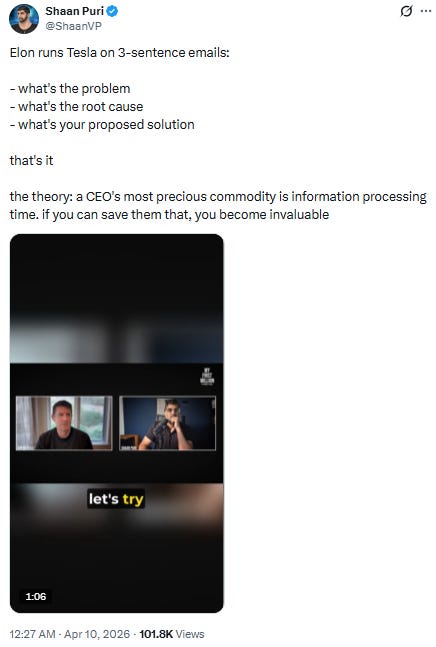
Superb and simple 3-part structure. Btw, it’s the same as the ‘What-Why-What next’ framework I mention in Chapter 6 of Story Rules. 🙂
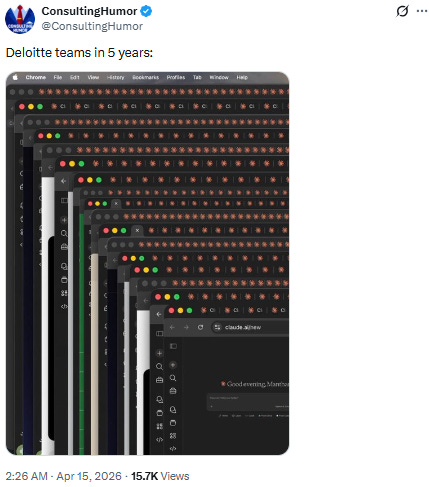
Hahaha, look at ‘em open tabs.
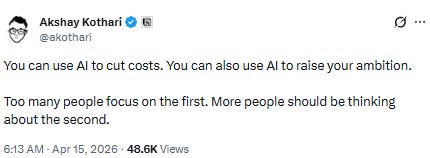
Well-said. It’s important to consider the new possibilities that AI unlocks. Easier said than done though…
📄 2 Articles of the week
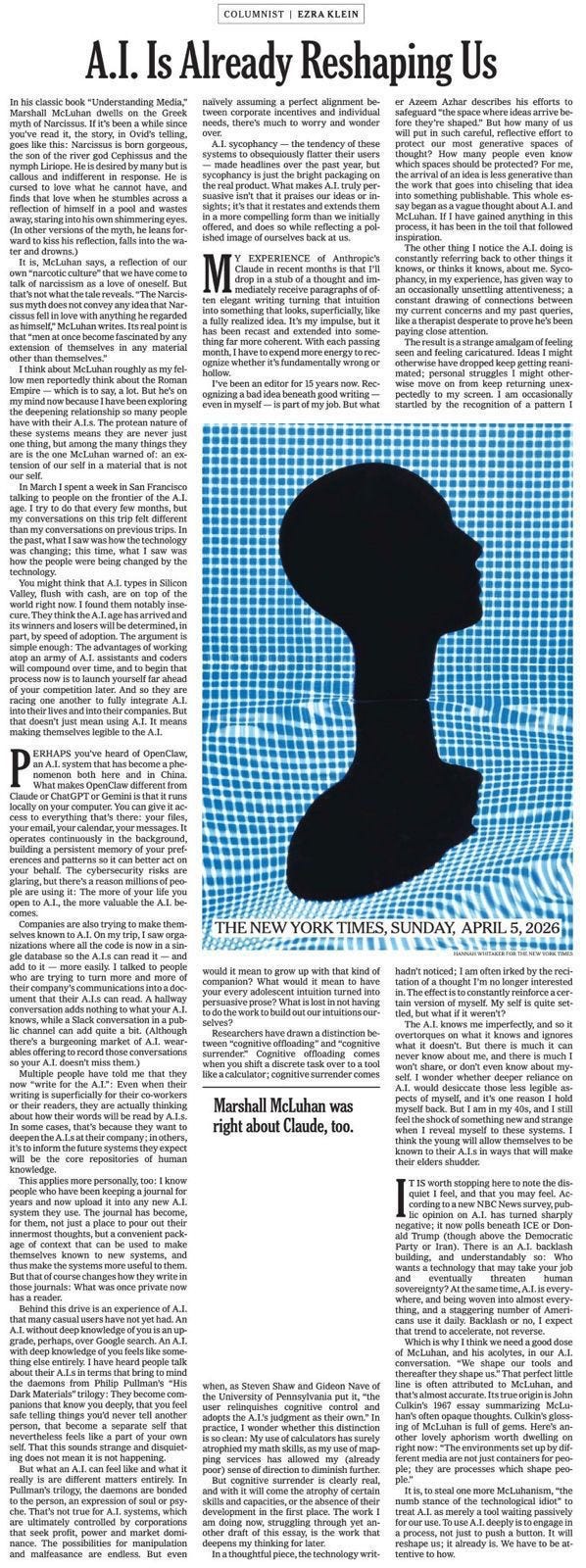
a. ‘AI is already reshaping us’ by Ezra Klein (The New York Times)
This is a superb piece by Ezra Klein. Recommend reading it in full.
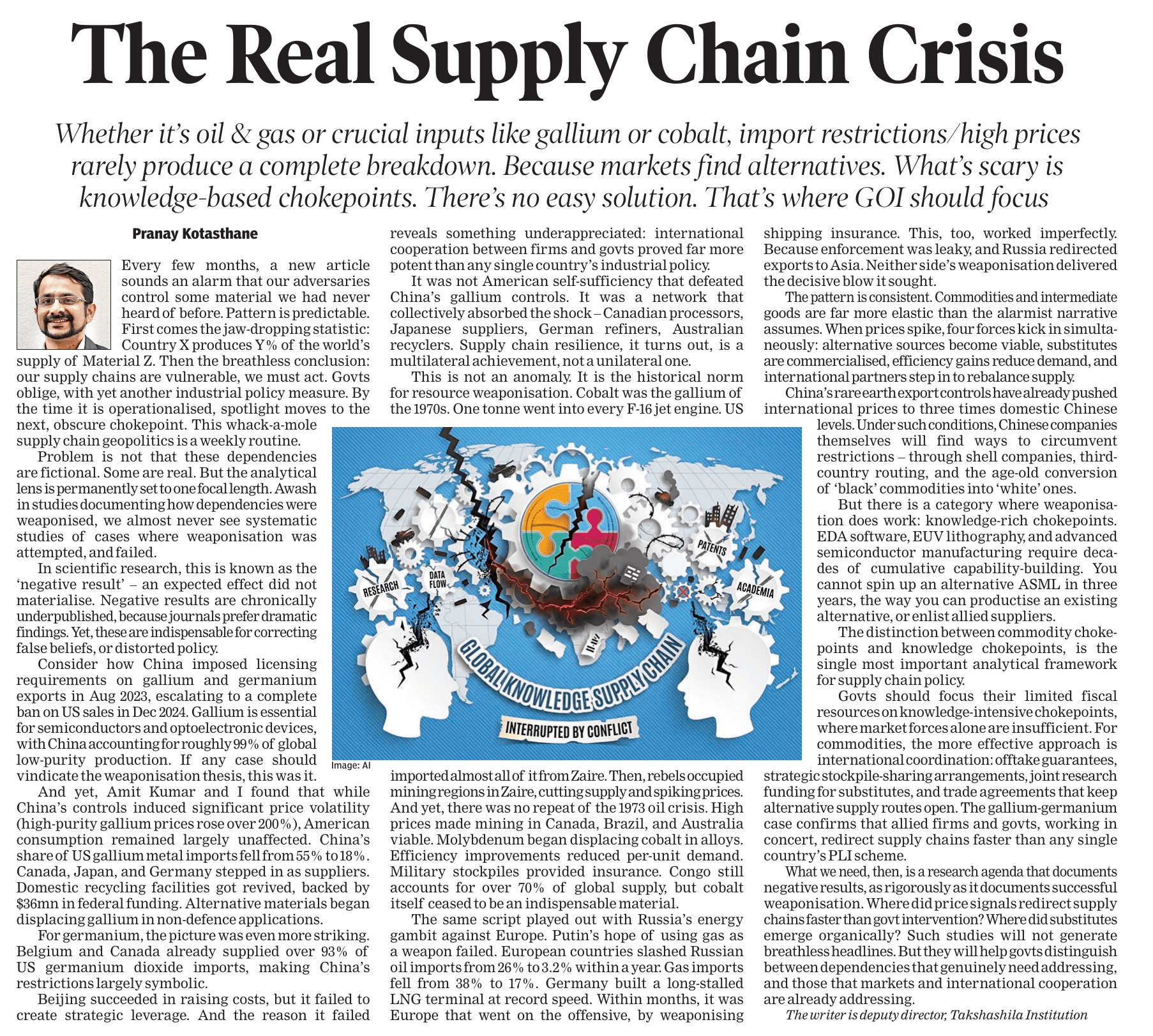
b. ‘The Real Supply-chain Crisis’ by Pranay Kotasthane
Kotasthane has written frequently on the supposed crisis in key materials like rare-earths… and believes that the markets usually intervene to solve bottlenecks.
Love the concrete examples that he uses to make his point.
🎧 1 long-form listen of the week
a. ‘How to Write Incredible Stories’ (Wright Thompson Interview on the How I Write podcast)
Wright Thompson, author and long-form writer who’s written for ESPN, shares some good writing advice in this conversation with David Perell.
Writing is hard – because bad writing is so easy:
Thompson: Bad writing is the easiest thing in the entire world. I don’t think there’s such a thing as writer’s block, but there is writer’s vomit – where you just can’t stop writing.
This is one of the best definitions of good writing I’ve ever heard:
Thompson: All writing is, is trying to say something new, that’s true, that is both specific and universal, and that helps the reader understand something they didn’t understand before – preferably about themselves.
Writing is about architecture, not words:
Thompson: I wish someone had told me a long time ago that if you’re going to be a professional writer for decades, writing is not going to be about words, but it’s going to be about architecture. And only when you really understand how things fit together and move can you then actually be thinking about the words.
Want to get better? Put in the reps:
Thompson: Nobody wants to hear what I have to say, which is – it’s just reps. Zen is a butt in a seat. There’s no mystery. It’s just reps. I wrote a bunch of 1,200-word stories until I really understood what a 1,200-word story could and couldn’t do. And then I wrote a bunch of 2,500-word stories. I worked for the Kansas City Star for 5 years – 3,600 words. I went over that I think once. And then the ESPN magazine stories were 7,200 to 8,500 words almost every time. I’ve written 300 magazine stories as prelude to learn how to go do something.
Write fast and edit slow:
Thompson: Talking is – you just say stuff. Writing is – you say just a little and it has to be said exactly right. I write really fast and then edit slow. My first draft I just race through it, flying. I try to get it down and then go back. I love to cut.
Thompson uses note-cards to think though the structure, but doesn’t let it become to restricting:
Thompson: I have note cards pinned to the wall. So the barn – what’s interesting is I outlined it broadly, but within that I didn’t outline at all, because I wanted to have the experience of section to section trying to feel my way. I’m going to have a better idea in the seat of what works than whatever theory I had standing in front of my wall. So I know I need to get from here to here, but what I didn’t want to do is storyboard out how to do it.
Writing finesse cannot paper over reporting holes:
Thompson: You cannot write your way out of a hole in reporting. When somebody says something is purple, something is overwritten – all overwritten really means is under-reported. You just don’t have it. Every time I feel like I can write myself out of a hole, I can write around a hole in my knowledge – it’s just bad. A great detail will do the work of 50 shitty sentences.
On why he doesn’t care about how well his pieces do, and uses an old Latin saying to talk about flawed causality:
Thompson: Every time I hear somebody in an analytical position trying to tell me what they think the data says about what audiences want, I just always think – post hoc ergo propter hoc. It’s the logical fallacy: after, therefore because of. I fundamentally think we have no idea what people want to read and why.
That’s all from this week’s edition.
Photo by Diana Polekhina on Unsplash