Decoding Gen-Alpha Speak
This was a busy week with 4 days of training from Monday to Thursday. 3 days in Mumbai, 1 in Bangalore.
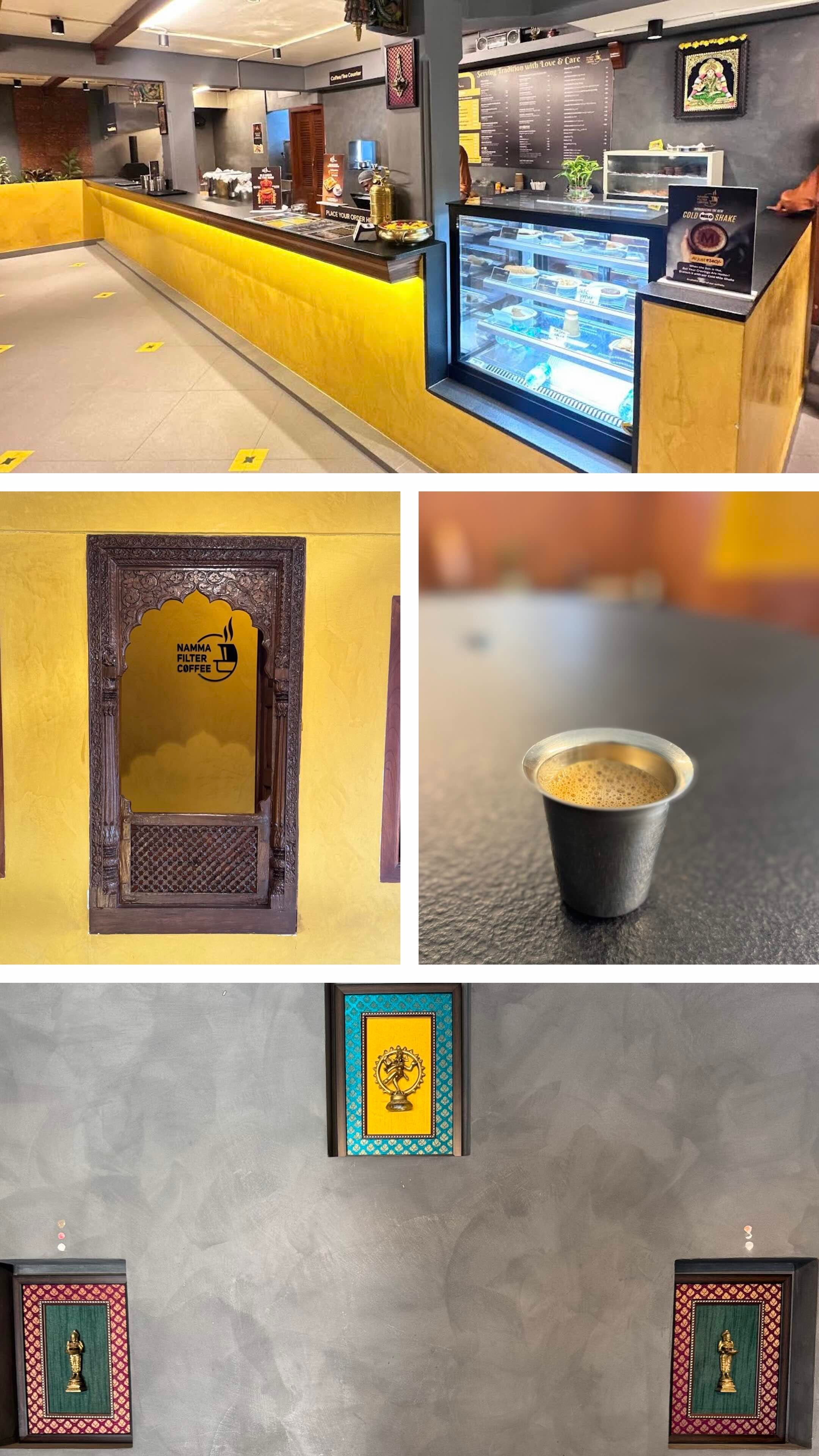
Had my fill of pav bhaji in the former, and some great filter coffee from this new chain called NFC in Bangalore.
Check out this post on LinkedIn, in case you missed it.
And now, on to the newsletter.
Thanks for reading The Story Rules Newsletter! Subscribe for free to receive new posts and support my work.
Welcome to the one hundred and fifty-ninth edition of ‘3-2-1 by Story Rules‘.
A newsletter recommending good examples of storytelling across:
- 3 tweets
- 2 articles, and
- 1 long-form content piece
Let’s dive in.
𝕏 3 Tweets of the week
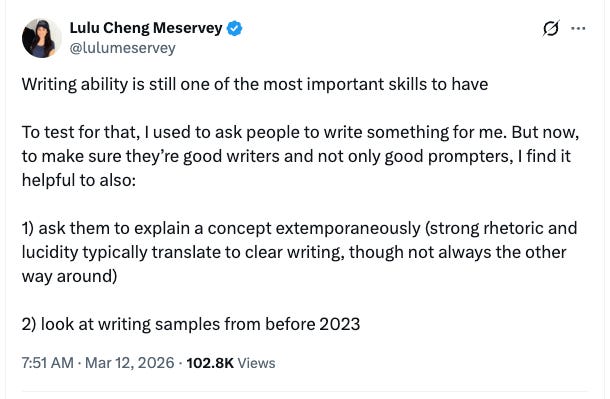
Interesting ways to test writing skills in the AI era.
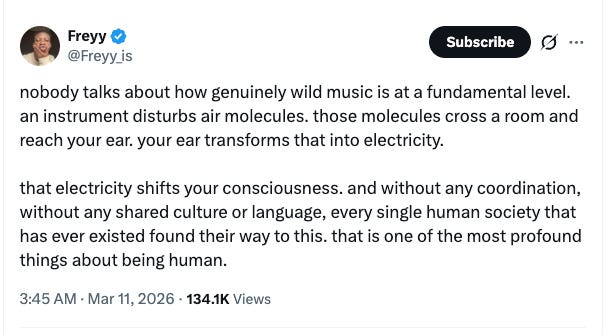
Beautiful description of music!
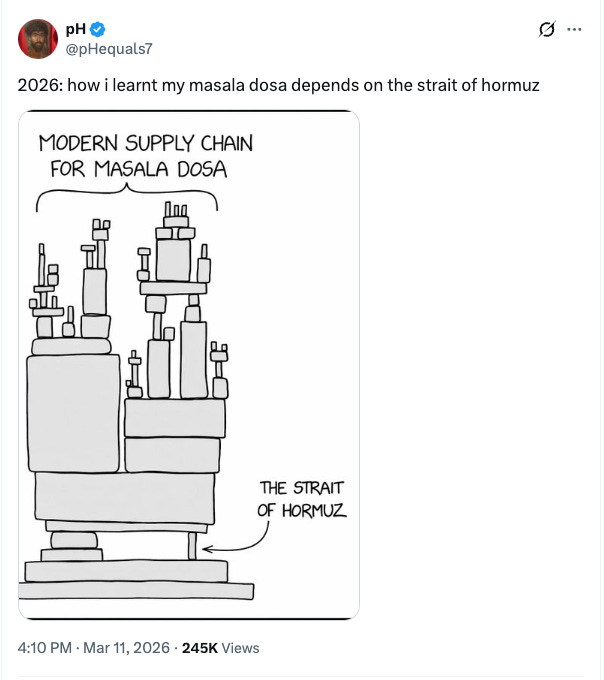
Hilarious!
📄 2 Articles of the week
a. ‘How do you detect A.I. writing?’ by Rubina Fillion (NYT) on LinkedIn
I loved this post by Rubina Fillion where she lists the most commonly used tropes in AI writing.
I now groan when I come across the following:
— Negative parallelism (”It’s not bold. It’s backwards.”)
— Self-posed rhetorical questions (”The worst part? Nobody saw it coming.”)
— False ranges (”From innovation to implementation to cultural transformation.”)
— Gerund sentence fragments (”Shipping faster. Moving quicker. Delivering more.”)
— False suspense transitions (”Here’s where it gets interesting.”)
— Patronizing analogies (”Think of it as a Swiss Army knife for your workflow.”)
— Historical analogies (”Every major technological shift — the web, mobile, social, cloud — followed the same pattern.”)
— Asserting something is obvious (”The reality is simpler and less flattering.”)
I’m surprised she missed the overuse of adverbs that aim to add gravitas (e.g. ‘quietly’).
The sad part is that some (actually most) of these tropes are actually good storytelling techniques when used well. (For instance, I love a good historical analogy).
But overuse of anything makes it quietly lose its value.
The worst best part? Now, anyone can see it coming.
b. Ed Conway Primer on the Iran War
This video is a superb data story on global crude oil export numbers and how the world is trying to fill in the supply gap caused by the Iran War.
Conway is a master of controlling the release of information. Notice how he withholds just that one bar (from the full chart) and ‘unveils’ it dramatically, to make his point.
Also great use of visual animation.
A masterclass in data storytelling.
🎧 1 long-form listen of the week
a. ‘Demystifying Gen Alpha slang with Adam Aleksic’ on ReThinking with Adam Grant
Adam Grant (ReThinking) interviews Adam Aleksic, a 25-year-old linguist known online as Etymology Nerd, about how algorithms are reshaping language, the ancient connection between words and magic, and why memes spread the way they do.
Aleksic shares the origin of the word ‘etymology’ itself:
The word etymology, actually, in Greek etumos means the study of truth. You find out something real about ourselves and about how we relate to society and to each other through our words.
Aleksic makes a fascinating connection between language and magic:
Hocus pocus in Latin means this is my body. There’s such a fascinating connection between words and performance. The word spell as in magic spell and spell as in spell a word go back to the same source, because it’s thought to be the same thing. By writing down the word, you are conjuring a physical change in the universe.
To this, Grant adds that ‘abracadabra’ in Aramaic translates to ‘I create as I speak.’
I didn’t know that most of Gen-Z/Gen-A slang originates from African-American English and a messaging platform called 4chan:
Pretty much 90% of internet slang right now is either from African American English, or it’s from 4chan…
For example, Aleksic traces words like slay, cooked, served, back to its roots:
A lot of the slang specifically comes out of the ballroom scene in the eighties and nineties. This is gay Black Latino space, and it was used as a tool to subvert the straight white norms of the English language. Words like slay, serve, tea, cooked, ate, bussin – all those are from that era. Now they’re thought of as Gen Z internet slang. And they percolate outwards into the, into the mainstream. And now you know, you have your white middle school girls saying slay, but it loses that initial power that it had within that community.
Perhaps the most insightful observation in the conversation was this one by Aleksic on language being the canary on the coal mine of culture:
I see language as a bellwether, like a canary in the coal mine of greater cultural shifts. And if 4chan is influencing our language that much, it stands to reason that 4chan is influencing our political beliefs, our social understandings as much. Language is never isolated in a system. It serves as an indicator of how we think. It is a little map of our vibes.
On the origin of the word ‘meme’ itself:
The word was coined in 1976 by Richard Dawkins in his book The Selfish Gene. It comes from the Greek word for imitate. There is this idea that it can evolutionarily compete against other memes. We have memes competing against each other in the wild. And when a meme is better able to compete for your attention, it is the one you end up using. The meme is winning. It is self-replicating.
On why some memes (like 6-7!) have more staying power than others:
Six seven is very popular because it shows up all the time. You are primed to see it whenever you count to 10. It is a very common number in prices, in accounting, in math – you see the number six seven almost daily, and so you’re reminded of this meme constantly. I think that’s partially what makes a meme successful, that it has this applicability!
That’s all from this week’s edition.
Photo by Diana Polekhina on Unsplash