Limitations of Writing with AI by Fareed Zakaria

I shared a new video—on my favourite storytelling framework, the 1-3-9 Story Spine.
Also shared a deck on how to differentiate yourself when using AI in your storytelling. I used Gamma to create the presentation. Let me know what you think!
And now, on to the newsletter.
Thanks for reading The Story Rules Newsletter! Subscribe for free to receive new posts and support my work.
Welcome to the one hundred and fifty-sixth edition of ‘3-2-1 by Story Rules‘.
A newsletter recommending good examples of storytelling across:
- 3 tweets
- 2 articles, and
- 1 long-form content piece
Let’s dive in.
𝕏 3 Tweets of the week
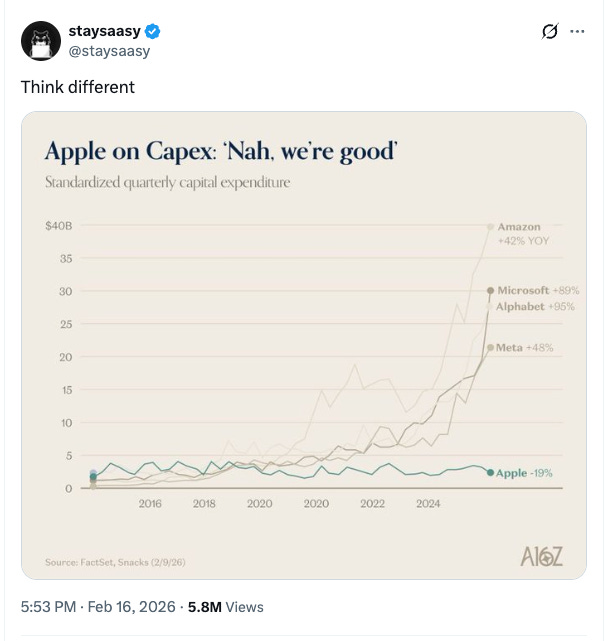
Striking contrast in the capex spend by Apple vs.the major tech companies.
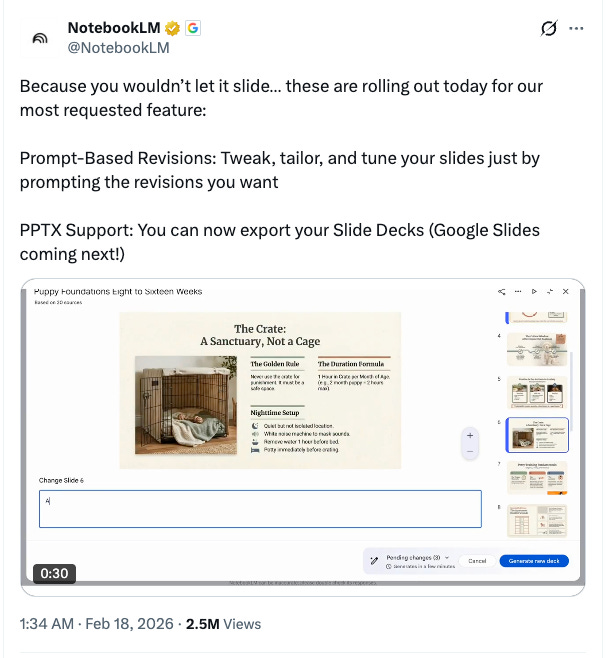
That’s an impressive feature by NotebookLM. Need to try it out along with Gamma!
Stoppress: And now Claude also has a feature to edit on PowerPoint. These guys are ensuring that I will be busy!
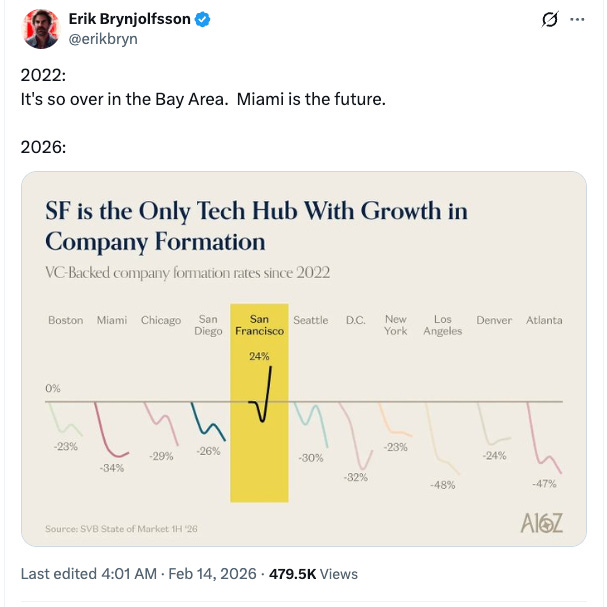
Fascinating chart. Great use of norm-variance across space (cities) and time (2022 vs. 2026).
📄 2 Articles of the week
a. ‘A Guide to Which AI to Use in the Agentic Era’ by Ethan Mollick
If, like me, you’ve been following AI developments on X, you’d have been overwhelmed with the pace and diversity of new shiny tools.
Gemini 3, Veo, Codex, Sora, Nano Banana Pro, Deepseek, Opus 4.6, Claude Code, Claude Co-work, Notebook LM, Antigravity, OpenClaw, MoltBook… it’s staggering… and overwhelming, and paralysing.
Thankfully, we have the stellar AI expert, Ethan Mollick, with a superb primer of all the key extant AI tools, and the implications for laypeople.
Mollick acknowledges the increasing complexity:
Until a few months ago, for the vast majority of people, “using AI” meant talking to a chatbot in a back-and-forth conversation. But over the past few months, it has become practical to use AI as an agent: you can assign them to a task and they do them, using tools as appropriate. Because of this change, you have to consider three things when deciding what AI to use: Models, Apps, and Harnesses.
A brief explainer of harnesses:
Harnesses are what let the power of AI models do real work, like a horse harness takes the raw power of the horse and lets it pull a cart or plow. A harness is a system that lets the AI use tools, take actions, and complete multi-step tasks on its own. Apps come with a harness.
OpenClaw, which made big news recently, is mostly a harness that allows you to use any AI model locally on your computer.
Mollick is unequivocal—you need to spend to access the better models:
…if you want to use an advanced AI seriously, you’ll need to pay at least $20 a month (though some areas of the world have alternate plans that charge less). Those $20 get you two things: a choice of which model to use and the ability to use the more advanced frontier models and apps. I wish I could tell you the free models currently available are as good as the paid models, but they are not.
Uff, the complexity of model options!
The issue is that GPT-5.2 is not one model, it is many, from the very weak GPT-5.2 mini to the very good GPT-5.2 Thinking to the extremely powerful GPT-5.2 Pro. When you select GPT-5.2, what you are really getting is “auto” mode, where the AI decides which model to use, often a less powerful one. By paying, you get to decide which model to use, and, to further complicate things, you can also select how hard the model “thinks” about the answer
A clear recommendation:
If you are just getting started, pick one of the three systems (ChatGPT, Claude, or Gemini), pay the $20, and select the advanced model. The advice from my book still holds: invite AI to everything you do. Start using it for real work. Upload a document you’re actually working on. Give the AI a very complex task in the form of an RFP or SOP. Have a back-and-forth conversation and push it. This alone will teach you more than any guide.
For those who are already doing the above, the next step would be to try the higher-order apps:
If you are already comfortable with chatbots, try the specific apps. NotebookLM is free and easy to use, which makes it a good starting place. If you want to go deeper, Anthropic offers the most powerful package in Claude Code, Claude Cowork (both accessible through Claude Desktop) as well as the specialized PowerPoint and Excel Plugins. Give them a try. Again, not as a demo, but with something you actually need done. Watch what it does. Steer it when it goes wrong. You aren’t prompting, you are (as I wrote in my last piece) managing.
b. ‘India’s AI Wedding Buffet: Generous Portions, Political Economy Heartburn’ by Shruti Rajagopalan
A superb long-form piece by economist Shruti Rajagopalan on India’s AI ambitions and what could be key roadblocks.
The difference between MeitY and other govt. departments:
Government of India is hosting the summit under the IndiaAI Mission, with Ministry of Electronics and Information Technology (MeitY) in a central role. MeitY is unlike most Indian government departments, in that it is more an investment promoter than regulator. It rolls out schemes to incentivize semiconductor firms to invest, or woos Apple into setting up manufacturing in India
Compare this to the Ministry of Information and Broadcasting, whose main goal is not promoting broadcasting technology or equipment or innovation. They regulate what can be broadcast, whether television shows and channels and advertisers have violated the code.
Rajagopalan praises the draft guidelines on AI regulation:
India, with these guidelines, has landed somewhere interesting, closer to the US in its instinct to avoid a standalone AI law, but far more deliberate in articulating why it is choosing not to regulate horizontally yet. The framework’s core bet is that India’s existing legal infrastructure (the IT Act, the Digital Personal Data Protection Act, sectoral regulators like the RBI and SEBI) can handle most AI risks if enforced properly and updated where needed.
Good use of norm-variance to describe how the Indian framework is different:
Most frameworks spend their energy on the risks of deployment. This framework asks, what happens when institutions do not adopt AI and fall behind on fraud detection, cannot counter AI-enabled cyberattacks, and fail to reach the underserved populations that voice-enabled multilingual AI could bring into the formal financial system.
Many countries are trying to build their own foundational AI models
South Korea picked five teams to build a national foundation model by 2027. Saudi Arabia created HUMAIN, a state effort to build Arabic multimodal models. The UAE partnered with Microsoft and OpenAI and declared it would become the world’s first AI-native government by 2027. Singapore and Japan started open-sourcing local-language models. The logic was the same everywhere. If your government runs on someone else’s AI, your government runs at someone else’s discretion.
But she cautions that the road would be difficult and steep:
What counts as foundational is decided by users and markets, not by researchers or ministers or even Twitter trolls. Until an Indian model is adopted globally and competes across general-purpose benchmarks, it will not be considered in the same league. That is not a judgment about Indian talent. It is how technology markets work. Nobody cares where a model was trained. They care whether it works. Sarvam’s success is real. But it is success in a niche. And niches, however valuable, do not rewrite the hierarchy of global AI.
Meanwhile, we still struggle with basic infra and buildout challenges:
Last year, Tata Electronics discovered that the soil at its semiconductor fab site in Dholera, Gujarat, was too soft. The ₹91,000 crore ($10.11 billion) facility, the first large-scale chip fabrication plant under the flagship of the India Semiconductor Mission, had to be redesigned from the foundations up
India has a key advantage which it does not seem to be leveraging as of now:
And then there is the thing India should be doing right now, with urgency, because it already has the advantage. India has 20 percent of the world’s semiconductor design engineers. AMD, NXP, Qualcomm, and Intel all maintain design centers here. This is not a marginal position. It is an enormous comparative advantage, and India is doing remarkably little with it.
Superb summary of the hard on-ground challenges:
Every section of this essay follows the same pattern. The government identifies a genuine need, commits real money and political capital, and the project stalls somewhere unglamorous that nobody in Delhi was paying attention to. The soil under the fab. The compliance process around the subsidy. The balance sheet of the electricity distributor. The tax ruling that arrives ten years after the investment. These are not AI problems. They are the problems India has been deferring across every sector, stunting its manufacturing and structural transformation, now converging on the one sector where speed matters most.
🎧 1 long-form listen of the week
a. ‘How to Write Consistently Well — Fareed Zakaria’ in the How I Write podcast
I’m a fan of Fareed Zakaria’s calm, unique, and data-driven perspective on world affairs. In this conversation, he shares some thoughts on how he looks at his work across formats (articles, TV, books) and how he is coping in the AI age.
A book is a great learning tool… for the author!
I find that I learn more when I write a book than at any other period in my professional life… you have to make deep, deep dives and you have to kind of know what you’re talking about.
Zakaria relies on structure for his books
The books are much harder… you have to plan… I’ve had to put in place more of a structure and a plan for writing… I can’t do [it] haphazardly anymore… I have to say… ‘what’s the research I need for chapter 1… what’s chapter two…’”
About limitations of research with AI, he mentions that access to all sources is spotty:
For a very deep dive… the access to all the sources is still quite spotty… it can’t actually look at the 30 best books… Most of them it doesn’t have access to… it’s partly because the AI has only the ability to look at the reviews of those books because those are in open source, or an excerpt…
Also, good writing is thinking, and for thinking, you need to consume copious content:
The way you come to your argument is partly by reading… talking to smart people… part of your thinking process involves ingesting… and in some ways… the AI can’t do that for you.
Perell asks Zakaria, “What’s the skill that will always be scarce?”, to which he responds:
ultimately judgment… the AI… can give you the best argument for one of six different positions, but which is the right one at this moment…? …Which of those is the right one to present to the world… and put your credibility… behind?
A newspaper column has to be about one idea:
A take or a column… has to organize itself around an idea—not an idea and a half… not two ideas… not three ideas… you lose the narrative structure if you try to do that.
Having the right norms is critical in storytelling. When people talk about the US abusing its power, Zakaria responds, ‘compared to what’:
My serious analytic answer… is: compared to what…America has been in my opinion the best superpower or you know great power in modern history because what I’m comparing it to is you know the Kaiser’s Germany and Hitler’s Germany and the Soviet Union and Mao’s China and you know the the the the French Empire and the British Empire. You can’t compare you know the United States and all its power to Costa Rica
While data matters, one should not blindly rely on it:
… the plural of anecdote is not data. You’ve got to look at the data and two stories do not make a trend. But it’s also true that the data can sometimes hide some very important things.
That’s all from this week’s edition.
Photo by Diana Polekhina on Unsplash