The 5-step process to learn anything

There are five steps to learning a new skill. And number 5 might be the most important.
I’ve been teaching the skill of storytelling at work since 2016, and have worked with 10,000+ leaders across global organisations.
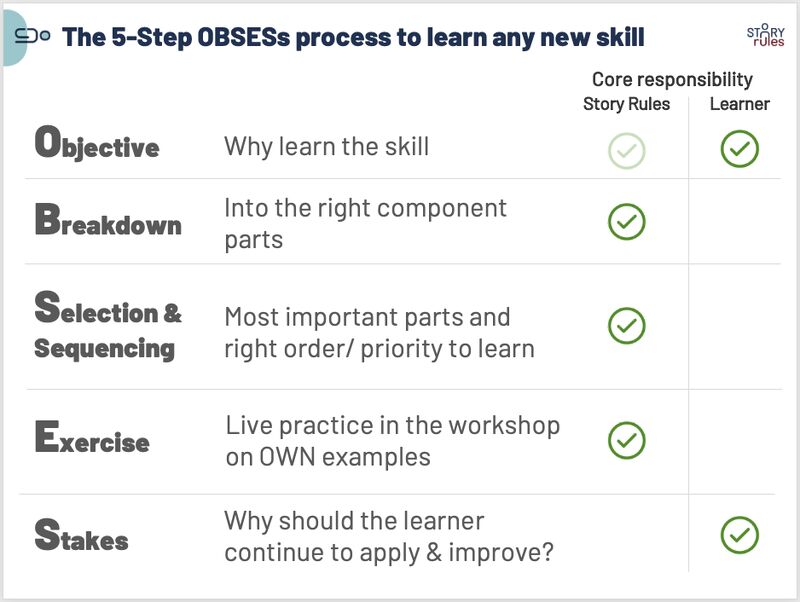
When I reflect on the process to learn this skill (or any skill for that matter), I can distil it into five steps, using the acronym OBSESs:
– O: Objective – Why learn the skill
– B: Breakdown into the right components
– S: Selection of the right components for the audience and Sequencing them for optimal learning
– E: Exercise – Practising the skill on your OWN stories in the workshop
– Ss: Stakes – the most important element. Why should the learner bother to put in time and effort to apply the skill *after* the event?
Let’s expand on each element
– Objective: Why do you want to learn the new skill? For professional growth, for impressing friends, or for your own joy and fun? Knowing the why will help you gauge your success.
– Breakdown: Learners should know the core components that make up the skill.
For Storytelling, I have structured it under 4 heads called ABCD: Align with your Audience, Build the story narrative, Choose the right visuals, Deliver with impact. Under each head, there are sub-components. The idea is to make the list of components MECE (Mutually Exclusive, Collectively Exhaustive) and yet simple.
– Selection and Sequencing: Not all components would be relevant for all learners. They need to be curated based on the learner’s objective and context. The learner should know what 20% of components would give them 80% of the value. They should also know the sequence in which the topics should be learnt.
– Exercise: Learning happens much better going out than going in. No concept is understood unless you practice it—on your OWN work stories in the workshop itself.
– Stakes: Finally, once you have attended a workshop to learn a skill, comes the moment of truth. Why should you continue to put in time and effort to apply the skills to your work? Without stakes, most new skills evaporate from your mind. You need to add stakes to the learning journey.
It could be an upcoming event (say a town hall talk or fundraising pitch), a new process adopted by the company (e.g. six-page narratives by Amazon), or it could be you telling a friend, “Here’s 20K. If I don’t do X by Y time, please donate it to the political party that… I hate”
—
Now let’s talk who’s responsible for each step.
As a coach, I can help you with the Objective, but you need to reflect on it.
The BSE (Breakdown, Selection+Sequencing, Exercises) steps are all my responsibility. For any skill, ensure your coach knows these cold.
But the Stakes are all on you. No teacher can force the learner to apply the techniques after the workshop is over.
—
Happy learning! And yes, whenever you want to master a skill, try and OBSESs over it!
Credit: Tim Ferriss shared a version of this framework (DSSS) on a recent podcast episode.
That’s all from this week’s edition.
Photo by Diana Polekhina on Unsplash