
The Best Podcast Episode I’ve heard in 2026

The kids are at home for the summer vacation, and it’s not an easy task to keep them occupied and to manage the screen time. If you have any ideas, do let me know!
I released a new YouTube Video this week on the 4 most common errors people make when it comes to charts. Let me know what you think:
And now, on to the newsletter.
Thanks for reading The Story Rules Newsletter! Subscribe for free to receive new posts and support my work.
Welcome to the one hundred and sixty-fifth edition of ‘3-2-1 by Story Rules‘.
A newsletter recommending good examples of storytelling across:
- 3 tweets
- 2 articles, and
- 1 long-form content piece
Let’s dive in.
𝕏 3 Tweets of the week
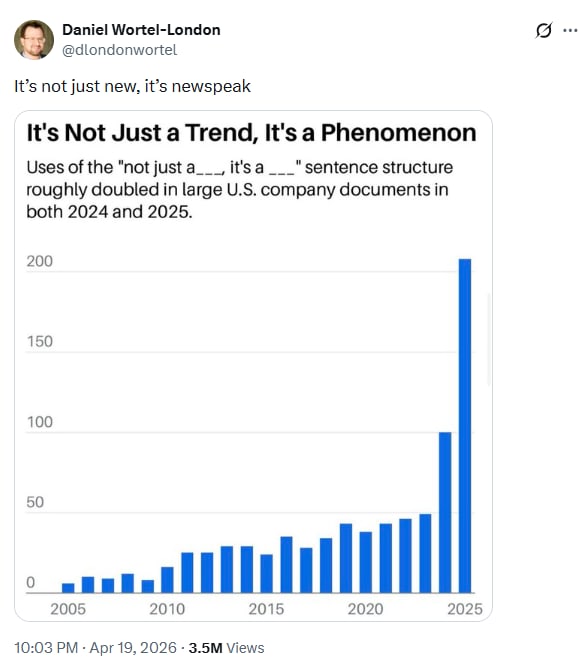
Uff, this AI language slop is tiring to read.
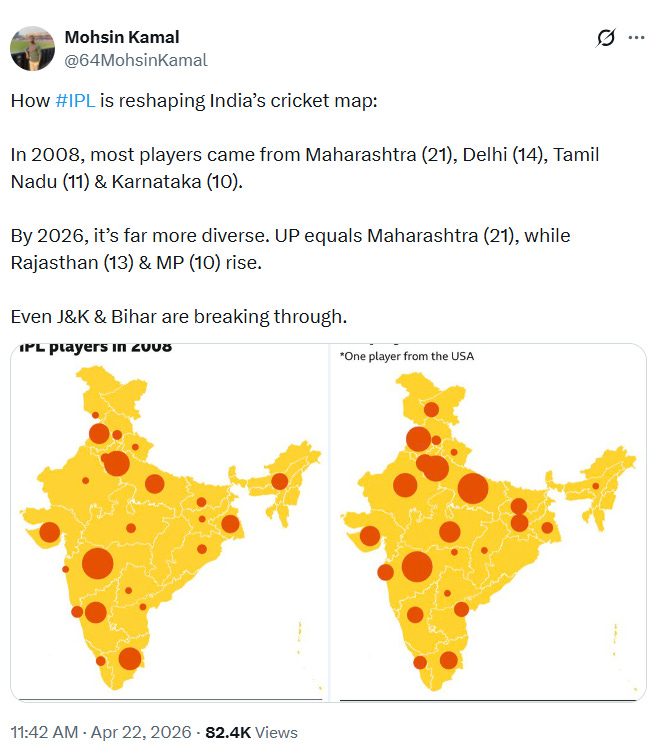
Fascinating norm-variance and great use of the map.
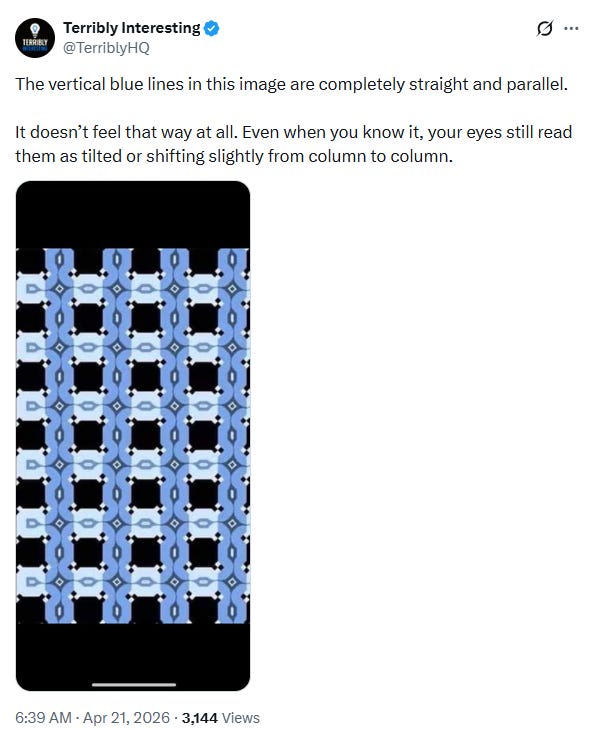
I still can’t believe that these are parallel lines.
📄 2 Articles of the week
Surprise surprise: Everyone is using AI for their writing. Sample these comments from shareholder letters:
Progressive’s shareholder letter stated that its purpose was “not just a statement; it’s a guiding principle that shapes everything we do.” Citizens Financial Group framed growth in its private banking franchise as “not just a win for the private bank, it’s a win for the entire enterprise.” Synopsys insisted engineering AI’s future was “not just a software challenge, it’s a physics challenge.” Royal Caribbean called disruptive technology “not just a tool, it’s a capability.” A.O. Smith said sustainability was “not just a goal, it’s a core part of who we are.”
So. Bloody. Tiresome.
The author calls it ‘the Great Flattening’:
I call this the Great Flattening. Language models are trained to produce the statistical average of everything ever written, so when enough companies route their communications through them, every company starts sounding like the average of every other company.
Great insight, this:
Sounding different becomes the rarest competitive advantage a company can have. The company with real personality, earned conviction, and concrete specificity stands out like a bonfire in a field of flashlights.
A neat test to check for originality:
Take your last shareholder letter. Your last press release. Your last blog post. Your last LinkedIn post from the CEO. Remove the company name and logo. Show it to someone who knows your industry. Ask them which company wrote it.
If they can tell, your voice is working. A blank look means your communication has been flattened, either by AI directly or by the committee-driven approval process that produces AI-like output even without AI.
b. ‘How Did Islam Spread So Fast?’ By Tomas Pueyo
Blogger Tomas Pueyo turns his gaze to the fascinating and rapid rise of Islam in the 7th century:
In the 600s AD, Mecca was a village of a few hundred people, off the beaten path, a backwater uninteresting to distant empires. Then along comes a guy—Muhammad—and somehow within five years he and his heirs went from ruling one oasis to controlling all of Arabia, and thirty years later everything from Morocco to Pakistan. HOW?!
The piece is a typical Pueyo one with superb visual storytelling. Sure, he may get some details wrong (and you can read the comments where he engages with the audience).
But overall, it is a great example of visual storytelling.
🎧 1 long-form listen of the week
This is a mind-blowing podcast episode, and I highly recommend you listen to it in full.
McNeill is the REAL deal. Strategic thinker, solid executor and a superb storyteller. Rare package.
He was President of Tesla during its explosive growth from 4,000 to 40,000 employees. This conversation has some amazing insights from the trenches.
McNeill and Musk spent a LOT of time interviewing people:
McNeill: Elon said to me, “Hey, look, as fast as this thing is growing, we’re going to split this up and you and I are going to interview everybody that’s hired at a manager level and above.” Growing from 4k to 40,000 employees, there were a lot of interviews we were doing. In fact, 60% of my calendar was interviews. But it was super important because you totally win and lose on talent. So that’s another hack for entrepreneurs to think about – how much of your calendar is devoted to the number one driver of your success, which is talent?
In interviews, trust the conversation, not the resume:
McNeill: Trust the conversation, not the resume. You could have a great resume, but if the conversation is not giving you ‘wow wow wow’ – it’s not there. And if it is – forget the resume, this is legit.
Loved this counter-intuitive insight for hiring retail salespeople:
McNeill: Our head of retail came to me and said, “Hey, I’m hiring a lot of Apple people from Apple stores.” And I said, “Time out. You can work in an Apple store and you are an order taker. Go down the hall to the people at the Microsoft store who have to sell a Surface two doors down from a MacBook Air. Those people know how to sell. The fact that they’re not starving is unbelievable. So go hire them.”
The most powerful analytical instrument in the world – your two eyes and years:
McNeill: A mentor of mine taught me this. He used to haul me down to the customer support teams and he’d say, “Just sit here on a chair and listen to these calls.” And his first principle was – “I’m going to introduce you to the most powerful analytics you have as a leader. Your two eyes and your two ears. Use them, because you will get insights so much faster than the data can get to you.”
Follow your customer home to find where they are struggling (and where there could be opportunities for you):
McNeill: I learned this technique from Scott Cook, the founder of Intuit. He has a process he calls ‘follow me home.’ What it means is you look over the shoulder of real customers who are using your product. When you look over their shoulder, you see all of the friction you’re putting into that product. And often those customers will turn around and say, “Would you just fix this?” or “Could you do this for me?” And they get new product ideas too.
One of the (customers) in this exercise turned to a senior manager and said, “Be a whole lot easier if the payroll was just done by QuickBooks.” Boom – that idea was right back into the senior management team discussion. That’s a huge business for Intuit now, but it came out of ‘follow the customer home and watch them click.’
Musk would set audacious goals to force fundamentally different thinking:
McNeill: Goal setting can determine what outcome you’re going to get. If you set a goal for 5 to 7% improvement, you’re probably going to get 3 to 5. If you set a goal for an order of magnitude improvement, now you’ve got people that have to think way differently about that problem – because you can’t tweak the status quo to get to a 20x improvement.
I loved this story about how they went about improving the online sales experience for buying Teslas:
McNeill: Nobody was buying $120,000 things sight unseen online. Elon said, “Improve digital sales by 20x.” So now I’ve got to think way differently about this. He said, “How many clicks does it take to buy a Domino’s pizza on their app?” We pulled it out. Turns out it takes 10 thumb taps. He’s like, “We are 64, Domino’s is 10. Let’s go to 10.”
This next part is even better – how McNeill framed the new plan (of reducing customisation options for Teslas) to the heads of manufacturing and engineering:
McNeill: That religion of fully customisable, build-to-order product led to 360,000 different combinations of a car that you could choose – which was driving a lot of clicks, plus a lot of decision fatigue. My team ran the data and we figured out that people weren’t buying 360,000 versions – they were buying two. It was either what is known today as a Standard or a Performance.
I went to the head of manufacturing and the head of engineering. I said, “Hey, look, I’m the new guy here. I’ve never been in the car business. But let me show you what the data says. Out of all these 360,000 combinations, people are only buying two. What would it mean to you guys if there were only two?”
Greg, who’s running manufacturing, says, “Oh my god, I’ve been waiting for this day. It totally simplifies the factory. It simplifies the supply chain. We could increase throughput dramatically.” Doug in Engineering: “Are you kidding me? I don’t have to design all these parts. I don’t have to test them. I can put engineering’s time on the stuff that really matters.”
New technology often creates more jobs than it destroys. A great example is this story about how the decline in switchboard-operator jobs was more than offset by call-centre employees:
McNeill: When I was growing up, to make a long-distance phone call, you had to dial zero and talk to a human being – usually a lady in your town who would literally plug the local phone network on one end of a cord and then plug that cord into the national phone network. Humans were switches.
By the late ’70s, early ’80s, 100% of those 800,000 operator jobs had gone away, replaced by electronic switches. But what people couldn’t see while they were doing the hand-wringing was what was going to happen on the other side. Now that a long-distance call is free and doesn’t require human labour – just requires electrons – you could offer toll-free calls. And entrepreneurs said, “I’m going to create businesses: 1-800-Flowers, 1-800-Junk, 1-800-Insurance.” And those required centralised answering of phone calls. A few years into the 1980s, there were now millions of people employed in call centres.
That’s all from this week’s edition.
Photo by Diana Polekhina on Unsplash