
Why Young Men are Struggling in the US

This week, I unlocked a dubious achievement as an author—I found the first pirated copies of my book!
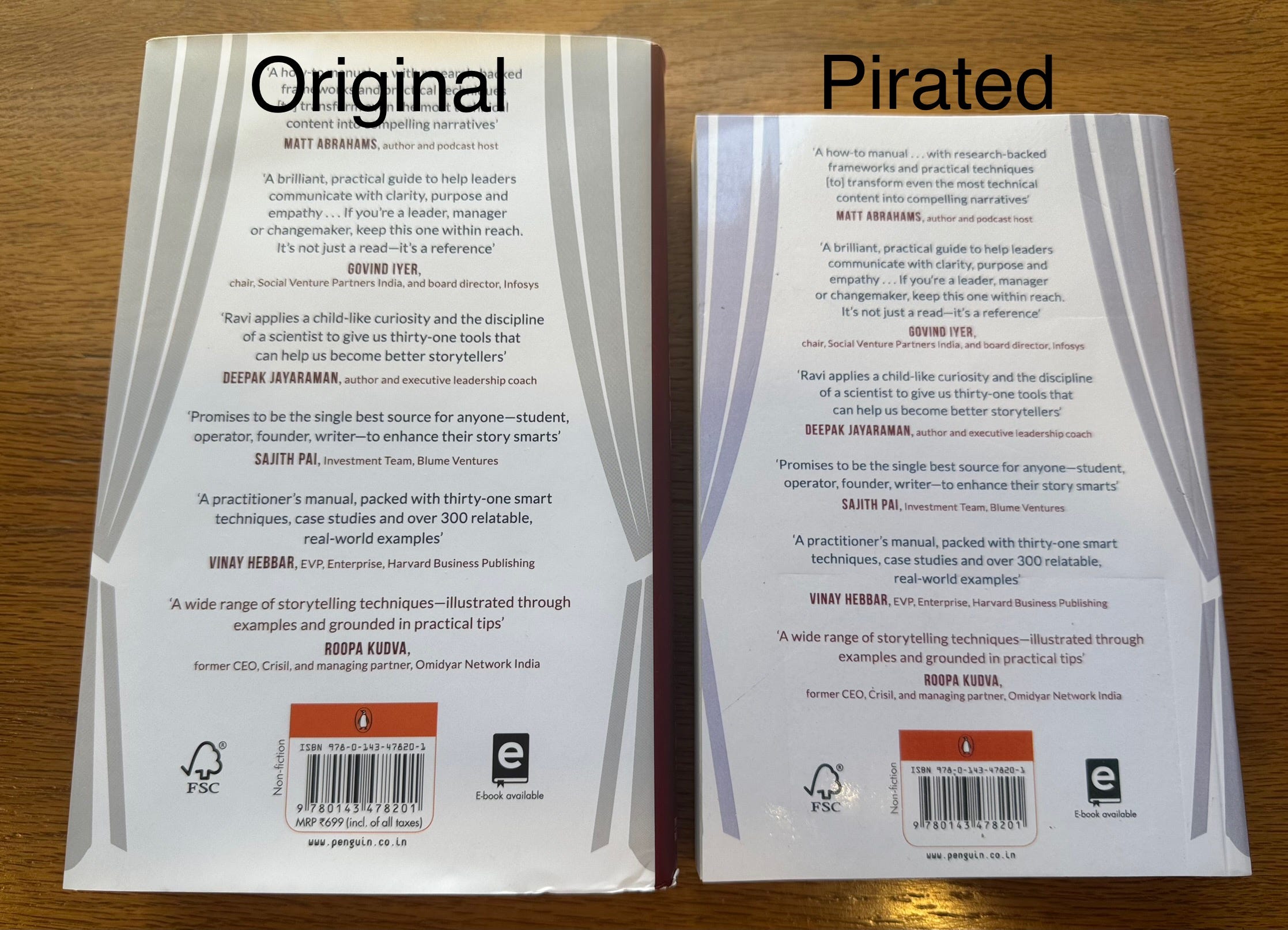
I wrote about it in a post here!
This week’s video was about a simple but powerful idea: the need to have a clear summary on the top of your presentation slides.
And now, on to the newsletter.
Thanks for reading The Story Rules Newsletter! Subscribe for free to receive new posts and support my work.
Welcome to the one hundred and forty-seventh edition of ‘3-2-1 by Story Rules‘.
A newsletter recommending good examples of storytelling across:
- 3 tweets
- 2 articles, and
- 1 long-form content piece
Let’s dive in.
𝕏 3 Tweets of the week
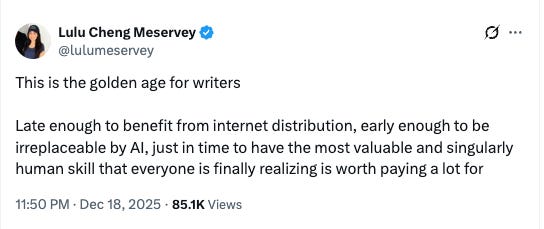
Write posts, record your voice or videos, capture and share pictures… Just start putting your authentic work and voice out there. The universe will reward you.
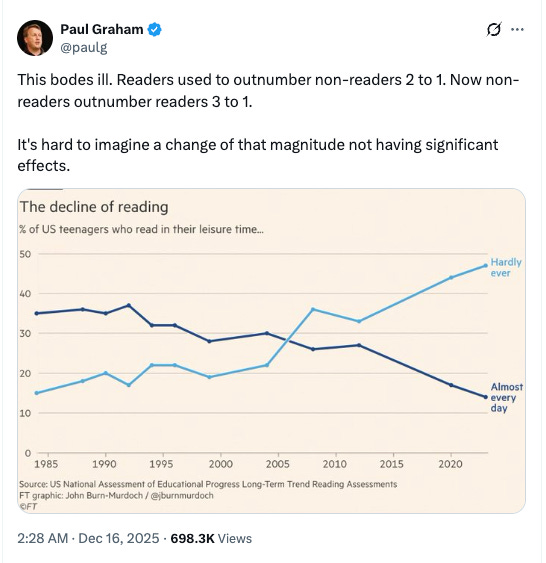
Not a good sign. But as one of the replies pointed out, maybe the kids are learning from videos…?

Uff, that’s a brutal take!
But a useful cautionary tale on how a nation must be focused on scientific advancement and sound economic policies… and avoid too many distractions into religion and other opiates of the masses.
📄 2 Articles of the week
a. ‘The only number that really matters’ by Brian Albrecht (Vox)
Albrecht does a good job of defending the much-maligned metric of GDP. He starts with the inevitable reference to the metric of ‘Gross National Happiness’ espoused by Bhutan:
In 1972, the King of Bhutan announced that “gross national happiness is more important than gross domestic product.” It was a charming sound bite that captured imaginations worldwide. Finally, someone was brave enough to say it: Happiness matters more than money.
In Bhutan today, life expectancy is 73 years — higher than the 51 years in 1972, but still only right at the world average. Meanwhile, politicians are concerned about “unprecedented” levels of people leaving the country, mostly for economic opportunities elsewhere. While Bhutan’s own Gross National Happiness surveys show rising happiness since data collection started in 2010, internationally comparable surveys show a fall in self-reported happiness in the country.
He then compares Bhutan with South Korea, which focused on GDP as a clear goal:
Bhutan explicitly prioritizes happiness over economic growth, but its happiness has increased only marginally, and the country has not experienced the broader improvements in living standards that matter to people. South Korea pursued concrete development goals, used GDP to measure progress, and succeeded at economic transformation. South Korea hasn’t prioritized happiness metrics, but, in surveys of self-reported happiness, remains consistently ahead of Bhutan.
Albrecht then does a simple explainer of what GDP is—a useful 101 for those who aren’t from an economics background.
He then shares that GDP correlates closely with other outcomes that people care about:
GDP carries weight as a metric for good reason; despite its narrowness, it relates closely with nearly every outcome people care about.
For example, people in countries with higher GDP per capita live longer. While detractors sometimes point to cherry-picked examples, such as New Zealand, which has a lower GDP than the United States but higher life expectancy, that’s not the case in general.
Higher GDP per capita also correlates with lower infant mortality, higher educational attainment, reduced extreme poverty, and higher self-reported happiness. This last point deserves emphasis: life satisfaction, the primary measure used in the World Happiness Report and similar well-being indices that critics often propose as alternatives to GDP — itself highly correlates with GDP.
Sure, GDP is an imperfect metric—but, to paraphrase Churchill, “GDP is the worst metric, except for all the others”.
Albrecht then mentions some advantages of of GDP over other measures. I loved this paragraph (especially the cheeky last line):
The most important advantage is the timeliness. In the United States, the Bureau of Economic Analysis releases preliminary GDP estimates roughly one month after each quarter ends, with revisions following as more complete data arrives. This frequent reporting allows governments to spot recessions early and adjust policy accordingly, as they hoped to do during the Great Depression. By contrast, Bhutan’s latest Gross National Happiness data is from 2022. Presumably, that could be sped up with more funding, but I’m not sure happiness rising from 0.76 to 0.77 from July to August is going to help Bhutan’s central bank when setting interest rates.
He ends with a crucial point, delivered with an analogy:
Are there situations where raising GDP might conflict with other goals? Sure. Trade-offs exist, but we shouldn’t get bogged down in imaginary ones. There are people for whom training to become a faster 5K runner might hurt their marathon time. But that’s really only if you’re an elite athlete optimizing for specific events. For most people, like me, there is no real trade-off.
For most countries, for more policy decisions, what we need is to build productive capacity, and raising GDP captures whether they’re succeeding. All the outcomes move together. Debating little trade-offs between GDP and alternative metrics misses the point.
b. ‘CEOs as Chief Storytellers’ by Ashley Mayer (on X)
A lot of you might have come across the recent WSJ piece which spoke about how companies are ‘desperately seeking storytellers’!
I liked this take by Mayer where she states that storytelling is a key role of the founder and not something that they can outsource.
She then talks about the three main levels for founder/CEO-led narrative (Industry, Brand/company and Product), and how each leader needs to find which level are they most comfortable with.
Of course, there’s the rare spokesperson who is fluent in all three. Steve Jobs probably being the clearest example.
The most important thing for a founder to figure out is where they’re most comfortable – otherwise it’s like trying to sing in the wrong octave.
🎧 1 long-form listen of the week
Scott Galloway is one of the most thought-provoking, articulate and charismatic storytellers we have.
In this interview on The Daily Show, watch him enthrall the crowd, that too in a comedy show, where you have to be at the absolute top of your speaking game to land your punches and soundbites.
He talks about his latest book, ‘Notes on Being a Man’ and talks about the crises faced by young men in the US.
He talks about the need for young men to have a positive interpretation of masculinity:
We all need a code. And some people get that from religion, their family, the military. I think a lot of young men are lacking a code. And then masculinity can be a wonderful code that helps young men lean into some of the things they feel more inclined to lean into, be a provider, be economically viable.
I think in a capitalist society that it makes sense up front to assume, at some point, you need to take economic responsibility for your household, which sometimes means getting out of the way and being more supportive of your partner, who might be better at that whole money thing.
Look at the use of the analogy (fire) and anaphora (repetition of ‘makes you want’) in this para:
I think we need to stop pathologizing young men’s desire to have relationships and want sex. I think that sexual desire among young men is fire. It can be destructive.
But I also think, for the most part, it’s a wonderful thing that, if channeled correctly, makes you want to be a better man, makes you want to dress well, makes you want to be in better shape, makes you want to have a kindness practice, makes you want to demonstrate intellect, demonstrate humor.
There’s nothing wrong with getting out there and wanting to meet people and have a wonderful partner.
This next part got the most cheers—when Galloway trains his guns squarely at Big Tech for their proclivity to use rage and clickbait to fuel their ever-growing need for eyeballs (watch this portion to observe his fabulous, flawless delivery):
One in seven men are called NEETs. They’re not in education. They’re not employed. And they’re not in training.
Effectively, you have the deepest-pocketed companies in the world that represent 40% of the S&P, who have one mission. And that is to sequester you from your family. And the way they do that is– we used to think sex sells. We figured out there’s something that sells better than sex. And that’s rage.
So you have a group of young men whose prefrontal cortex doesn’t catch up to a woman until it’s 25, is looking for that immediate dopamine. And they think, I can have a reasonable facsimile of life online.
Why go through the pecking order of having friends when I have Discord and Reddit? Why go through the BS of putting on a tie and navigating the corporate world when I can trade stocks or crypto on Coinbase or on Robinhood? And why would I go through the humiliation, the expense, the rejection, the perseverance of trying to establish a romantic relationship when I have lifelike porn?
Big Tech is not our friend. The bottom line is, they are doing everything they can to sequester you from the most meaningful and important thing in your life. And that is relationships. Get off your [BLEEP] phone. [CHEERING] And get outside.
That’s all from this week’s edition.
Photo by Diana Polekhina on Unsplash