
A Superb Primer on the World Economy and India

Major announcement!
I am going to make a small but critical tweak in this newsletter: Instead of six content pieces (three tweets, two articles, and one long-form), it will now have just four(three tweets and one long-form piece).
Why? 3 reasons:
- (Hopefully), Easier for you to read: I want to make it shorter so that it’s easier for you to go through the email
- Easier for me: I realized that the articles were taking a slightly longer time for me compared to the other two. So this would reduce my workload a little bit.
- Better overall quality? While I never run short of good tweets or long-form content to recommend, I have sometimes struggled to find really good articles. So, I thought, let me remove the weakest link and focus on the good stuff.
You’ll notice that I have changed the name, while sneakily retaining a similar sound.
Some of you might be thinking—’But I loved some of the articles you covered Ravi!’
I get you. In case I come across something really good, I will share it as a bonus link! (Check this one!)
And now, on to the newsletter.
Thanks for reading The Story Rules Newsletter! Subscribe for free to receive new posts and support my work.
Welcome to the one hundred and sixty-sixth edition of ‘3-to-1 by Story Rules‘*.
A newsletter recommending good examples of storytelling across:
- 3 tweets, and
- 1 long-form content piece
Let’s dive in.
*Yes, technically, it’s the first edition, but let’s just continue with the old numbering, what say? 🙂
𝕏 3 Tweets of the week
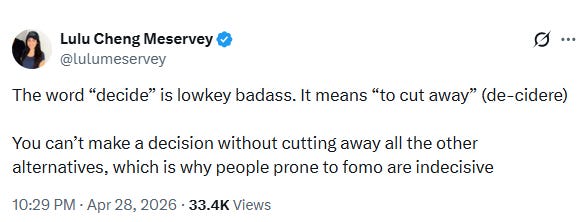
I mean, is that tweet appropriate for this week or what?!

Taste and judgement matters.

Ooh, that is a GOOD one. I shall be using that line for sure.
Bonus Article:
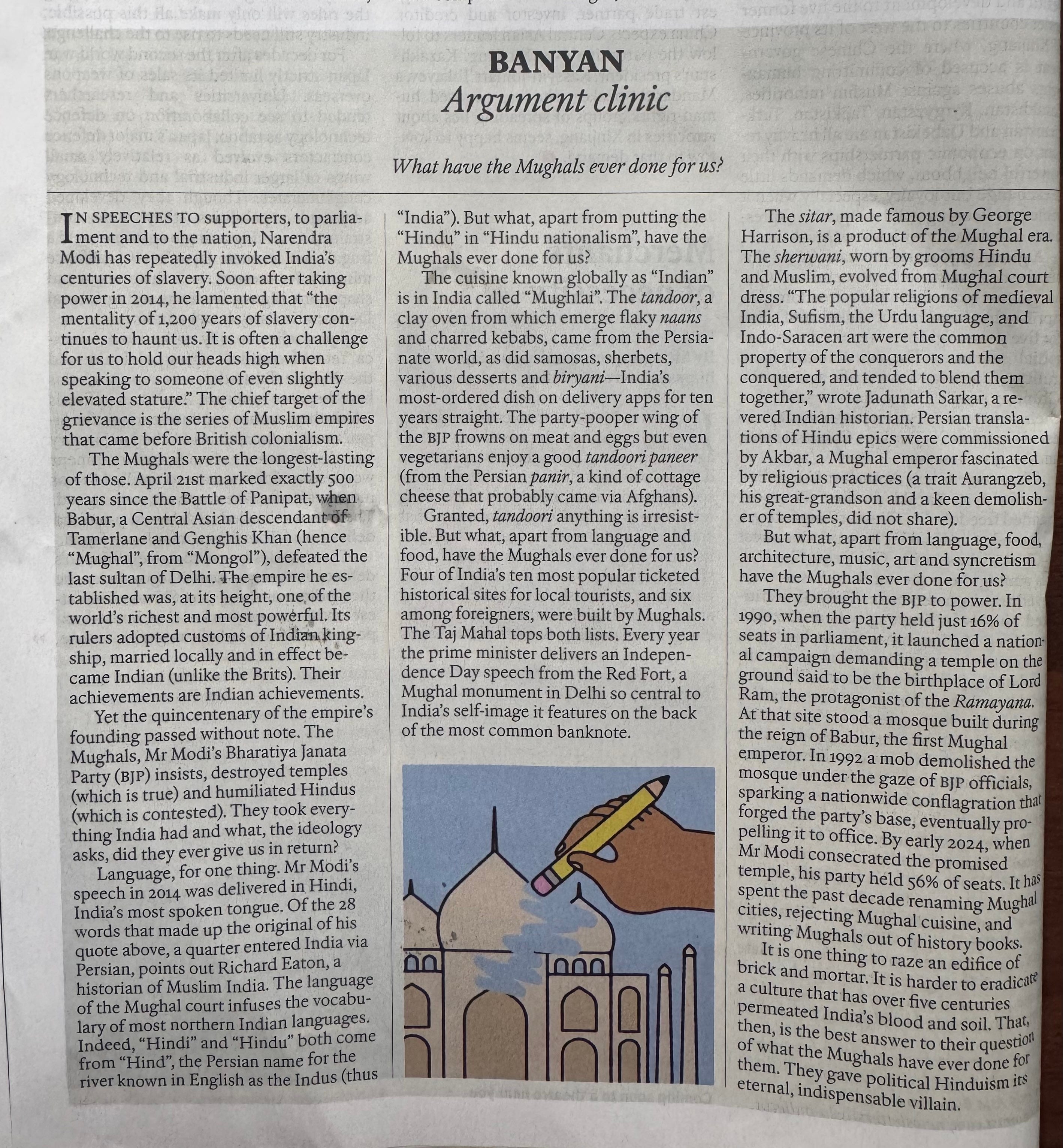
Cheeky take by The Economist on the impact of the Mughals, by making a reference to the iconic Monty Python scene.
Not exactly a good comparison (Romans vs. Mughals), but interesting take!
🎧 1 long-form listen of the week
Ruchir Sharma is one of my favorite storytellers from the world of finance and investing. He provides a superb balance of big-picture stats with anecdotes from the ground. Lots of TILs for me from this interview.
India has the highest inter-state inequality of any country—fascinating stat with norm-variance:
In America, the gap between the poorest state and the richest state in per capita income terms is about two to three times. Brazil, China – similar, maybe three to four times. In India, the gap between a Bihar and Bengal and a Telangana and Karnataka is six times in terms of per capita income. These are very different Indias. It’s not one India.
Development was simply absent from the electoral conversation in Bengal:
In Bengal, at least in this election, development was not on the table by either side. When we asked the BJP people why aren’t you talking more about development, their answer – even with the top leadership – was, we want to first make sure that the people’s basic concerns about security are taken care of before we talk about development. So we can criticise Ma a lot about development, but the fact of the matter is that it just wasn’t an issue that we encountered in all our travels over six days.
Welfare handouts have increased, but at least they are reaching the beneficiaries:
(It) sounds very cruel and brutal when you say that people shouldn’t be given handouts, because you see the poverty, you see what’s exactly happening out there. Fine, do handouts. But the one interesting thing which has changed in India which we must acknowledge is at least now when the politicians make the promises, the delivery is happening. The leakages have been stopped a lot because of digitisation. That’s a big improvement – that the delivery now happens, that someone says we’re going to make it and it actually hits the final mile. The old Rajiv Gandhi coinage that for every one rupee only 15 paisa goes – I don’t know what that number now is, but it’s possibly well over 90 paisa to the rupee.
Ruchir makes a very interesting point on why India can’t grow at the 8-10% growth rates that the East Asian miracle economies managed earlier, because of the need to spend on welfare even before becoming rich (which the East Asian countries didn’t do):
When people ask me why can’t India grow like China, Korea, Taiwan – let’s remember, these countries followed a very brutal form of capitalism. In China, Korea, Taiwan, they said no handouts until we reach a particular per capita income. We’re going to spend all the money we can on building infrastructure. In China, they fired 90 million people in their bloated state-owned enterprises in the 1990s. 90 million people. And they told people that if you can’t get a job, too bad, there is no support system.
So you can’t have it both ways. Either you say that listen, our polity is such that we have to settle for whatever growth rate we get. But don’t tell me then that we will do handouts and yet we want to grow at 9 or 10 percent. The two are not happening together, because there’s no economic model in the world where that has happened together.
Foreign capital has turned away from India recently—and its all because of… not the tariffs, or the Iran War, or oil prices, but… AI:
The entire world today has a monomaniacal focus, which is AI. That’s all the world is about today – which countries are the winners of AI, which countries are the losers of AI. Unfortunately for India, in contrast to what happened in the tech boom in ’99–2000, this time as far as AI is concerned, foreigners have taken the view that India is a loser in the AI race.
We are at the current stage of AI where the entire thing is about building the AI infrastructure – the picks and shovels, semiconductors, memory, the compute. That’s the phase. It’s a mad dash going on for that. India unfortunately just doesn’t have that.
And that is leading to indifference:
As far as India is concerned, in my 30-year investing history, what I can tell you categorically is I’ve never seen such indifference towards India. As that old line goes, the opposite of love is not hate. It is indifference. In 2013, when we had the fragile five, it was hate. Today it’s just indifference. You cannot chat about India because people just aren’t that interested in it, because they are just focused on one thing for now, which is AI.
Sharma makes a brilliant connection between this result and the root cause—of India’s abysmal spending on R&D over the decades:
The amount of money we spend on research and development in India as a share of GDP – again shows our priorities – is 0.6 percent. Korea, Taiwan, which have become the two biggest beneficiaries of the AI boom in the world today, spend four to five percent of GDP on R&D. It was always said that our IT is just doing an arbitrage business, it’s not actually doing innovative stuff. We lived with that, but today that is coming back to haunt us.
He then talks about how the US is able to get away with its unpredictable and erratic behaviour—because of its dominant leadership in AI:
That’s also something which is helping America continue to get away. Sitting here in India, when I travel in Singapore, all these investors – they love to bitch about America all day and then buy America all night. All day they’ll complain, but all they’re putting their money into is America, and most of it is into these tech AI plays.
Last year, about 1.6 trillion dollars was invested in America. We were losing. They got 1.6 trillion dollars. And the whole thing is hinging on one thing, which is AI. India unfortunately is not seen to have any AI plays at this stage.
The reports of the US dollar’s decline have been greatly exaggerated:
The financial hegemony of America has not only lasted so long but is disproportionately high. America’s share in the global economy is about 25 to 30 percent. But the dollar’s usage – if you look at transactions – is close to 90 percent. The Chinese currency barely registers two, three, four percent, even though China’s economic size is 20 percent.
China has been unable provide the leadership as a viable alternative to the US:
One of the biggest problems is the fact that China is just not being able to step into that void. This should be a golden moment for China, and it’s not being able to do it. The Chinese growth model is heavily built on debt and heavily done by pumping lots of money and liquidity into the system. So the fear the Chinese government lives with is that if we open up the country and make the currency convertible, you will end up getting a massive flood of money which will leave China.
The paradox of the current moment? Nobody’s winning, but the US is losing least:
I won’t say America is winning, but I would say unfortunately it is losing less than the rest of the world. No one’s winning in this, but it is losing less. Because it is not that dependent on the world for its energy needs, and it is at the heart of the AI mania just now. So the US is not feeling the impact of its actions, and the rest of the world is suffering much greater consequences. The longer this goes on, the more the rest of the world ironically loses compared to the US. And that is the paradox of this entire situation.
That’s all from this week’s edition.
Photo by Diana Polekhina on Unsplash