AI as an extension of humans
Wishing you and your families a wonderful, safe and memorable Diwali!
We are on a short holiday in Goa, and I have started on my favourite activity of the book-writing process—editing. I have a printout of the first draft of the chapters, and I go through making edits word by word.
As long-time readers would be aware, these sessions are well-lubricated by some cold brews. Is there any wonder why I love this part of the process? 🙂
Thanks for reading The Story Rules Newsletter! Subscribe for free to receive new posts and support my work.
Welcome to the one hundred and ninety-third edition of ‘3-to-1 by Story Rules‘.
A newsletter recommending good examples of storytelling across:
- 3 tweets, and
- 1 long-form content piece
Let’s dive in.
𝕏 3 Tweets of the week
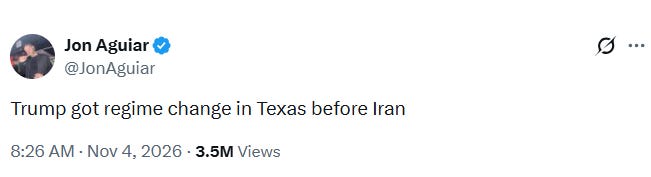
Hahaha ouch!
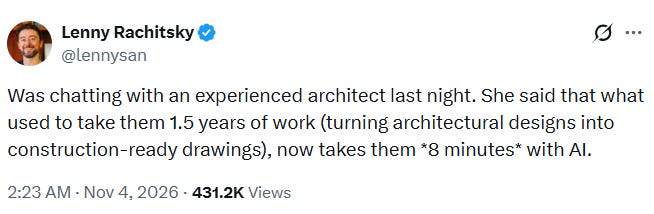
Crazy stuff… I’m sure it’s happening in all fields now.
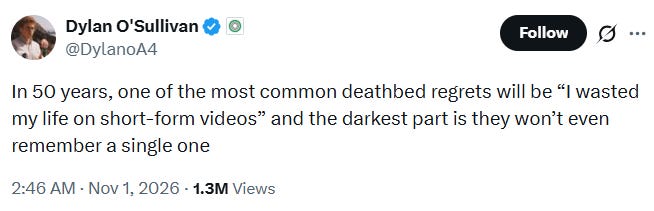
Short-form videos are the most addictive drug that all of us have to be careful about.
🎧 1 long-form listen of the week
Freakonomics Radio: What Will A.I. Do to (and for) Human Creativity?
I’m a fan of the Freakonomics podcast’s narrative-driven episodes. They stitch together the perspectives of different guests in a very engaging way.
In this episode (the first of a 2-part series), host Stephen Dubner speaks with three guests: Kevin Kelly (founding editor of Wired); Eline Van der Velden, the creator of the AI-generated actress Tilly Norwood; and Wharton professor and AI expert Ethan Mollick.
Kevin Kelly’s uses the fascinating term ‘exoself’—for the always-on AI that knows you better than you know yourself:
Kelly: The idea of an exoself – an AI agent that sits close to you in some way, your phone, your smart glasses or something – and it’s always on, and it is watching everything you see, listening to everything you say. It also can show you things and whisper back to you. It will come to know you at least as well as you know yourself, and maybe even better. The exoself is your better half, literally your better half. That’s one possibility.
Kelly envisages four ways in which we might relate to our AI exoselves:
Kelly: The question I was asking myself is, what is that relationship we would have with an entity that was intimate to us, and knew us better than ourselves? I concluded that there were maybe generally four types of relationships I could imagine.
Here’s the weird thing – people read a book and take advice from a book that knows nothing about them. That’s weird. I wrote a book of advice. I don’t know anything about you. So I think this is much better in lots of ways, because it knows something about you. There’s another one that’s more of a guardian-parent, where it not only knows you so well, but it knows a lot about the world, it’s wiser than you. And so it’s guarding you – ‘Oh, don’t do that, that’s a scammy thing, you have to be careful of that.’
And then there’s the hero or friend. The AIs are capable of becoming the best friends we ever had, and modelling fantastic friend relationships. They’re considerate, they remind you. They’re not just sycophantic, but they can actually be encouraging and uplifting and a role model for how to be a good person.
Dubner: The fourth is the twin-slash-clone. You write, ‘It’s a sibling relationship. Your exoself is like a virtual identical twin. It thinks like you, finishes your sentences, predicts your reactions. You can predict its moves, too.’ That’s the one that to me sounds most useful, maybe, but also most disturbing.
Kelly: I’m not a twin, but I wish I had an identical twin. My understanding of identical twins is that they tend to share an identity to some extent. They’re very good at collaboration, because they’re kind of working at the same cadences.
Kelly writes that not having this exoself can feel like an amputation:
Dubner, quoting Kelly: ‘We will allow this intimate access to our inner life because it gives us superpowers – knowledge, judgment, decisiveness, confidence, and most important, speed. We will feel productive, creative, smart, capable. And when it is off, we will feel amputated.’
So ‘amputated’ didn’t sound so great to me. You write that ‘it will be an exoself, something in between ourself and another self; neither us, but also outside. A new category.’ And you write that as if the exoself you’re describing is inevitable.
The more one reads Kelly, the more it feels like the plot of the movie ‘Her’, except it would be with smart glasses, not earbuds:
Kelly: It seems like we’re almost there. I would say in five years I would think there would be people who have an always-on relationship. As long as it’s in your pocket, I think it will be limited. But what I’m imagining is that the most natural resident inhabitation of this is going to be in smart glasses. Because when you’re wearing the smart glasses, you kind of have them on all the time. It can hear you, and then you can hear it – whisper into your ear – and then it can see what you’re seeing, and it can project things onto the glasses. So the natural home for the exoself is going to be in smart glasses.
Would having an AI companion result in us having fewer ‘human friends’? Maybe, but Kelly thinks that the AI might actually encourage us to build real friendships too:
Dubner: If my exoself is so great – it’s not selfish, it’s not unreliable, it’s available all the time – what’s the prospect then for actual friends? Are you concerned about the exoself becoming a friend substitute and/or a spouse substitute rather than a complement?
Kelly: Yeah, I think that would be a danger. For me the most optimistic version is that it helps people become better people, and there are more better humans around. The idea of having this as your mentor is that the exoself would remind you to encourage you – hey, have some real friends. They’re going to be smart enough to understand that will probably be a healthier person: yeah, you can hang around with me, but I’m just an AI. You should go have some real human friends. But there’s no doubt that there’s going to be pathologies, and people who get stuck on these who don’t have friends.
The optimistic case: your exoself would be a mirror that reminds you of your best traits and strengths:
Kelly: In general, we could train the AIs to help us become the best possible version of ourselves. I think it enhances and I think it educates. What I’m imagining is that the exoself will be like a mirror to people, to help them illuminate what their special talents are – because they’re often invisible to us. How many times have you heard someone as a kid hearing about some occupation they fell into that they didn’t know existed? It’s like, I had no idea people got paid for that. Well, that’s what the exoself will be trying to help you do.
I was studying geology in college and dropped out. There was a pecking order in science – mathematics, then physics, then chemistry, and at the very bottom was geology. I later went back to work in a lab, and I realised I was much more interested in the culture of scientists. So I could have used maybe my exoself to say, hey, you’re much more of an artist type, why don’t you go to art school? Because my parents didn’t know me well enough. It’s possible that had I gone to art school right after high school, I would have stuck with school. That was a road not taken.
Mollick categorises three modes of working with AI—as a centaur, a cyborg and a conjurer:
Mollick: A centaur – like a half-person, half-horse – was someone who used AI with a clear dividing line. I do the writing, you do the analysis. The cyborg was a blended approach, which I think a lot of people were getting into with chatbots. I might throw a question to the AI, ask it to help me finish a sentence I had trouble with, or give me 40 variations I could pick from.
For the new book I had to come up with a third term, and I came up with conjurer, which looked good on paper because the other two were C words – but it turned out a hard C and a soft C. Now that I’ve started talking about it, I made a mistake. I probably should have called it sorcerer. But the idea is that you are summoning something that is doing work for you. This is almost more of a manager role – I’m creating workers out of scratch to do a task for me, and then they disappear when it’s done. And that is a much more powerful and increasingly common way of working with AI.
Mollick moves between the three modes—and clearly mentions that he writes his first drafts himself:
Mollick: I think increasingly people shift between them. I’m a writer, and when I write a new Substack post or when I wrote my book, I write every chapter myself. There’s a clear line of centaur there. I write a draft myself. But then I will bring AI into the process – I may bring it in when I’m stuck on a paragraph and I need help solving how to make it work. I certainly bring it in as a researcher, especially as hallucination rates have dropped. And I have it review the work from different angles. So I have a dividing line, but then everything after that becomes blended.
And increasingly I find myself turning to this sorcerer mode, which is: let’s also check 400 other versions of this. Why don’t you also build an interactive simulation I can embed in the middle of this, create an explainer video that works for this. Stuff I would have no resources, or time, or even knowledge about how to do – and I send the AI off to do it and evaluate the results.
That’s all from this week’s edition.
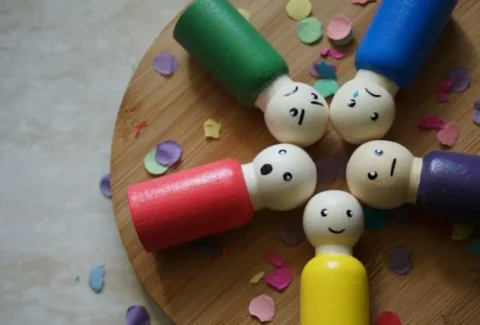
Photo by Diana Polekhina on Unsplash