
A Masterclass on Regulation in India

This week, we begin our annual summer vacation—we are visiting the UK! Excited to be seeing the sights in London, Scotland and beyond.
Especially looking forward to the Beatles Museum at Liverpool (we are big fans!).
And now, on to the newsletter.
Thanks for reading The Story Rules Newsletter! Subscribe for free to receive new posts and support my work.
Welcome to the one hundred and sixty-seventh edition of ‘3-to-1 by Story Rules‘*.
A newsletter recommending good examples of storytelling across:
- 3 tweets, and
- 1 long-form content piece
Let’s dive in.
𝕏 3 Tweets of the week
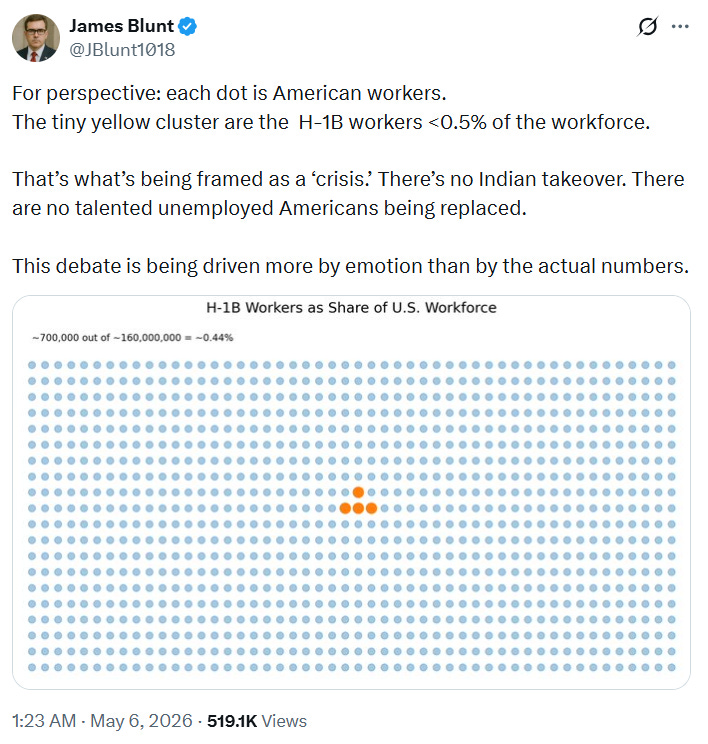
Superb visualisation of the number. Though I would not have used a striking orange to differentiate. Maybe just a darker blue would have been enough.
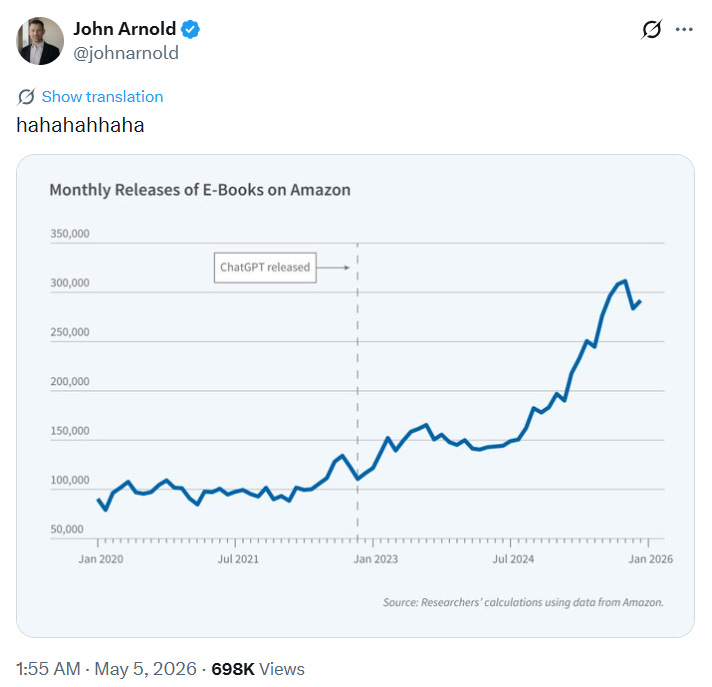
Ouch. Clearly, AI has brought a lot of wannabe writers out of the closet!
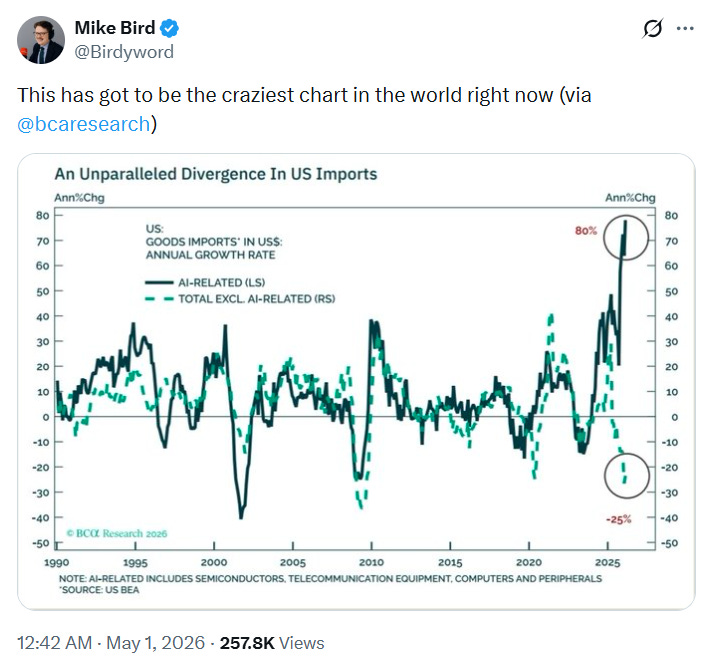
Fascinating how much AI has propped up the US economy. Wonder what will happen if the bubble bursts…
🎧 1 long-form listen of the week
This conversation is truly a masterclass on the history and impact of regulation in India, by Shruti Rajagopalan, one of the leading experts on the topic.
It helps that Amit deeply understands the topic and history, and is able to add a lot of value with his observations and nuanced questions.
Fair warning: This is super detailed and geeky and may not be everyone’s cup of tea. But if you want to really understand the topic, you cannot get a better primer.
Perhaps the most absurd example of Indian over-regulation – rules on the height of toilets:
Rajagopalan: The craziest one that I can think of is the Factories Act of 1948, which had a lot of stuff in there to basically regulate workplace conditions and make it healthier and safer for people to work in factories. But they obviously went overboard, and one example of that kind of crazy, overboard regulation is they actually regulated urinal heights in the Factories Act. This is Section 19 of the Factories Act. The good news is that in the new labour codes, this kind of specific regulation of prescribing minimum-maximum urinal heights has gone away.
Varma: I’m just thinking of the post of ‘Urinal Inspector.’ 80,000 PhDs applying for one post of Urinal Inspector is quite possible in India.
How World War II era controls became the DNA of independent India’s regulatory state – and why 1991, not 1947, was the real act of decolonisation:
Rajagopalan: The modern regulatory state in India very much has its antecedents in World War II war controls. The Defence Act had two particular provisions – Rule 81 and 84 – which put in a lot of restrictions on all kinds of commerce, the buying and selling of goods, moving of goods and so on. And as soon as India became independent, some of these rules became the Essential Commodities Act, some became the Industrial Act, some became the Industrial Policy, some became the Foreign Exchange Regulation Act.
In wartime, there is a single goal – all resources need to be moved towards the war effort. Central control makes sense. You don’t want to be negotiating with market players in a decentralised way. But now you are using that same regulation against Marwari cotton traders and Parsi aunties who are running a little liquor room. The whole thing of the modern regulatory state coming from British war controls – the more I think about it, I just think it’s bananas.
To me, the greatest act of decolonisation in India is 1991 and removing all these controls which were a direct import of the Defence Act which had turned into industrial regulation, essential commodities control, and things like that.
Varma: You began by saying, ‘Look, we are being oppressed. The British are oppressing us. Let’s fight against the British.’ You got the British out, but you kept the oppression.
The land ceiling act as a great example of how one intervention cascades into a tangled mess – from fragmented holdings to fertiliser subsidies to stubble burning to Delhi’s air pollution:
Rajagopalan: We start with something that sounds really benign – one of the biggest war cries during independence was that the Zamindari system had to go. So we have two kinds of regulation: direct land reform, which breaks up large Zamindaris, and Land Ceiling Acts, which cap the maximum land holding size that an individual or family can own. Almost all of this is still on the books.
Now within a generation or two, when you already have a maximum land holding size – and by the way, these were sometimes like 5 acres, 7 acres – and in India we don’t have primogeniture, the land gets split up between all the children who inherit. Within two generations, the land holding size becomes really small and fractional. We have a crisis in India today where 86% of the land holdings are marginal, which means they are below 2 acres.
So what did we do? We said, oh, we need subsidised inputs so they can improve the yields. The state started subsidising each and every input – fertiliser, electricity, water, credit, insurance. And I’m not even counting the cost of soil contamination because of over-use of fertiliser, or groundwater tables depleting, or Discoms going out of business because electricity’s free. There are third-order, fourth-order effects which are catastrophic. But it all started here.
Amit connects the dots all the way to Delhi’s air quality and India’s diabetes epidemic:
Varma: When you subsidise electricity and at the same time you have MSPs for rice, you incentivise a state like Punjab – which is arid and would not otherwise produce rice – to start producing rice on subsidised electricity. And what do they do with the rice stubble between seasons? They burn it. And in the winter months, this contributes massively to Delhi air pollution. And in this entire mix, the Indian government had Minimum Support Prices for cereals but not pulses. Cereals have carbs, pulses have proteins. And this is one of the reasons for India’s diabetes epidemic.
Why central planning is a fool’s errand – the absurdity of trying to reverse-engineer an economy from a single commodity:
Rajagopalan: You start with, we need steel and heavy industry to be controlled by the government because these are essential goods and the private market doesn’t have capital for it. Okay, so now we need to know how many tons of steel to produce. To know that, we need to know: what are the uses of steel? So we need to know how many bicycles will be made, how many Bajaj Scooters will be made, how many surgical instruments will be made, how many reading glasses will be made – and now we will reverse-engineer how much steel we need to produce through this command and control system.
This is the beauty of the market: the market just coordinates this through the price system – in that wonderful 1945 Hayek paper on the ‘Use of Knowledge in Society.’ But when you do it through command and control, you don’t have the knowledge.
The simplest and most powerful question any regulator should ask before writing a single rule:
Rajagopalan: I start every lecture I give on deregulation with: you tell me, do we want more or less of an activity? If you want less of an activity, you need to regulate it – that is, you impose costs on it. Now you can’t simultaneously tell me that we have a jobs crisis in India, we want our MSMEs to become employment hubs, and we want every young person in India to become an entrepreneur, and then tell me simultaneously that we’re going to have this crazy number of labour codes which are going to kick in at 10 workers and start dictating what colour paint and what colour uniform and wage slips there are.
So we need to start at a much more basic level in the deregulation conversation, where the conversation literally has to be: do I want more or less of a particular activity? And make sure that in regulating the externality I don’t want, I don’t kill the activity I want. Which is actually how most of Indian regulation is designed.
Why deregulation can’t just be a Union government exercise – it needs to happen state by state, each with its own priorities:
Rajagopalan: In each state it’s going to be different. In some states, you are going to get the greatest bang for buck by doing agricultural level reforms. In some other states, that’s not where you begin – you need to start with factory reforms or environmental protection or something else. So we need state-level thinking. There should be a NITI Aayog equivalent and these high-level committees at each state level to actually say, you know, in Rajasthan we need a completely different kind of agricultural regime which works for arid climates, and we need to do something completely different somewhere else.
That’s all from this week’s edition.
Photo by Diana Polekhina on Unsplash