12 Experts on Writing with AI

We had a long weekend this week… holidays from Wednesday to Sunday!
I’m writing this from a short break in Karjat. Love the verdant greenery all around. Konkan (actually Maharashtra in general) is just stunning in the monsoons.

Thanks for reading The Story Rules Newsletter! Subscribe for free to receive new posts and support my work.
Welcome to the one hundred eighty-third edition of ‘3-to-1 by Story Rules‘.
A newsletter recommending good examples of storytelling across:
- 3 tweets, and
- 1 long-form content piece
Let’s dive in.
𝕏 3 Tweets of the week
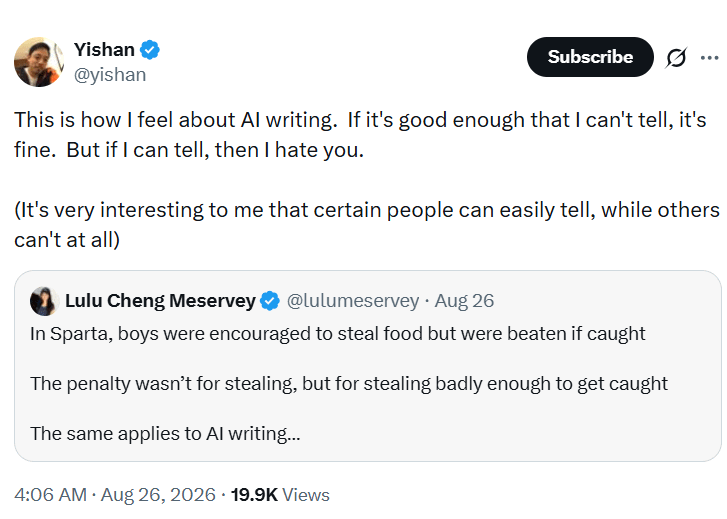
Good test. Use AI, but it shouldn’t be seen.
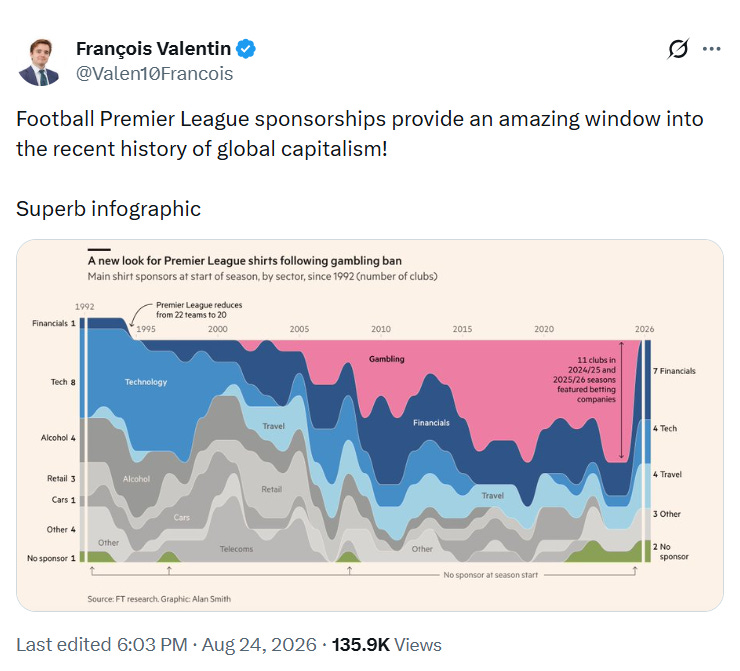
Fascinating to see the rise and fall of gambling and the recent increase in travel
Cool graphic!
🎧 1 long-form listen of the week
a. How I Write (David Perell): 12 Writers on AI and Creativity
This episode is a compilation of views on AI by 12 accomplished writers. Speakers include Ezra Klein, Tyler Cowen and Jimmy Soni.
You get an interesting cross-section of views on AI and can figure out which views resonate the most with you.
Author Ezra Klein does not use AI for summaries or research—since it would not see the things that he can spot:
Klein: Having AI summarise a book or a paper for me is a disaster. It has no idea what I really wanted to know. It would not have made the connections I would have made. It’s the time I spent researching that was the most important time. Having AI do research for me is a bad idea.
I’m interested in the thing I will see that other people would not have seen. And I think AI typically sees what everybody else would see.
Perell: I think of AI almost like looking at the world through a kaleidoscope – the default prompt gives you the way that everybody else is looking.
Klein: But that’s assuming that I know what my prompt should be. There’s no prompt that would have told me – just go read more books, man. You’re not there. You haven’t gone far enough.
Klein makes an interesting analogy—that the human mind does not work like shown in the movie ‘Matrix’:
Klein: I used to conceptualise knowledge the way you see it in the movie The Matrix – I wanted the port in the back of my head that the little needle would go into and then I had read John Rawls’s Political Liberalism. I thought that what you were doing was downloading information into your brain. And now I think what you’re doing is spending time grappling with the text, making connections. It will only happen through that process of grappling.
Part of what is happening when you spend seven hours reading a book is you spend seven hours with your mind on this topic. The idea that o3 can summarise it for you – there’s all this stuff you just will not have read, and you didn’t have the engagement. It doesn’t impress itself upon you. It doesn’t change you. What knowledge is supposed to do is change you. And it changes you because you make connections to it.
Even economist Tyler Cowen (an AI-power-user) does not hand over his writing to AI (even if it gets better than him):
Cowen: If I’m writing on a legal issue and I’m not a lawyer, I will ask o1 Pro for the relevant legal background. I just wrote a column about declassifying classified documents. I don’t know that law very well. I asked the AI for a lot of background on the topic. I didn’t use what it gave me, but now I feel like I’m not an idiot on the topic.
But I don’t let it write for me. I want the writing to be my own. It’s like my little baby, so to speak. I don’t care – whenever it’s better than I am, I’m still not going to let it write for me. A lot of the sources I write for wouldn’t let me. I agree with that decision on their part. But even if they would let me, I wouldn’t do it.
Cowen uses AI when he is reading, as a ‘secondary literature’:
Cowen: Most of all, I use AI when I read things. I use it as the secondary literature. I’m preparing a podcast for a British historian who does the history of Richard II and Henry V. In the old days, I would have ordered and paid for 20 to 30 books on those kings. Now maybe I’ve ordered two or three books, but I’ll keep on interrogating the best LLMs about the topics of her books. And I acquire the context much more quickly. Keep in mind, I’m the questioner – so if there’s a modest degree of hallucination, it doesn’t matter for me. I’m not giving the answers. I can now do many more podcasts than I used to because I’m using AI for my prep.
It’s improving the quality of my reading, which I use for my pleasure reading. I reread Shakespeare’s Richard II. In the old days I would have piled up a lot of secondary literature. I’m also rereading Wuthering Heights, and I just keep asking the AI – what do you think of chapter 2? What happened there? What are some puzzles? What should I ponder more? How does that connect to something else later in the book? It just gets me thinking. It’s the new secondary literature for me. It’s more fun, I learn more just by being more actively involved asking a question.
I love this framing—AI is not ‘end to end’, it’s ‘middle to middle’:
Jimmy Soni: Balaji Srinivasan has a line where he says AI is not end to end, it’s middle to middle. What he means is that when people criticise AI, they say – well, you’re going to need to figure out what the thing you want to do is in the first place, and there’s going to be hallucinations, you have to check it at the end. That’s the end-to-end stuff. Humans have to work at the very beginning to set the vision. Humans have to work at the very end to verify, to fact-check, to make sure everything’s good. But a lot of that middle-to-middle work can now be done by AI.
A lot of the criticism about AI is being levelled by people who don’t use it. A lot of the people critiquing it have an understandable anxiety about how it might threaten their work, their income, or just their position in life. But they don’t actually sit down with the tools and put things in and play around and learn how to use it. Learning how to use these tools effectively is a skill unto itself.
Soni says that he finds AI to be an ‘anxiety antidote’ because it can help you get to the first draft faster:
Soni: There’s a tool I like called Wispr Flow. It’s really, really effective voice dictation. Sometimes if I’m feeling really stuck, or I feel like I’m not myself that day, I will use Wispr Flow to just dictate thoughts and it’ll do a very good cleaned-up transcription of what I just said. And then at least I’ve got a bad first draft that I can play around with. And I didn’t get in my head about it. I didn’t wait and wait and agonise and research and clean the kitchen and make sure my shoes were all lined up by the door – all the stuff we use to excuse ourselves from actually finishing the work. AI is an anxiety antidote. People think AI causes anxiety, and for sure for some people it does. For me, it’s been the ultimate antidote to the thing that prevents me from getting my work done – because I can get to a bad first draft very quickly and then bring to it polish and flair and attention and refinement.
Please don’t use AI to write something personal—where the recipient is expecting to hear your authentic voice:
Perell: The question that’s coming to mind in terms of how much I want to read something written by AI is – how much does it matter to me that there’s a human on the other side of this? I need to draft a contract later this week. I’ll probably use AI to help me do it, because when I send that out, the person isn’t looking at me saying, ‘David, did you dig into the depths of your heart and soul to write this?’
But a friend was getting married a few years ago – this was ChatGPT-3 time. There were probably 100 people at the wedding, and at every single table was a note written from the bride and the groom about why we meant so much to them. I sit down and open it up, it’s probably 80 or 100 words, and I’m like, wow, that is so touching that they did that.
We’re out partying that night and I go up to the groom and say, ‘Hey, I just want to let you know that was one of the nicest things I’ve ever seen at a wedding.’ And he gives me the old wink and says, ‘Yeah, we got AI to write it.’ And I was just like – dude. I would have so much rather you’d written something half as sincere as that, filled and littered with typos, than to have AI write that. It felt like a violation and a betrayal.
That’s all from this week’s edition.
Photo by Diana Polekhina on Unsplash