Silicon Valley’s preeminent Comms expert on Storytelling

Busy week with 3 days of training. September and October are looking significantly busier than July-August. Completing the book on time would be challenging—wish me luck!
I wrote a small tribute to Amazeum—Pune’s unique Children’s museum founded by my wife—which unfortunately closed down on 31-Aug.
Thanks for reading The Story Rules Newsletter! Subscribe for free to receive new posts and support my work.
Welcome to the one hundred eighty-fourth edition of ‘3-to-1 by Story Rules‘.
A newsletter recommending good examples of storytelling across:
- 3 tweets, and
- 1 long-form content piece
Let’s dive in.
𝕏 3 Tweets of the week
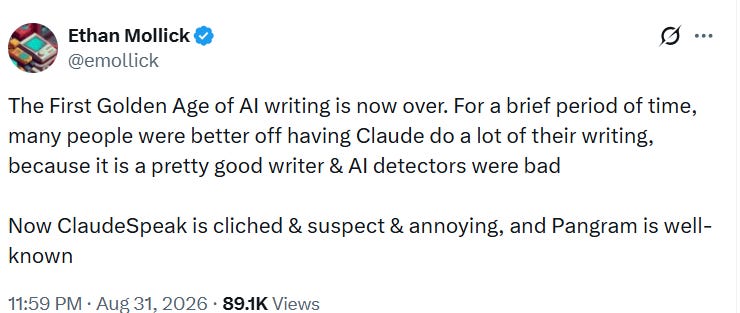
You hear that, AI slop-posters?!
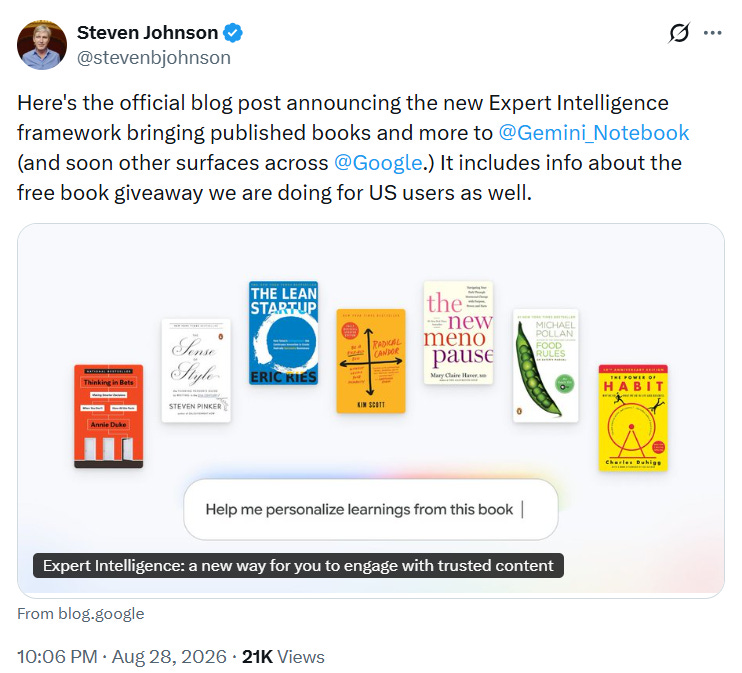
This is a very cool feature. Not sure if available in India yet, though.
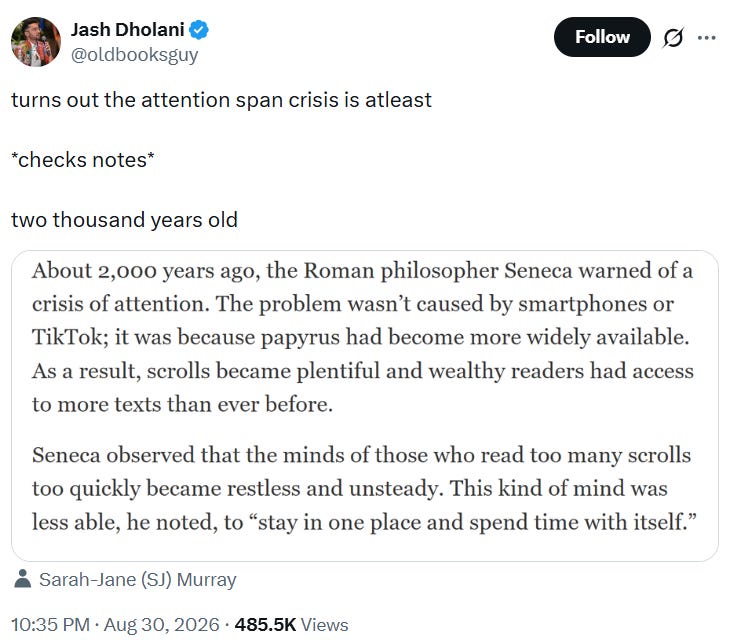
Fascinating!
🎧 1 long-form listen of the week
a. David Senra in conversation with Lulu Cheng Meservey – Narrative Sovereignty
Lulu Cheng Meservey is one of the clearest and most original thinkers when it comes to the art of narrative framing. What’s very cool is that she relies on foundational principles, invoking examples from the ancients like Cicero, Napoleon and Caesar; and even modern-day examples like the Jetsons.
Her bio: She ran PR at Anduril and Substack, sits on Shopify’s board, and now runs a communications advisory firm called Rostra.
I’ve shared her podcast episodes frequently in this newsletter and thought that this was one of the best conversations with her.
—
She makes the case for narrative-sovereignty:
Meservey: We are sovereign human beings. We should be in control of our destinies. We should be in control of our narrative destinies and the stories that help us achieve the destiny. This is narrative sovereignty. You never just want to be depending on someone else.
I loved the origin story of the word Rostra:
Meservey: The reason the company is called Rostra is because Rostra was the speaker’s platform in Rome from which place history was changed. There were many times when the mood in the city was A, somebody hauled themselves up there and stood to face the crowd, and then they stepped down, and the mood was B. This happened after Caesar’s murder – the city completely turned in its perception of what had just happened, who was the good guy and who was the bad guy, and who had legitimacy, because of words spoken from the Rostra.
Founders should give as much importance to their story as their code or hiring:
Meservey: The same amount of seriousness that you apply to the product or the code or the hiring, you have to be applying to your story. And you’re the only person who can say it. You’re the only person who can do it that effectively. Because at the beginning especially, you have not a lot of evidence to back you up. You have your word. And you’re going to back it up with your personal reputation..
You don’t need to be a charismatic founder to own your narrative and go direct:
Meservey: It works better with that (charismatic) kind of founder, but you don’t have to have traditional personal charisma. You can be more quiet, more introverted. You can have a whole range of personality types – but you have to have intensity of belief in the idea. So the idea has to be fleshed out and coherent, and then your belief in it needs to be unassailable.
Meservey shares a simple example of simplifying a startup’s story into a compressed, clear idea:
Meservey: I met a founder at an event. We spoke for maybe seven minutes, and for six of the minutes he’s saying, ‘Okay, I have a business where anybody can become their own cloud kitchen. There’s all these people at home who know how to cook really good food, and there’s people who want more variety than the stuff they get on DoorDash, and I’m connecting them, and there’s a network of…’ And there’s a lot there. And I’m listening to this, and I thought – okay, so you’re turning a cook into a chef. And he said, ‘That’s it,’ and he ran with it.
Sometimes it’s just having somebody who’s not necessarily smarter than you, and doesn’t know more about the topic – especially some of these AI founders who are technical geniuses. But sometimes someone sitting across from you can take your word cloud of thoughts and ideas and suggest for you a synthesis. And for you to see that coming from someone else makes you recognise that that actually is the core of your idea. Now you have the compressed, simple thing that you can share and spread.
Just building great products is not enough; you have to convince people why it matters to them:
Meservey: The greatest and most underestimated barrier between technology existing and actually having an impact is people understanding it, welcoming it into their lives, and wanting to go work on it. There are a lot of really brilliant people working on the engineering and the building. I don’t think there’s a commensurate amount of effort and thought being put into the second part – the human part of the equation, of convincing people to want it and use it and work on it.
You see that with AI today. We can build the AI. Is the government going to allow it to be released? Are people going to use it? We can build data centres – we know how to build a data centre. What are you going to do when there’s a moratorium because people don’t want it?
She does a great diagnosis of what went wrong with the Eric Schmidt speech where he got booed off stage:
Meservey: A lot of the CEOs are describing that AI will cause massive job loss. Most people will look at that and say, don’t say that it causes massive job loss. I look at it a little differently. If you believe that it’ll cause massive job loss, and you’re in that rare position, I think you do have an obligation to warn people and to try to get us to prepare for it. But the really small but really important thing is – don’t look happy when you’re saying it. Don’t be smiling when you say there’s going to be a 50% unemployment rate in a year.
Eric Schmidt gave a commencement address. The vibe of it was ‘it is taking away jobs, deal with it, and get on the train or you’re on the tracks.’ Two things. One is that at the centre of his story, the protagonist wasn’t the human, and it wasn’t the person he was speaking to. He wasn’t saying, ‘You can go change the world, and you have the world’s most miraculous technology to use – think of what you could do with this.’ Instead he said the technology is the protagonist. It’s coming whether you like it or not. You’re potentially in its way, or you can get on the bandwagon with me. Which is just the wrong framing.
The second is that when he was talking about the possibility of AI taking half the jobs of these anxious graduates in the audience, he didn’t seem upset. He didn’t share what fear or anxiety would be. He dismissed any potential anxiety that would arise from that. He sounded completely secure and blasé.
She shares the example of the Jetsons as a great example of techno-optimist framing:
Meservey: The last time there was a really effective techno-optimist message was The Jetsons – and it’s because they weren’t beating you over the head with ‘technology’s going to make your life great.’ The show was about other stuff. It was a family sitcom. But you have a robot in your house doing all your work. You have a flying car. It was in the background. It was ambient and assumed.
Everything techno-pessimist, the tech is in the foreground, and it’s about the tech. Terminator, Blade Runner – the dystopian stories about tech, the tech is the thing people focus on. But the utopian stories about tech, when you make tech the thing people focus on, they write it off as PR. What we want is for the optimistic stories about tech to have it in the background, just be ambient.
Analogies can convert two paragraphs of explanation into a simple idea:
Meservey: I was talking to a founder a few weeks ago where he said, ‘We take a system that ingests the data and then finds the inefficiencies and identifies…’ And I thought about it and said, oh, it’s Ozempic for companies. If you know what Ozempic is, then you’ve just saved yourself two paragraphs of explaining. You get the complexity, but you also get the simplicity. Best of both worlds.
AI writing can make your work “average”, but you are robbing yourself of the opportunity to stand out:
Meservey: AI is a wonderful tool, I use it all the time. But if you are relying on AI to write for you and to generate ideas for you, you are putting yourself at sea level – or at the level of anyone else in the population who wants to pay fractions of a cent for a token to get the same output from the same shared brain.
So if you are far below average, you should do that. Because average is better than you. But if you believe that you can be even a little bit better than average, you would be robbing yourself to do that. Ralph Waldo Emerson calls it a form of suicide – because in imitating others, which is what a template is, you are killing your own ideas. What are we if not a unique combination of beliefs, ideas, feelings? If you take that and you mute it, you are killing a really sacred part of yourself.
That’s all from this week’s edition.
Photo by Diana Polekhina on Unsplash