How to Write with Humour

This was a light week spent fully in Pune.
On reflection I realised that while I have built up around 15 videos for the YouTube channel, there are no Shorts (which is the most popular format!).
And so, this week, I visited the video recording studio and recorded a bunch of Shorts that I plan to release in a few weeks. It was fun using AI to convert my old video scripts into short 35-50 second scripts.
I’m slowly getting the hang of using AI, though there’s still a long way to go. Currently, I have subscriptions to Claude Pro, ChatGPT Plus and Gemini Pro… Going forward, I might drop ChatGPT, I think…
Meanwhile, I wrote an article about the three kinds of people, based on whether they dwell mainly in the past, present or future. Let me know what you think.
And now, on to the newsletter.
Thanks for reading The Story Rules Newsletter! Subscribe for free to receive new posts and support my work.
Welcome to the one hundred and sixtieth edition of ‘3-2-1 by Story Rules‘.
A newsletter recommending good examples of storytelling across:
- 3 tweets
- 2 articles, and
- 1 long-form content piece
Let’s dive in.
𝕏 3 Tweets of the week
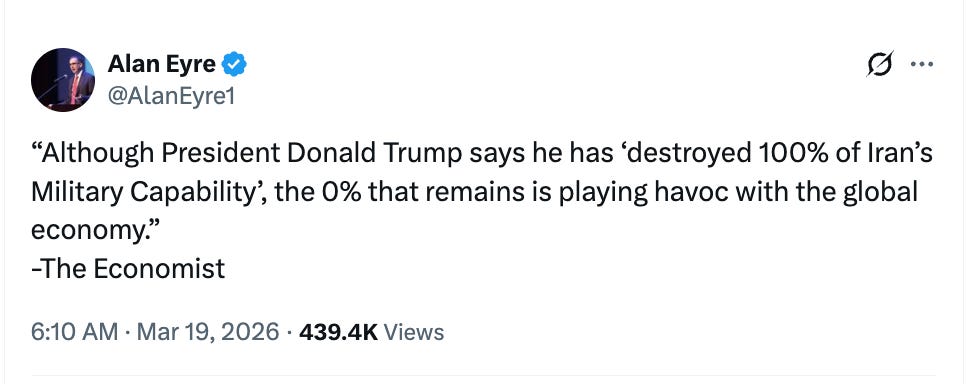
Ouch, brutal line.
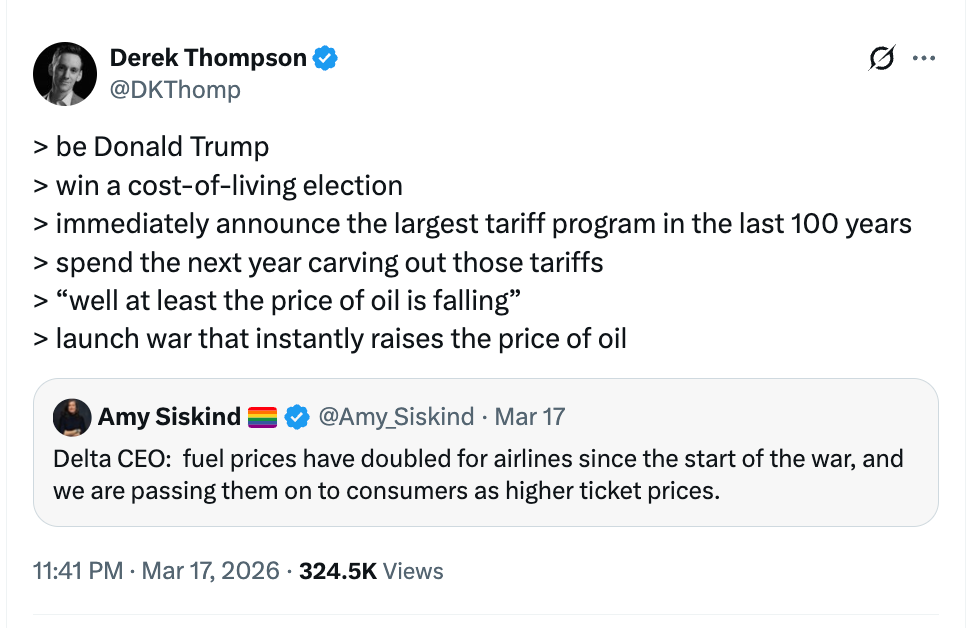
Interesting framing of the Trump presidency mainly from the perspective of inflation!
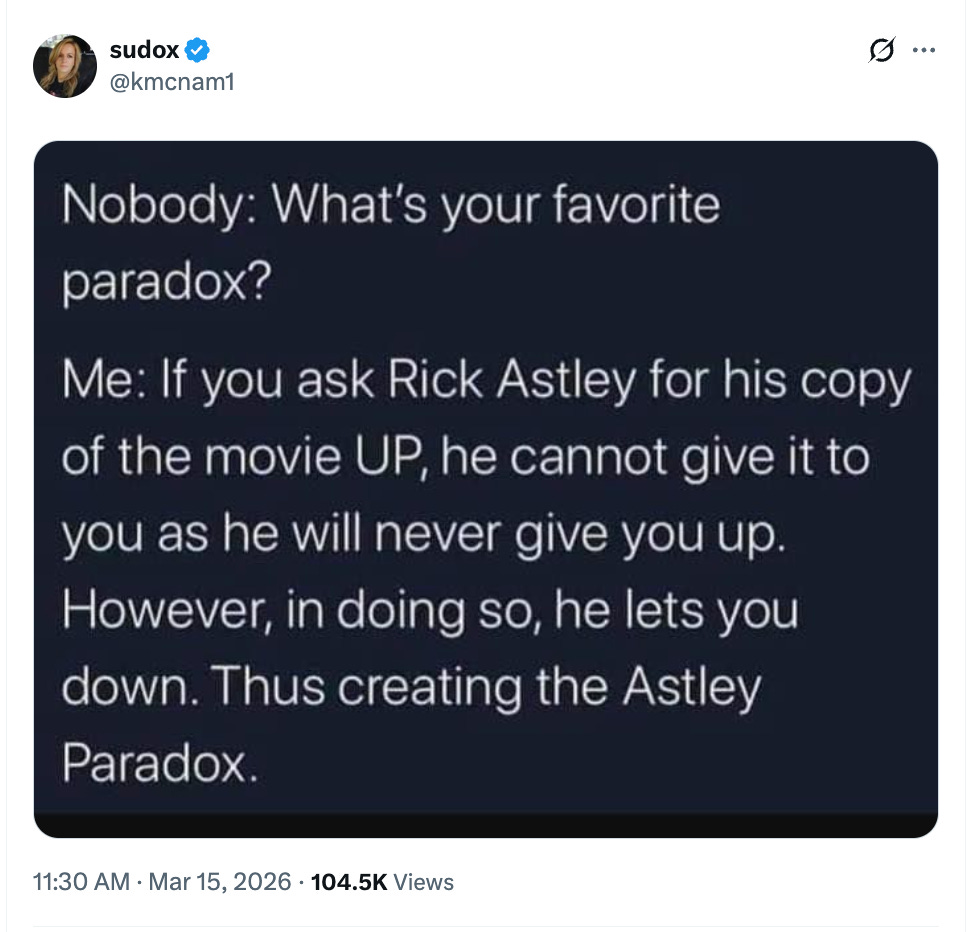
This is seriously good humour, if you know the Rick Astley meme!
📄 2 Articles of the week
a. ‘The visual shift: why words are losing’ by Grant Lee (Gamma)
Thought-provoking piece by Grant Lee (founder of AI-presentation company, Gamma), on how visuals were a key bottleneck for slides earlier, but now are easier due to AI.
Lee zeroes in on the core reason why communication is difficult:
We form thoughts at 1,000 to 3,000 words per minute. We speak at 150 and type at 60 to 90. That gap is the central friction of human communication. And nearly every major shift in computing history has been an attempt to close it.
All leaders struggle with this asymmetry:
Every founder I know experiences this asymmetry. You have a fully formed strategy in your head. You spend two hours writing it into a document. Your team spends thirty minutes reading it. By the time they finish, the richness and detail have been lost. Key insights slip through. Context has to be rebuilt at both ends.
The human brain’s visual processing is powerful:
Research from MIT’s neuroscience lab found that the brain can identify images seen for just 13 milliseconds. Ninety percent of information transmitted to the brain is visual.
Images are more memorable than words because they have more representation in memory. The idea is called dual-coding theory.
I love this quote by Tufte:
Edward Tufte captured the design principle decades ago: “Graphical excellence is that which gives to the viewer the greatest number of ideas in the shortest time with the least ink in the smallest space.”
Now AI can help in creating visuals:
AI is collapsing the production cost of visual communication. Generating a custom infographic, an interactive dashboard, or a visual product brief now takes minutes.
This matters because it removes the only real barrier that kept visual communication reserved for polished external presentations. Every internal alignment meeting, every investor update, every product spec that used to exist as a wall of text can now be a structured visual document.
b. ‘What’s with the rise in corporate Storytellers?’ by Elliott Fisher
Fisher makes some good points here about the reasons and implications of the rise of storytellers in various organisations:
The premium in storytelling has shifted to judgement:
Because AI has made content a commodity, any company can produce blog posts, social copy, and press releases on demand now. As a result, the premium has shifted from production to editorial judgment: knowing what’s worth saying and how to say it. In fact, “exercise sound judgement” is listed as a direct responsibility for the communications role at OpenAI.
This is true—I can almost always figure out if a piece is AI written (at least till now):
“Supreme Court Justice Potter Stewart once wrote, in a case about whether a French film was obscene, that he couldn’t define pornography — but ‘I know it when I see it.’” Jake tells me. “The same goes for AI-generated writing: It’s obvious when you’re reading it. That puts a real premium on content that comes from a human, not a machine.”
Storytelling becomes critical for GEO:
Brands now need to think about GEO — Generative Engine Optimization — alongside traditional SEO. AI search tools are surfacing and recommending brands based on narrative clarity and consistency. If your story is fragmented, you’re invisible to the algorithms too.
I loved the distinction made here between storytelling and marketing:
Just like a Chief of Staff is the product manager for the organization, the corporate storyteller is the product manager for the company’s story.
And storytelling is different than marketing. Marketing takes a product and figures out how to sell it. This lives upstream. It’s the narrative infrastructure that marketing, recruiting, investor relationships and internal comms all draw from.
The analogy I like to give is that your core story is like your mother dough. It’s the source for all the story “breads” that different functions can create.
🎧 1 long-form listen of the week
a. ‘Master Comedian Breaks Down 13 Jokes’ – Robert Mac on the How I Write Podcast
David Perell (How I Write podcast) sits down with stand-up comedian Rob Mac to dissect what makes jokes work—going through one-liners from famous comedians, and extracting the hidden principles of comedy along the way.
Incidentally, I have also done this in the Humour chapter of my book, ‘Story Rules’ and was glad to see many common themes emerge. (A part of me also feels that my structure is simpler to understand and remember!). Let me know what you think if you’ve read the book.
Surprise (unsurprisingly) is the main emotion that triggers laughter:
Surprise is the biggest trigger of laughter, something that’s surprising. And incongruity is probably the second most common trigger of laughter. It’s when something doesn’t fit.
I liked this specific type of surprise – the idea of misplaced focus (I would categorise it as a form of incongruity):
“Other than that, Mrs. Lincoln, how was the play?” … The founder of The Onion has identified these comedy filters, and one of the filters is a misplaced focus. So Lincoln gets assassinated but this person is focused on – yeah, yeah, but tell me about the play. It’s about taking things out of what should be focused on and focusing more on this other thing.
On the power of contradicting ideas:
“I am a big fan of science. I follow it religiously.” Those are two thoughts that sometimes don’t go together. And some people would call it irony when you have fighting or competing ideas. … Anything that contradicts itself is funny because again, it’s two opposing thoughts at the same time. And there’s kind of some wisdom about it.
Misdirection is a commonly used technique in comedy. Mac calls it deviating from the expected pattern:
The joke: “never raise your hands to your kids, it leaves your groin unprotected”
… pattern recognition, which I think is the hidden secret of what comedy does and how comedy works. Because when I say “never raise your hands to your kids,” our brains are thinking of a certain thing – oh, the kids, the future, you got to protect kids – because that is the pattern that we’re used to hearing. And patterns have helped us evolve and become the smartest creatures on the planet. So “it leaves your groin unprotected” is a left turn. It’s a surprise. It gets the laugh.
A good joke writer is able to manipulate how our brains work. They set up a couple clues to go one way and then the punchline is something completely different because they know that our minds will follow certain patterns. It’s the secret of comedy – how powerful our brains are.
Knowing your audience is the fundamental rule:
I have a joke about being in Bryce Canyon in southern Utah – it’s where they film the Roadrunner cartoons. Yeah, back when they filmed cartoons on location before all the animal rights protesters came in and shut down the Acme Rocket Skate Company once and for all. I mentioned that, which always gets a laugh, but this audience – nothing. Because they weren’t raised with that TV show. They didn’t have that cartoon growing up. So a joke that always gets 100%, I got zero on.
Bad stories are almost always an editing problem:
When a story is laborious, it’s almost always that they’re just sharing too many details and the wrong details.
A story isn’t everything that happened. The story is only the important things that happen. I don’t need to know what the guy was wearing when he walked into the bar. I just know that a guy walks into a bar. That’s all you need.
The last point is true not just for comedy, but also for any kind of storytelling!
That’s all from this week’s edition.
Photo by Diana Polekhina on Unsplash