The Story of the European Rennaissance
This was the week of Dhurandhar 2, and I saw it twice already. Blown away by the storytelling. Working on a post!
I also wrote a post about why OpenAI is promoting its Atlas Browser so heavily, and a post on some storytelling lessons from the Ramayana (on the occasion of Rama Navami)!
And now, on to the newsletter.
Thanks for reading The Story Rules Newsletter! Subscribe for free to receive new posts and support my work.
Welcome to the one hundred and sixty-first edition of ‘3-2-1 by Story Rules‘.
A newsletter recommending good examples of storytelling across:
- 3 tweets
- 2 articles, and
- 1 long-form content piece
Let’s dive in.
𝕏 3 Tweets of the week
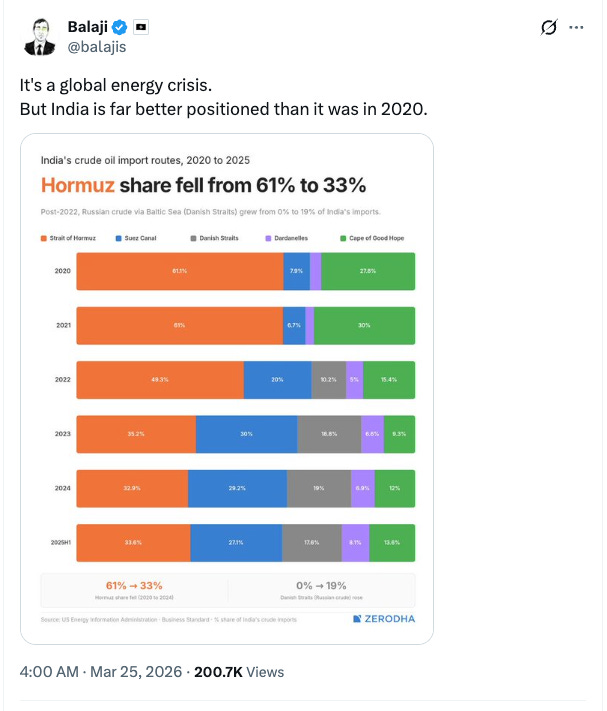
Super interesting. I didn’t know that we have almost halved our dependence on Hormuz Strait in the last 4 years. Good work by the govt.
PS—Notes on the chart:
- This should be a stacked column not a bar (time flows left to right)
- They need not colour the other components. Just the Hormuz one is good
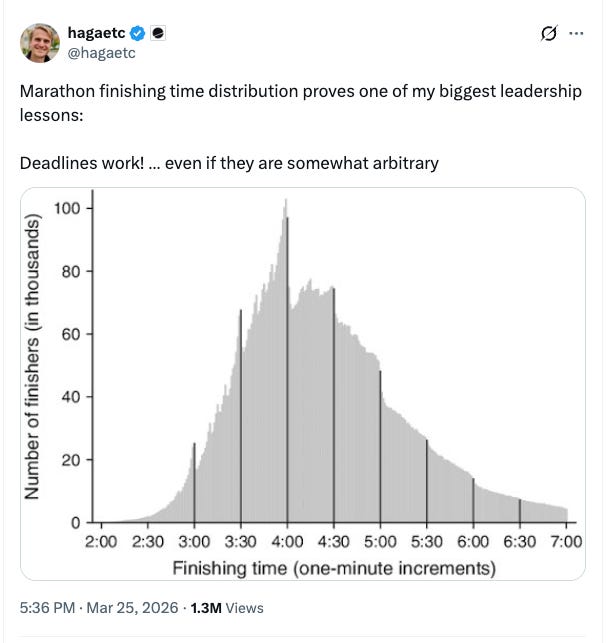
Fascinating data insight into human psychology!
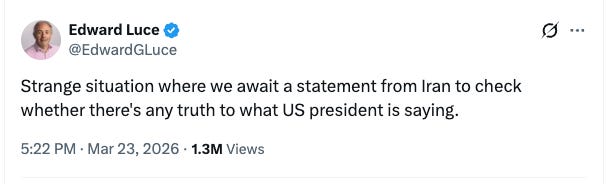
Haha, brilliant observation!
📄 2 Articles of the week
a. ‘Miracle On Soil – Act III: The Coda’ by Sarthak Dev
Sarthak is brilliant as always in this masterpiece that reflects on India’s historic Test win against Australia in the 2001 Chennai Test. (He’d also written about that epic Kolkata Test).
Sarthak writes a beautiful ode to Sachin:
There was a leitmotif to Indian batting in the 1990s. First, a pulsing anticipation; then the intoxicating thrill of watching Sachin Tendulkar tear apart the best bowling attacks in the world, his bat drawing neat and satisfying shapes in the air; and then the hush from his dismissal, as India’s hopes left with him.
The team wasn’t short of batting talent. You couldn’t call a lineup of Navjot Sidhu, Mohammed Azharuddin, Sanjay Manjrekar, Ajay Jadeja, Vinod Kambli, then a young Sourav Ganguly and Rahul Dravid, deficient. But when the stakes rose high, when pressure pressed into muscle, everyone looked at Tendulkar.
India’s two biggest matches from that decade illustrate their Tendependence™.
And this one to Harbhajan Singh, poetic and yet with striking contrast:
Just one year back, after the death of his father, Harbhajan had considered leaving cricket entirely and moving abroad. “I don’t come from a family with a lot of money,” he told Scott Oliver here. “When my father passed away, I could continue with cricket – but I was going through a lot of dramas out there, problems with the cricket board… Or I could take the easy option and go abroad to work. As what? Could be anything: truck driver, labourer, filling petrol, whatever.”
And now, he has 8 wickets in the innings and 15 in the match, taking his series tally to 32. For perspective, India had picked 50 Australian wickets in that series. The next best after Harbhajan’s 32 were Tendulkar and Zaheer Khan with 3.
If you are on X, I would highly recommend that you follow posts by a handle called ‘@oog84_’.
This person writes short posts from the point of view of a caveman called ‘Oog’.
The posts are always engaging, simple, and heartwarming. They are the equivalent of a hot cup of adrak chai on a cool rainy afternoon. Fills your soul with warmth.
Take this example from one of the posts:
fire circle. full tribe. good night. belly full.
somehow conversation turn to “what love is.” everyone got opinion. everyone expert.
dak: “love is when you think about someone first thing when sun come up.”
chuk: “love is when you share last piece of meat.”
young hunter bruk: “love is when your heart beat fast and your hand get sweaty and—”
nana dust: “that not love that infection.”
everyone LAUGH. bruk embarrassed. nana dust not even smiling. dead serious. which make it funnier.
And then this profound one:
“tell oog about childhood.”
nana dust look at oog like oog ask about color of wind.
“what about it.”
“do you miss it.”
nana dust pick at fire with stick. long time. oog think maybe she not going to answer.
then:
“nana dust don’t miss childhood. nana dust miss the weight of it.”
“…the weight?”
“when nana dust was small… a butterfly was IMPORTANT. rain was EVENT. first snow? might as well be world ending and beginning at same time. everything heavy with meaning. a good day was the BEST day. a bad day was WORST day. everything was everything.”
she look at oog.
“then you grow. and butterfly is just butterfly. rain is just rain. you learn the word ‘just.’ that the word that kill childhood. ‘just.’ nothing is everything anymore. everything is ‘just’ something.”
The posts are consistently good. Great going, Oog!
🎧 1 long-form listen of the week
Dwarkesh is an interesting interviewer in the sense that he prepares a lot for his interviews and assumes that the audience listening would also appreciate that. So he does not waste any time setting context about the topic/guest.
He directly dives into the topic and asks high-quality, intelligent questions that the guest will appreciate. This is a very guest-oriented podcast which is focused on the intelligent layperson audience.
Also, Ada is not just a respected academic but also a superb storyteller. Not just in the content (full of analogies, concrete details and present-day references) but also in her delivery. She’s almost like a theatre artist in how she lands some of her lines. You should listen to this podcast just for that.
In this wide-ranging discussion on the European Renaissance, they begin the story with a 14th-century scholar named Petrarch, who was among the first to look towards ancient times for wisdom:
Petrarch reads about the ancient Roman Brutus – not the one who killed Caesar, but the ancestor – one of the first consuls of Rome, who learned while in office that his sons were plotting to take over the state and make him king. So he executed his own sons for treason against the state. Can you imagine Lord Montague wanting to execute Romeo for treason against Verona? He would never do that.
(Petrarch then asked), “Can we recreate the educational environment that produced them?” His students and successors embrace this idea and pour money into travelling across the Alps to look for manuscripts, travelling to Constantinople to purchase manuscripts from the wealthier East – and bringing them back to assemble these libraries and then raise tutors who can surround the young princes and princesses of Europe with these values.
The underlying assumption being that education matters:
This is based on an assumption that education is very much like osmosis, that if you’re exposed to something, you’ll imitate it.
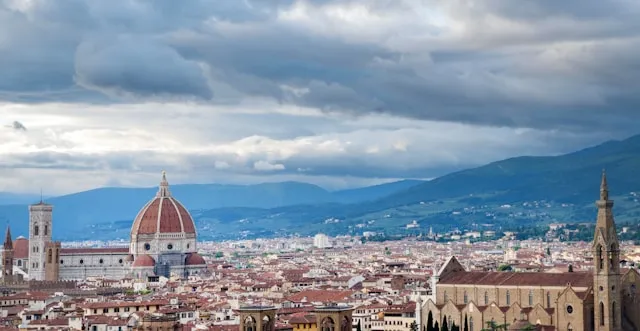
For various reasons, Florence (which was not regarded as a very important city) became the centre for the Renaissance.
Palmer paints a vivid, beautiful picture of what it must have felt like for a foreigner visiting the Medici household in Florence:
…You approach the city. And there are these statues and they look like ancient statues, the kind that are so lifelike that it’s as if they’re about to breathe and move. You’ve never seen an intact new statue like that. That isn’t something we know how to do.
The banker greets you humbly at the door and apologises that his humble palace is not worthy to host your excellency. And you’re like, yeah, it’s not. You’re correct. And he invites you in. And the instant you step inside, you’re in a space like nothing you’ve ever seen before with white light streaming in through this airy, rounded windowed courtyard. That feels more clean and outdoors than the outdoors did.
And off in the corridor are some men wearing robes that look kind of like the robes the ancients wear. And you say, who are those guys? And he says, oh, they’re Platonists. They’re speaking ancient Greek. And you say – ancient Greek? And he says, yes, we have lots of ancient Greek here. And here’s my grandson, Lorenzo. He’s just written a poem in ancient Greek about the three parts of the soul. Would you like to hear him recite it?
And then the call-to-action by Medici:
That’s the moment that Cosimo de’ Medici turns to you and says, would you like to make an alliance with Florence? … Or you could say, yes, let’s make an alliance. Give me a bronzesmith and an architect and a Greek teacher and a Platonist. And we’re going to do the French court like this. And then when the ambassador from Portugal comes, he’s going to feel like an uncultured fool just like I feel right now. The power dynamic just flipped upside down.
The second and third-order effects of new inventions are difficult to predict:
Trains and bicycles come in and we get feminism because it’s easier for people, especially women, to move freely and independently. They can organise. They can mobilise. We get suffragettes. Did the inventor of the train intend for there to be women’s liberation? No. Did it go the way he imagined? No. Did it go well? Yes.
Did you know that Gutenberg—the inventor of possibly the most important innovations of the last millennium—went bankrupt?:
Printed books are a mass-produced commodity in a world that does not have distribution networks for mass-produced commodities. The great example is – technically e-books existed the first time anyone typed a book on a computer, right? Certainly in the 1970s there was such a thing as an e-book. But there was no market for e-books until the Kindle came out and made there be a commodity way to buy and sell e-books.
You’re Gutenberg. You print your Bible. You have 300 Bibles. You sell seven of them to the seven people in your small landlocked German town who are legally allowed to read the Bible in a period in which only priests are allowed to read the Bible. Congratulations, Mr. Gutenberg. You have 293 Bibles and you can’t sell them and you go bankrupt.
Slowly, over time, the distribution problem for books was solved:
Book fairs come into existence in which printers will spend all year printing a book. They go with a thousand copies of their book to a book fair where there are a thousand other printers. They all trade and then they go home to their town with five copies each of 200 books instead of a thousand copies of one book – and then they sell them in bookshops. Things like the Frankfurt Book Fair, which still exists today, developed as the distribution mechanism.
Pamphlets were another lifeline for printers—they were the short-form content of their era:
Printers start printing pamphlets because they can have one press that’s slowly printing a valuable book that will take six months to print. Well, next to it, they have another press that’s printing pamphlets where in two days, they’ve printed a fashion report on what everyone was wearing at the royal wedding, which they can sell right away.
The pamphlet is a way of making money while you’re printing your longer book.
Fascinating conversation that deserves a full listen.
That’s all from this week’s edition.
Photo by Diana Polekhina on Unsplash