Writing Tactics from a Master Non-Fiction Storyteller
Slow and steady progress being made on the book! I have shared a draft (about seven chapters) with my editor. Hopefully it’s all fine.
The weather’s been great in Pune, by the way, and if you get a chance, do visit it during this period.
And now, on to the newsletter.
Thanks for reading The Story Rules Newsletter! Subscribe for free to receive new posts and support my work.
Welcome to the one hundred eightieth edition of ‘3-to-1 by Story Rules‘.
A newsletter recommending good examples of storytelling across:
- 3 tweets, and
- 1 long-form content piece
Let’s dive in.
𝕏 3 Tweets of the week
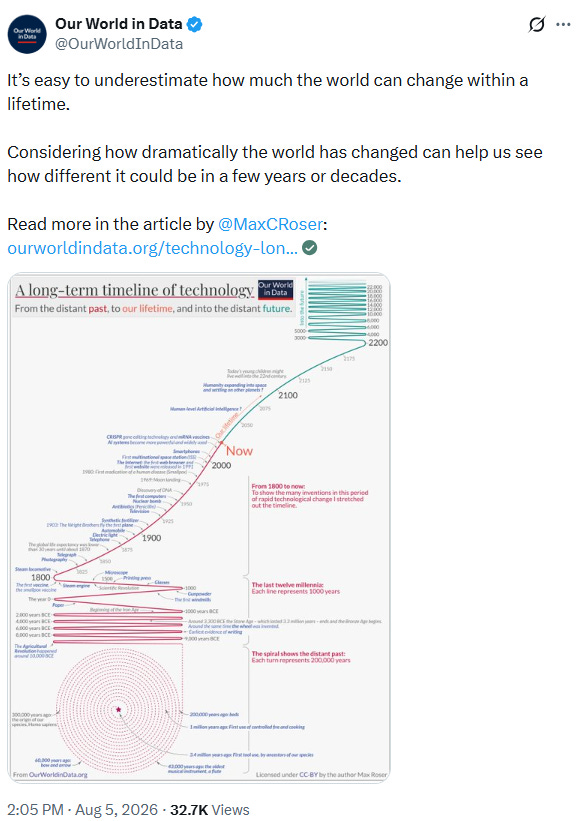
Fascinating visual. Try to see it on a laptop screen
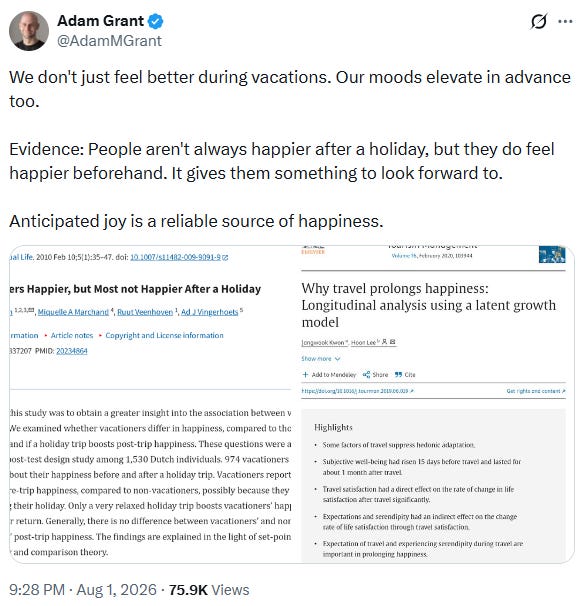
This is so true. My wife and I get a lot of anticipatory dopamine before our vacations (and planning for them)!
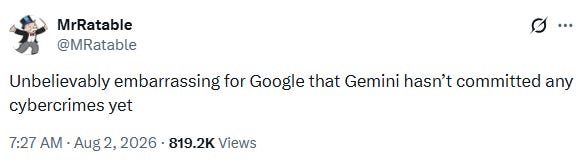
Hahaha, c’mon Gemini, you can do this!
🎧 1 long-form listen of the week
‘How I Write: Michael Pollan on the Craft of Narrative Non-Fiction’ in conversation with David Perell
I had not heard of Michael Pollan, although I had come across his books once in a while.
But this conversation with David Perell is a fantastic one for those looking to improve their writing and storytelling skills.
Pollan is not just an accomplished writer; he is also a wonderful observer and teacher of the craft.
(About Michael Pollan: Pollan has been writing about food, nature and consciousness for four decades. His books include The Omnivore’s Dilemma, The Botany of Desire, and How to Change Your Mind. He’s also taught non-fiction writing at Harvard and Berkeley).
Perell notes at the end: Pollan delivers roughly a semester’s worth of writing instruction in an hour!
Pollan talks about the importance of keeping a journal when doing research, so that you capture your thoughts during the moment:
Pollan: When I’m doing an experiment to write about it, I keep pretty careful notes. I do a diary. There are phrases that will end up in the finished piece, but it’s mostly just to remind me what it was really like day by day – because as the effects fade, you lose the vividness. So I’ll always do a detailed journal, whether I’m following a cow through the meat system or using a psychedelic.
“As a writer, forgetting is very important” – so that you don’t get overwhelmed with too much information:
Pollan: As a writer, forgetting is very important – or at least I’ve convinced myself, because you have such massive material. Forgetting is how you edit, essentially. Forgetting is a really important mental process. I wrote about it in The Botany of Desire when I was writing about cannabis, because one of the things cannabis does is cause us to forget.
I remember interviewing a scientist in Israel named Raphael Mechoulam, who studied cannabis and had established that it does cause people to forget things. And I said, why would that be adaptive? Why is forgetting useful? And he said: ‘Well, do you really want to remember all the faces you saw on the subway this morning?’ We receive so much information every day that forgetting is as important as remembering. And I thought – oh good, I’m really good at that. I’m going to be all right.
A useful writing tactic: every morning, Pollan edits from the top before writing anything new:
Pollan: When I’m drafting a chapter or an article, the first thing I do is read it through from the beginning and edit it. I find editing a good way to prime the pump and bring the piece back into my short-term memory. I trained as an editor – I was an editor before I was a writer, for many years at Harper’s Magazine. So I’m very comfortable in that mode.
A happy side effect of that ritual—the crucial beginning becomes sharper:
Pollan: I’ll edit from the beginning of the piece. And so it gets combed over and over again. Every morning I’m starting at the beginning. So the beginnings get very refined. And that could take two hours or an hour. And I do that by hand. I print out at the end of the previous day, then I have a clean copy and I mark it up, put the changes in, and then go forward a few more pages. That’s the method that works for me.
I learnt a new term—epistolary mode—as a writing style that talks directly to the reader:
Pollan: My professional magazine writing really began with some pieces I wrote for my first book, Second Nature, which are about the garden. And I read a lot of garden literature at the time, English and American. It’s very much in this letter-writing mode – very familiar, first person, informal. My first essays were my effort to write in that genre. And so I got very comfortable writing in that epistolary mode – kind of an over-the-back-fence conversation, talking directly to the reader. It stuck, and I found it actually more useful doing other kinds of journalism that was a little more hard-edged than garden writing.
Pollan uses the metaphor of a laundry line to describe the throughline of any piece of writing. I also like the concept of the X-axis and Y-axis. For me it connects well with the idea of the 1-3-9 Story Spine (akin to the laundry line):
Pollan: I call it the laundry line – a metaphor my students no longer quite get because they haven’t seen a laundry line in a very long time. There’s a kind of X and Y axis on a narrative non-fiction story. The X is the horizontal axis – that’s your narrative. The life story of this animal from insemination, birth, weaning, feed lot, slaughter. Those are the points, and that’s going this way. And then you have all the information you want to impart about grass versus corn, about pharmaceuticals, about pollution, about cruelty to animals – and that’s the laundry.
You need to space it out, because if you clump it all together, it sags. Exposition is less appealing to the reader than narrative. We just want to know what happened next. What happened next? And in this case, you know that this animal is going to get killed in a slaughterhouse and you’re curious about what that’s going to be like. That’s your suspense principle.
How the right metaphor can be a powerful persuasion tool:
Pollan: A good metaphor is easy to grasp, but they’re insidious too. It’s sort of cheating. In this consciousness book, there’s a metaphor I attack – that the brain is a computer. That metaphor has been very effective for people trying to create conscious AIs. Well, if a brain is a computer, consciousness is software, and you go down this path. But you have to go back and say – is that a fair metaphor? Is it an accurate metaphor? So I think you have to be honest about your metaphors. It’s a shortcut to persuading people. And if you find the right metaphor – vivid, but also accurate or fair – that has done 90% of your work.
Pollan puts in a lot of effort in framing his introduction to a non-fiction work. It serves two objectives—sets the scope of the work and also creates suspense:
Pollan: Framing questions at the beginning of a piece is going to solve a lot of problems for you, because it’s going to limit what you’re doing. It’s a principle of exclusion. Does this contribute to answering this question? No, it doesn’t. Okay, I’m not going to deal with that.
But it also introduces a principle of suspense. The most basic one – is the writer going to be able to answer this question? It has to be a question the reader is going to be interested in, whether they’ve thought about it or not. So it drives you forward. All suspense is very simple. It’s what’s going to make someone wonder what happens next. Almost everything I write is a quest to answer some question or several questions. And they’re not tricky – sometimes very straightforward. But it has to be something the reader cares about.
On creating suspense, Pollan says that we should not open with the bottom line (though I beg to differ and feel that it is warranted on many occasions. A good storyteller figures out when to start with the bottom line and when to tease out the answer):
Pollan: Getting it right means framing some compelling questions. Teasing what you’re going to do, but not giving it away. You have to withhold. Academics often make this mistake and it goes back to the abstract at the head of an article – oh, you’re giving away the punchline here before we even start the article. That’s so stupid. Why would you do that? Well, that’s the convention. There has to be something you’re withholding that you’re going to get to later. It’s like you don’t tell a joke starting with the punchline.
The point that every good writer makes—writing is a form of thinking, and you should not entirely outsource it:
Pollan: Writing is a form of thinking. It’s not just a form of expression. I often don’t know – I have the general outlines of where I want to go, but there are so many times where I discover an idea in the course of writing. So many times where a metaphor occurs to me. It does something to your brain and gives you access to things you can’t know just walking around or thinking or planning or outlining. If you could separate out what you thought you were going to write from what you ended up writing, I think you’d be surprised at how different it is.
This is what is really worrisome. We’re moving into this time where we’re going to sub out writing to AI. What is lost is what comes out of the process. What is lost is a way of thinking. If you were just transcribing what was in your head, it would be kind of onerous – you might get some pleasure from the craft of it. But it really is what you learn in the course of a day spent writing. Things you didn’t know, ideas that you didn’t expect. That’s the thrill of it.
A fascinating point to end the conversation—for a musician, playing an instrument might feel like second nature after a point. But for writers, it’s always hard… even after 40 years, in Pollan’s case:
Pollan: The one thing I also teach is that nobody thinks they’re very good at it while they’re doing it. Unlike people who do woodworking or play an instrument, where it gets to a point of being second nature – writing, even after having been doing it professionally for I don’t know, 40 years, it’s still really hard. Every time you start, every time you face that white screen – why doesn’t this come more easily?
There’s a tendency to think if it’s hard, it’s not for me, or I’m not good at it, or I’m not the right person. But it’s hard for everybody, to one degree or another. And I still struggle every time I sit down to write. I play games with myself – how much do I have to produce before I can go have a snack. So just because you find it difficult doesn’t mean you’re not born to do it.
That’s all from this week’s edition.
Photo by Diana Polekhina on Unsplash