Video is Killing the Reading Habit

Slow and steady progress being made on the book! I have shared a draft (about seven chapters) with my editor. With great sadness, I wanted to share that storyteller and good friend Uday Kiran is no more. He passed away suddenly due to a heart attack on Wednesday…
I am shocked and in complete disbelief. Uday was part of my first storytelling open course cohort in 2020, and we had been in touch since then. I enjoyed meeting him in Bangalore during the Clear Writing Community meetup.
I can’t believe that I am talking about him in the past tense. It seems unfair… he left us too soon. May God give his family strength and courage in these difficult times…
I will remember Uday as someone who was always sunny, optimistic and generous. He would also always say nice things about my work, whether it was a LinkedIn post, a podcast, the book, or this newsletter…
Keep heaven entertained with your stories Uday…
Thanks for reading The Story Rules Newsletter! Subscribe for free to receive new posts and support my work.
Welcome to the one hundred eighty-first edition of ‘3-to-1 by Story Rules‘.
A newsletter recommending good examples of storytelling across:
- 3 tweets, and
- 1 long-form content piece
Let’s dive in.
𝕏 3 Tweets of the week
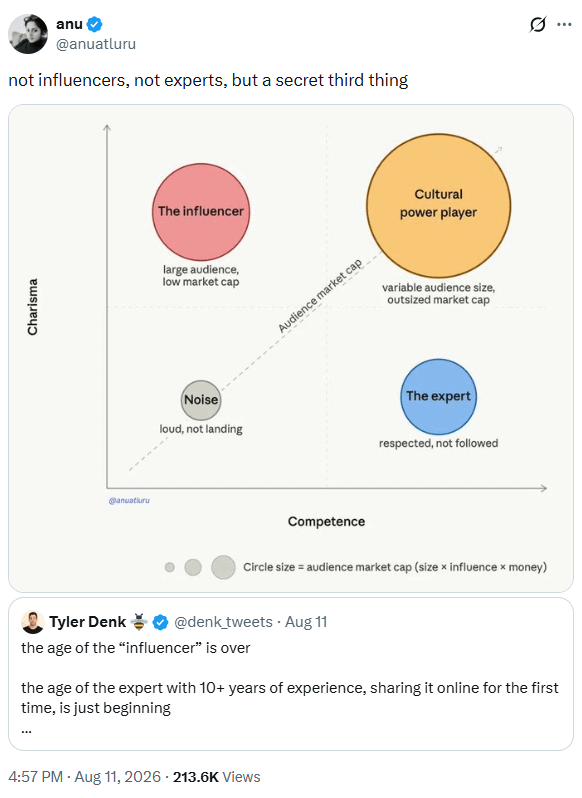
I always love myself a good 2×2 chart.
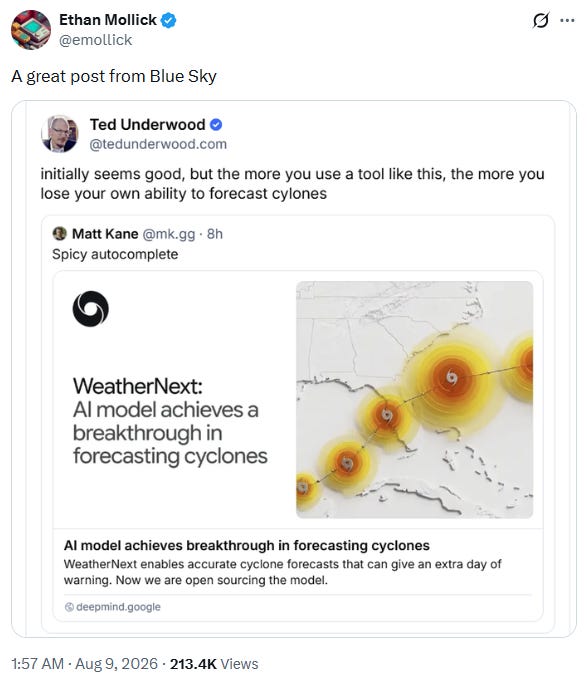
That comment by Ted… 🙂
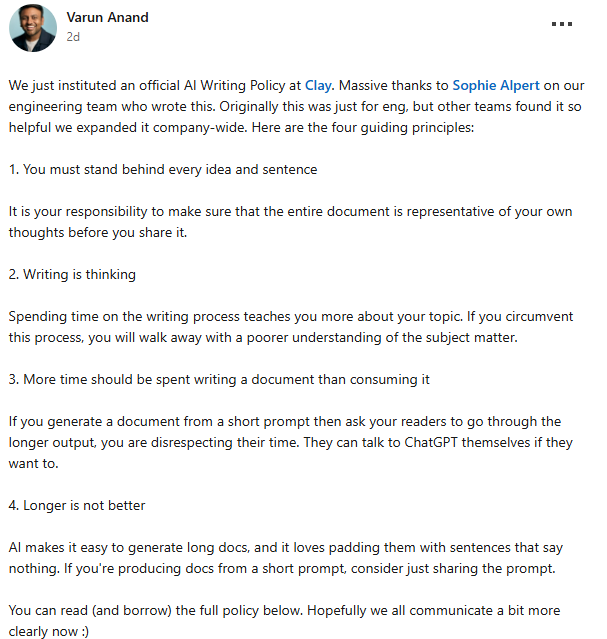
This one is from LinkedIn, but such a good one. I recommend that you click and read it. I wish more leaders put out ‘Writing with AI’ policies like this.
🎧 1 long-form listen of the week
a. Plain English: Rose Horowitch with Derek Thompson – ‘The End of Reading Is Here’
One of my favourite non-fiction writers, Derek Thompson, interviews The Atlantic writer Rose Horowitch about the steep decline in reading in the US.
This conversation goes into some interesting trends in the data and also gets philosophical about the importance of reading and writing and the implications of being in a “post-literate” world. (Hint: It’s all about video)
Thompson lays down the stats on the decline of reading, and it ain’t pretty:
Thompson: The share of Americans who read for pleasure declined by 43% in the last 20 years. While Americans today might see more words than ever between all those texts and posts and emails and captions, less than half of Americans read books anymore. The average sentence in New York Times bestsellers is one-third shorter than it was 100 years ago. Nearly 30% of American adults cannot paraphrase or make inferences from a multi-page text – in 2017, that number was less than 20%. Between 1984 and 2025, the percentage of 13-year-olds who said they rarely or never read for fun increased from 8% to 29%. Reading is in decline. Reading complexity is in decline. Reading comprehension is in decline.
Horowitch: Gambling is now a more common and popular leisure activity than reading.
The conversation shares a fascinating anecdote—in an experiment, English major students could not understand the opening of a famous Charles Dickens novel, despite having access to the internet:
Thompson: Here’s how Bleak House begins. ‘London. Michaelmas term lately over, and the Lord Chancellor sitting in Lincoln’s Inn Hall. Implacable November weather. As much mud in the streets as if the waters had but newly retired from the face of the earth, and it would not be wonderful to meet a Megalosaurus, forty feet long or so, waddling like an elephantine lizard up Holborn Hill.’
Horowitch: This study was of students at some regional universities in Kansas – they were English and English education majors. The researchers asked them to read the first seven paragraphs and talk about what happened. The students really struggled to differentiate between literal and figurative language. A lot of them thought there actually was a dinosaur in 19th-century London. They later describe a man addressed by an advocate with large whiskers, and one student thought that was a cat. Only 5% of the students studied had a detailed literal understanding of what they read.
What’s so interesting about that is they were given access to the entire internet during this process. So they either didn’t know, or didn’t understand, or didn’t put the effort in to figure out what was happening – because they could have looked up any of these unfamiliar references.
A Harvard staff member talks about how students find reading an unnecessary burden:
Horowitch: I spoke with a staff member who works at Harvard who was talking about how students come to her and don’t understand why they’re being asked to read. They think that professors are presenting information in this arbitrarily difficult medium when they’re giving it to them in text instead of giving them a ChatGPT or Claude summary.
Thompson: Margaret Reneke, Harvard’s assistant director for humanities and social sciences support, told you that some students at Harvard University now view reading as an unnecessarily burdensome way to acquire knowledge. She said: ‘By asking them to read, professors are arbitrarily withholding information from students by forcing them to get it through this more difficult medium.’
The issue begins at school. Apart from the usual suspects (devices), shortened reading assignments are also a factor:
Horowitch: Last year in a survey, middle and high school teachers said they assigned usually between zero and four books a year. Instead they’re really encouraged to focus on short excerpts of informational text that can prepare students for standardised tests. Another big change is more and more Chromebooks and laptops and tablets going into schools as books are leaving – 80% of elementary school teachers said students receive a digital device from school by the time they enter kindergarten.
Surprisingly, reading decline is the highest among older folks:
Thompson: David Wallace-Wells, a writer in the New York Times, said the decline you’re describing, while it’s sometimes attributed to young people, actually seems much sharpest among the elderly in the American Time Use Survey. If you decompose the overall decline in reading books by age, the decline isn’t being driven by people in their teens and 20s. It’s being driven by boomers who used to read these novels and now are just watching cable news all night long.
Horowitch: I tried to note in my piece that the decline does cut across demographics, and that these groups that have previously read the most – older people and college graduates and women – have seen really big drop-offs.
Another surprising finding: despite the fall in overall reading, more bookstores are opening, and print sales are up!
Thompson: Book sales themselves don’t appear to be in free fall. Last year, print book sales were higher than they were a decade ago. Barnes & Noble opened more than 60 new stores in the last few years. Almost 400 independent bookstores sprang up just in 2025. How do you reconcile that – on the one hand reading according to surveys and professors is in decline, but also book sales aren’t falling off a cliff and some bookstore categories seem to be growing?
The reason? It’s the Pareto principle at play. The power-readers are making up for the fall among the rest:
Horowitch: When you look at the data, what’s happening is that the people who read are more dedicated to reading than they’ve maybe ever been before. Last year, 20% of all Americans accounted for 80% of all the books that were read. They even spend more time reading than they used to. They seem to identify more closely as readers than people used to. But they’re becoming a smaller and smaller minority in society.
The conversation then moves to deeper questions—why do reading and writing matter:
Horowitch: Walter Ong looked at what happened when reading and writing first emerged 6,000 years ago and made the argument that reading and writing are fundamentally different forms than speaking. People write a lot slower than they speak, so it forces you to slow down and reflect. It separates the writer from what they’re writing, so you can spread information much more dispassionately. You can also go back to a piece of writing in a way that you can’t with something you said – you can edit it or think about it again. He argued that this ushered in a new mode of rational, linear and analytic thought that was necessary for a lot of the things we take for granted now – for philosophy and modern science and a lot of academic disciplines.
Horowitch gives a fascinating example that illustrates the importance of reading and literacy:
Horowitch: Luria posed syllogisms to peasants who were starting to receive reading instruction. The most famous example is – all the bears in the far north are white, this place is in the far north, what colour are the bears there? The literate peasants could all answer. But the ones who had never even started to learn how to read refused to answer. They said they’d never been there, because their knowledge was much more situational. Print cultures and literate cultures do value this kind of sustained linear argumentative thinking that you just don’t find in oral cultures.
As for video, our brains are more active when reading vs. watching a video:
Horowitch: I spoke with a neuroscientist who did brain imaging of children between three and five as they took in stories through different formats – first as an animation, and then looking at static photos while listening to the story being read to them. The children who watched the animation had much less activation in the areas of their brain associated with learning and with imagination. Because the video was already presenting everything to them, they didn’t have to fill in anything. It was a much more passive way. It demanded less thinking and creativity.
To be fair, Thompson argues, there may be some different unseen benefits of shifting to video:
Thompson: In attempting to steel-man against my own instincts – the same way that literacy changed our brains and made us better at abstract reasoning, it seems possible that the shift toward video, even short-form video, will outfit us with different cognitive skills that were undeveloped among our ancestors.
Horowitch: The same researcher who found that our abilities to answer logic questions and analyse patterns had declined over the past two decades, she actually found that people were getting better at some forms of spatial reasoning. So it wasn’t a clear-cut ‘we are just getting dumber and worse at everything.’ There are some things we’re practising and selecting for that we’re actually improving at.
Finally, to take a realist perspective: Reading is down. Video is here to stay. We had better adapt:
Thompson: The most important shift we’re seeing is not just that 17-year-olds cannot read Charles Dickens… The most interesting thing is that the most powerful people in the world are adopting the values of television, not the values of literacy.
David Plouffe, an architect of Barack Obama’s presidential campaign, writing in the New York Times: ‘If it cannot be communicated in an Instagram post or a 10-second TikTok, go back to the drawing board.’ That’s Plouffe essentially saying – yes, we have a nation of 100% literacy, but people don’t want to read stuff. You need to tell it to them in four seconds and then move on.
That’s all from this week’s edition.
Photo by Diana Polekhina on Unsplash