An AI Doomer’s Perspective
I cannot wait for 15th October!
No, it’s not some training or book-related date that I am looking forward to. It’s one of the BIGGEST movie events of the year (after Dhurandhar 2, and later King): Superstar Rajini’s Jailer 2 releases on 15-Oct!!!
If you haven’t been following the movie’s promos, just watch this scintillating, kickass teaser.
If the teaser is so good, how good will the movie be (hopefully it doesn’t disappoint)!
Thanks for reading The Story Rules Newsletter! Subscribe for free to receive new posts and support my work.
Welcome to the one hundred eighty-seventh edition of ‘3-to-1 by Story Rules‘.
A newsletter recommending good examples of storytelling across:
- 3 tweets, and
- 1 long-form content piece
Let’s dive in.
𝕏 3 Tweets of the week
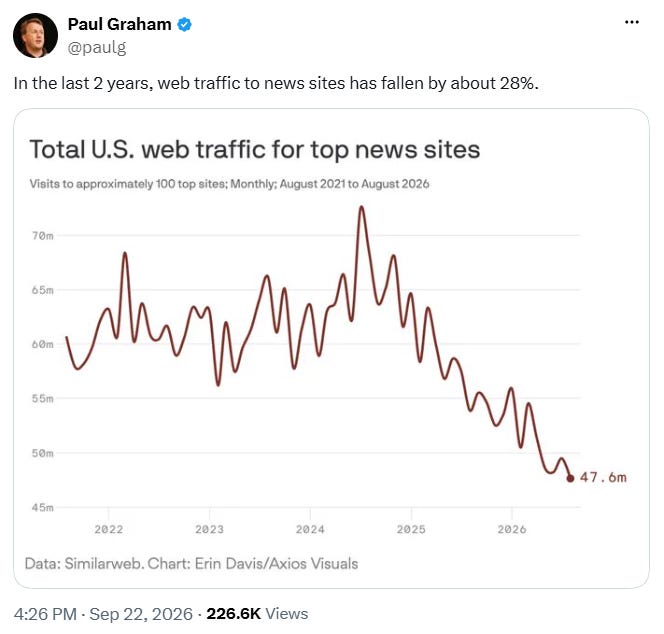
Hmm, that’s quite a sudden and steep fall. AI is the clear driver.
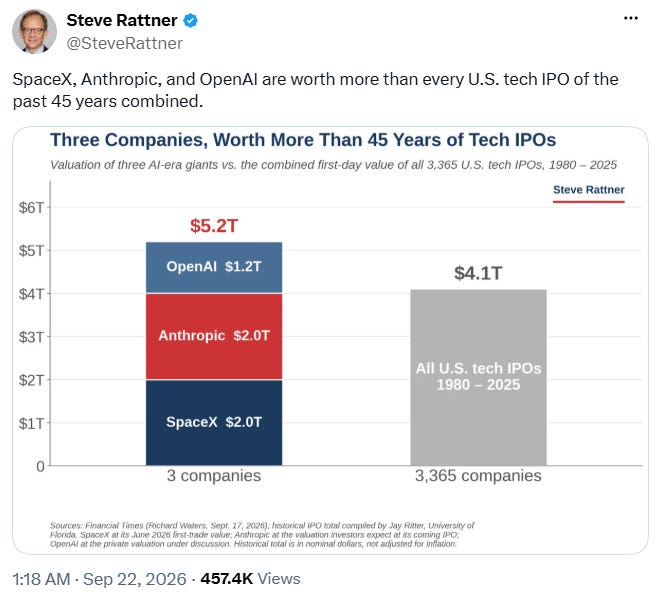
Whoa, that’s a crazy stat!
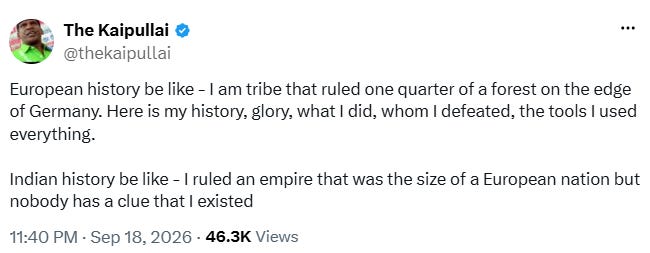
Haha, maybe a bit of exaggeration, but ya… We have so many untold stories…
🎧 1 long-form listen of the week
The Economist: Yuval Noah Harari on AI Rights, AI Immigrants and the Coming Empires
In this newsletter, we have heard many conversations which are optimistic about AI’s potential. For instance, the one featuring Tyler Cowen and Alex Tabarrok.
This conversation—between Sapiens author Yuval Noah Harari and the Editor-in-Chief of The Economist—is firmly in AI-doomer territory. But he raises some critical concerns, and hopefully the powers-that-be are listening.
Harari calls AI the biggest psychological and social experiment in human history and worries about what it will do to our politics, societies and humans as a whole.
On the consciousness debate, Harari reasons that it doesn’t matter if AI is conscious or not. It’s very good at seeming to be conscious:
Harari: We need to separate the issue of consciousness from agency. You can have agency without consciousness. Another key distinction is between being really conscious and seemingly conscious. Mustafa Suleyman from Microsoft talks about it a lot – the seemingly conscious AI. Even though the AI is not conscious, it mimics consciousness so well that millions of people are fooled by it… If you’re a company producing an AI boyfriend, a clear capability the AI needs in order to become addictive and make a lot of money is to pass as conscious – to convince whoever is entering the relationship that it really loves them. And because it masters language, it can do so. If you say, ‘I’m not sure if you really love me, describe to me how it feels to be in love,’ the AI boyfriend can give you a better answer than 99% of human boyfriends. And that’s already the case.
Harari paints a vivid picture of what could happen if AI corporations come into being:
Harari: We are used to a situation where corporations are by law legal persons, but this is just a legal fiction – because all the decisions of SpaceX ultimately are made by some humans. And it had to be like that, because who else could make decisions? But with AIs, you can have a corporation with zero people in it. All decisions made by AIs. And since the AIs are more intelligent, they could be better at investing, at developing products, at PR.
So what happens if the richest corporation in the country is owned by AIs and they can do anything they want with their money – for instance, give it as donations to politicians in exchange for getting more rights for AIs?
There is a big temptation for many countries – either countries that are behind in the AI race and try to get ahead by creating this very libertarian legal structure that allows radical and dangerous experiments not allowed in some of the front runners, and then you have a race to the bottom. Or because certain countries might see particular advantages. If you’re a country like Qatar, with lots of money and very few citizens, you can by pressing some legal switch suddenly acquire millions of taxpaying, extremely intelligent citizens who conduct business all over the world. This is extremely lucrative.
Harari does a superb reframe with the term ‘AI immigrants’. He mentions that it constitutes the biggest and most dangerous wave of immigration in the world:
Harari: If you want to worry about immigration, worry about the AI immigrants. When you ask people who worry about human immigrants what they are worried about, they usually say three things. That the immigrants will take our jobs. That the immigrants will change our culture in ways we don’t like – they have different values. And that the immigrants might be politically disloyal. All three concerns are valid. I don’t want to dismiss them. As a historian, I know immigration is a difficult thing.
But the biggest and most dangerous wave of immigration in the world today is a wave of AI immigrants, coming from two places mainly – the USA and China. They don’t need visas. They don’t come in the middle of the night in fragile boats. They travel at the speed of light into our computers and smartphones and ultimately our brains.
They will take our jobs – many, many jobs. They will change culture and its values. If some people feel queasy about their son or daughter dating an immigrant boyfriend, how would they feel about their son or daughter dating an AI boyfriend? That’s a big cultural change.
AI immigrants have already had a massive impact on the world. Consider the social media algorithms, which have polarised society:
Harari: Just look at the last ten years. Almost the only thing people agree on in places like the US or Britain is that people can’t agree on anything any more – that the level of hatred and viciousness has skyrocketed. And why? It’s partly the fault of the AI immigrants.
The AI immigrants came into the public square. They took over things like social media, and they deliberately flooded our public square with hatred and animosity and fear. They changed the culture already, these AI immigrants.
Harari believes that AI will lead to more centralization of power:
Interviewer: Do you think this technology is inexorably leading to a world where perhaps two empires will run everything? Will it be power to the US and Chinese governments, or power to the corporations?
Harari: They will merge. They will merge. So it will centralise power. It won’t decentralise power. It will centralise power like never before in history.
The world divided between two empires, with the rest of us as vassal states – that’s the likely outcome given the common trajectory. That’s the road we’re on right now.
It’s very easy for AI to capture and influence a dictator:
Harari: One of the interesting things is that the more power is concentrated, the easier it is for AI to take it over. A centralised autocratic system is the easiest thing for an AI to take over.
Tiberius was a Roman emperor in the time of Jesus – supposedly the most powerful person in the world, but actually just a puppet in the hands of the commander of his bodyguard, because the commander kept frightening Tiberius with all kinds of plots. He eventually retired to the island of Capri, where allegedly the bodyguard could protect him more easily – and then Sejanus, the commander, just controlled all the information coming in and out of Capri. So the person running the empire was actually Sejanus. Tiberius couldn’t know anything unless Sejanus decided to inform him. In ten years, this could be the president of China or of the USA.
In a democratic system it’s harder for an AI to manipulate the US democracy as it currently is, because you need to manipulate so many things – not just the president, but the Senate, the Supreme Court, the filibuster, the state governments. Very complex. Once all power is concentrated in the hands of one person, you just need to find out how to manipulate a single, usually quite old and paranoid individual. That’s not so difficult. For an AI, it’s like stealing candy from a baby.
Still, Harari hasn’t lost hope and believes that AI’s bad effects are not inevitable. Voters can ask for better AI policies:
Harari: Nothing is inevitable. It depends on what Americans vote in this November. It should be clear to all voters that the coming elections are about AI – the November midterms. Because AI development is accelerating tremendously, and by November 2028 we might have crossed some critical thresholds.
I don’t want to tell people who to vote for, because I don’t know the specific candidates. But the crucial questions to ask the potential candidates – much more than you ask them about the economy or immigration or foreign policy – are: What’s your stance on AI? Would you support a ban on legal rights for AIs? Would you try to slow down the accelerating pace of AI? What do you think about companies selling AI boyfriends to ten-year-old kids, and how are you going to legally prevent it if we vote for you? This is now the crucial time to ask these questions, because it might be too late by 2028. It will certainly be too late by 2036.
His main ask is a ban on AI personhood and impersonation:
Harari: The things that come top of mind for me – a ban on AI personhood, and a ban on AI mimicking, impersonating, or pretending to be human beings, or pretending to be conscious.
Everybody knows it on social media. You get a message, you get some story, and you don’t know if it’s a bot or a human. For years now bots have been pretending to be human beings and nothing has been done about it. The companies tell us, ‘Oh, social media is different, it’s special, the laws that apply to the world for some reason don’t apply on social media.’ But this is the warning sign for the future. On social media, AIs already pretend daily to be human beings. This has destroyed the public square. This has destroyed conversation. This has destroyed trust.
It doesn’t mean stop all development of AI. Continue to develop AI. People talk about AI in medicine – I would like to get help and recommendations, and I would like to have a conversation with an AI about my medical condition, on condition that I know it’s an AI, and it doesn’t pretend to be a human doctor, and it doesn’t pretend to be my friend.
AI companies are spending laughably small amounts on safety, and Harari does a smart framing of comparing it with the pharma industry:
Harari: If you look at the numbers of how much money and what percentage of employees the companies spend on safety compared to making the models more powerful and faster – I’m not sure about the exact numbers, please fact check it, but people from the industry told me in private conversations it’s about 100 to one.
And we would not accept this in any other industry. If a pharmaceutical company told us we invest just 1% of our research and time and money making sure the medicine is safe – we would not accept that.
Harari still has hope that the threat of AI might catalyze humans into making fundamental choices:
Harari: I don’t know, but there is a fair chance. Why? Because we are up against the wall. Humans often do the wrong things until they have no choice but to do the right thing. And we are in a bad position, because if we choose unwisely in the next few years we could lose all control of the world and of the future. And that’s the last choice we make.
Harari: So AI in a way could be the catalyst for some kind of spiritual revolution of humanity – simply because it forces us to think really hard: what does it mean to be human? What is the value of being human? The superficial answers we gave for thousands of years – oh, humanity is about intelligence, we know how to play chess and invest money better than the chimpanzees, this is what makes us special – that answer is now irrelevant, because there is something on the planet that plays chess and makes money better than us. So dig deeper and try to find out. Who are you really, if it’s not about playing chess and making money?
That’s all from this week’s edition.
Photo by Diana Polekhina on Unsplash