The End of Reading
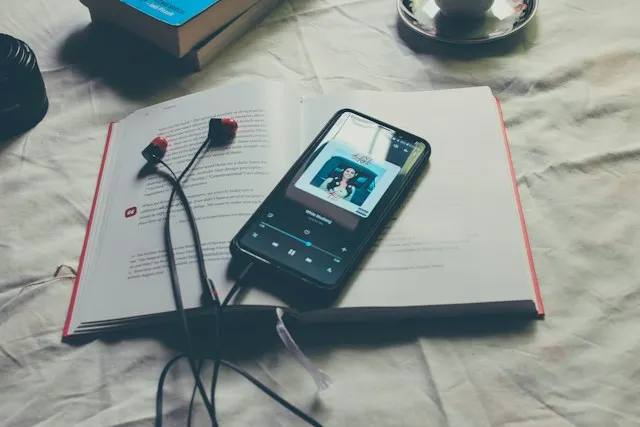
I have completed a very basic first draft of the second book and now am going to be spending time making some more additions, refinements and deletions.
I’m still not at the ‘take-printout-and-edit’ mode yet… that should happen in a couple of weeks, hopefully. That’s the stage that I enjoy the most!
Thanks for reading The Story Rules Newsletter! Subscribe for free to receive new posts and support my work.
Welcome to the one hundred and eighty-eighth edition of ‘3-to-1 by Story Rules‘.
A newsletter recommending good examples of storytelling across:
- 3 tweets, and
- 1 long-form content piece
Let’s dive in.
𝕏 3 Tweets of the week

Whoa, that’s a crazy stat. (And great use of visual hierarchy in that chart)
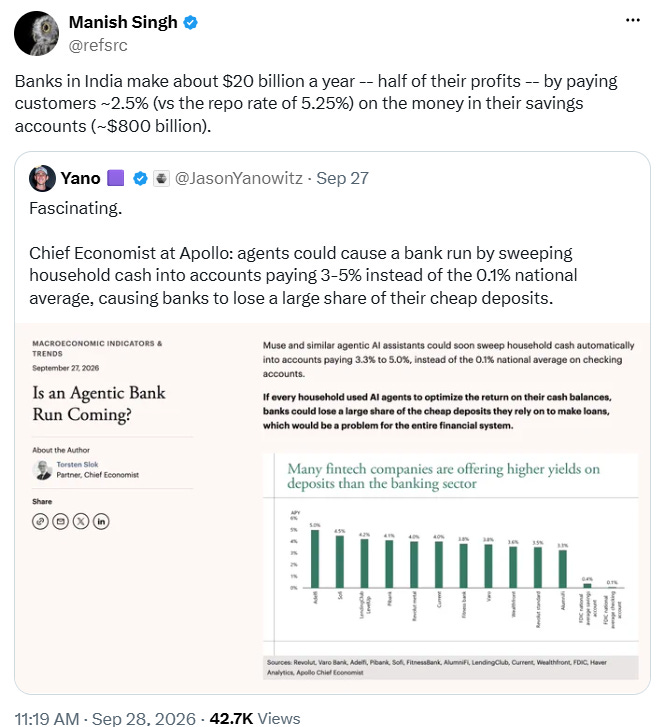
Fascinating. AI Agents could signal an end to ‘easy money’ for banks.
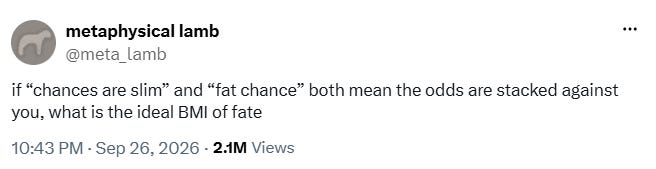
Superb. This was always there for anyone to make the connection!
📖 1 long-form read of the week
a. The New Dark Ages: The End of Reading and the Dawn of a Post-Literate Society
In an earlier post, we had covered a Derek Thompson conversation about the rise of video and the end of reading. This book by journalist James Marriott goes much deeper into that phenomenon and makes some profound (and worrying) observations.
Marriott also talks about his book in a few podcasts, and I (partly) heard two of them—EconTalk and The History of Bad Ideas. Both are great introductions to the book’s ideas, if you don’t get time to read it.
Here are some extracts from the book (and also from the podcast episodes).
Did you know about the time when… reading was a mass addiction?
What was happening was this: in the middle of the eighteenth century it suddenly seemed that everyone, everywhere had started to read. These new readers, one onlooker thought, seemed as ‘addicted’ to their reading habit as any gambler, smoker or drunkard. Respectable ladies neglected their household duties because they were transfixed by ‘poems and periodicals’.
(Take that last sentence. Replace the last three words with ‘smartphones’, the first two words with ‘Everyone’, and remove the word ‘household’ to describe our current era!)
Cut to today—and undergrads, even in the English department, are struggling to read:
…few years ago I began to hear that students were struggling to read the books their professors assigned to them. The idea was so persistent it seemed that this was more than the professional pessimism normally associated with lecturers in English literature. I got in touch with some senior academics teaching in English departments to follow up the issue for an article in The Times.
A conversation I had with one of them still stands out. ‘I used to expect students to easily read a novel in a week,’ she told me. But recently she had begun to realise that ‘I just can’t expect that any more.’ The university undergraduates she taught were having trouble concentrating on long texts to the point that it was becoming impossible to assign some of the classic books she had been teaching for her entire career.
Instead, we are all becoming slaves to the irresistible wiles of moving images and sound, especially stuff that is short in duration. Marriott traces the beginning to the launch of television (in the conversation in the ‘History of Bad Ideas’ podcast):
Marriott: People are talking about the age of video and the death of literacy a lot at the moment because of this short form video phenomenon. I think that story is actually a much longer one, and it begins in the 1950s and 1960s with the advent of television. Some of the best data comes from the Netherlands, where people were measuring leisure time use. In the 1960s as TV was introduced, TV viewing rose from about 10 minutes a week to more than 10 hours in the space of a decade. Over the same time, average time spent reading fell from 5 hours a week to 3 and a half – which from the perspective of 2026 still sounds like quite a lot of time spent reading. The short video smartphone revolution we’re in now is the latest stage of a much longer-term cultural trend which is 60 or 70 years old.
In the same podcast, Marriott refers to Marshall McLuhan’s assertion that the age of literacy is an aberration and we were always meant to go back to an oral culture. Marriott does not go so far, but agrees that reading and writing will become much less important:
Marriott: This idea that literacy was basically an aberration in human culture, and that we’re going to return to something that looks much more like culture as it existed before literacy, comes from Marshall McLuhan originally. He had this idea that there was something deeply unnatural about literacy – the way it structures our world, our information, our communication – that it was basically an aberration in history. I think people overdo this idea. It’s become a bit of a meme online, and there’s something quite attractive about the idea that we’re going to return to this oral world of heroic fighting and storytellers. I think that overdoes it. Walter Ong uses the phrase secondary orality. It’s not that we’re literally all going to become illiterate and return to listening to bards over TikTok. We’ll all still be literate, we’ll all still learn to read at school – but it will become much less important.
What’s wrong with only listening to podcasts instead of reading books? Well, for one, podcasts tend to be rambling and not always coherent because of the oral medium:
Marriott: The rambling nature of talk radio and podcasts is partly a symptom of a culture where people’s attention is shattered in some ways, and yet they retain this enormous attentional capacity to deal with Joe Rogan rambling on for three hours. When you listen to Joe Rogan, you’re not hanging off every single one of his words. You’re wandering around the house. It’s on in the background. You tune in and out. The extremely verbose, repetitive, rambling nature of those shows allows you to not fully concentrate.
Runciman: And repetition is the key. The thing I couldn’t believe about Rush Limbaugh is not just that it lasted for three hours, but that he said the same thing 300 times in those three hours.
Marriott: One of the characteristics (cultural historian) Walter Ong identifies as really characteristic of pre-literate cultures is this very repetitive and rambling style of communication – for the obvious reason that when you speak, you just can’t structure your thoughts coherently. So you tend to come back and re-clarify for your audience, and take multiple attempts at saying the best version of what you can say. Ong never lived to see podcasts, and yet his description of communication in oral societies – verbosity, repetition, rambling, lack of logical argument – he could be talking about Joe Rogan.
Writing forces you to structure your thoughts—and makes it easier for the reader to understand:
Marriott: This idea that you make a point and move on and make the next subsequent logical point, and the argument develops linearly – Ong argued that is an invention of the written word.
Reading is hard and unnatural, while watching videos is easier:
Marriott: Reading is a really unnatural thing to do. Absorbing language through your eyes is, as every neuroscientist of literacy points out, not something our brains were designed to do. It takes a lot of cognitive processing power. To look at printed text and turn that into language in your mind is quite hard, and you have to learn how to do it. You don’t have to learn how to watch TikTok. And reading never stops being cognitively taxing.
But we should still treasure this critical skill that it took us centuries to build, because of its unique benefits:
Writers painstakingly go over their thoughts until they have worked out the best version of what they want to say. And because readers have the words fixed in front of them they can subject them to more scrutiny.
No medium other than writing can contain the same density of argument, the same level of abstraction or the same intellectual rigour. To lose reading would be to risk losing the complex and sophisticated kinds of thinking that underwrite our entire civilisation.
Let’s hope we can resist the lure of video and set aside time for this very human and joyful practice.
That’s all from this week’s edition.
Photo by Diana Polekhina on Unsplash