
How ‘Billion-dollar PDFs’ move money

I was in BLR this week for a workshop and came across this hoarding—only possible in BLR!

Btw, a Toit (Indiranagar) visit was made, and respects were paid to their recently launched ‘New World IPA’. The OG IPA is still better imho, but this new one also packs a punch!

Thanks for reading The Story Rules Newsletter! Subscribe for free to receive new posts and support my work.
Welcome to the one hundred eighty-fifth edition of ‘3-to-1 by Story Rules‘.
A newsletter recommending good examples of storytelling across:
- 3 tweets, and
- 1 long-form content piece
Let’s dive in.
𝕏 3 Tweets of the week
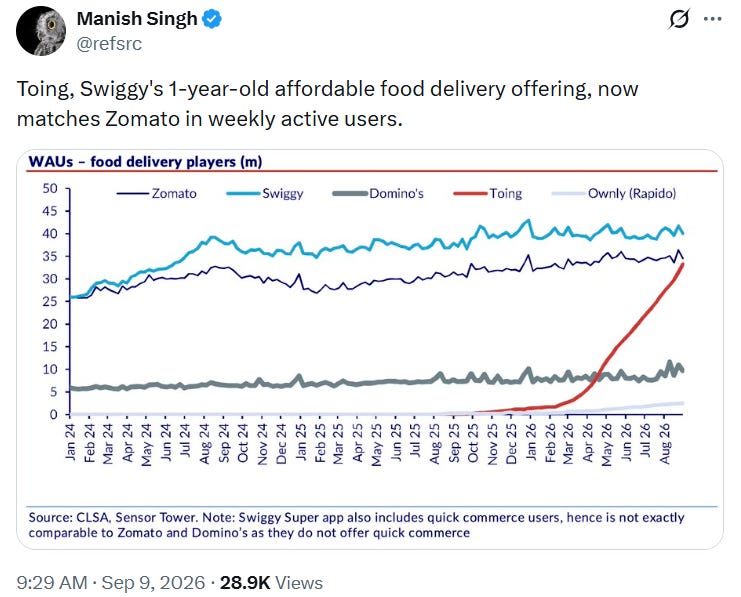
Fascinating to see the stupendous rise of Toing.
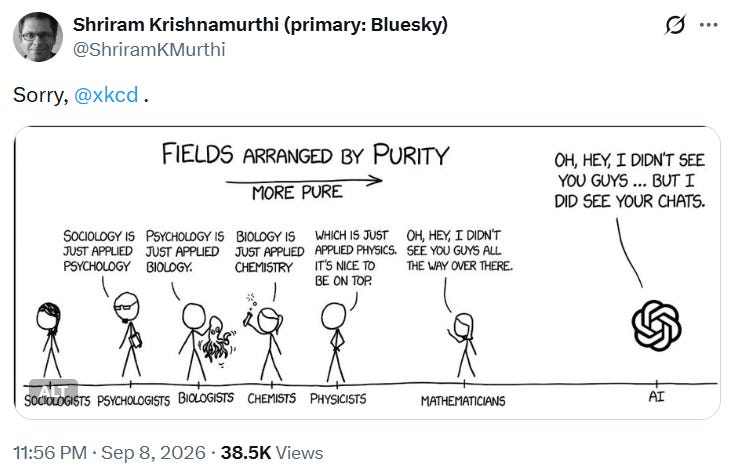
Hahaha!
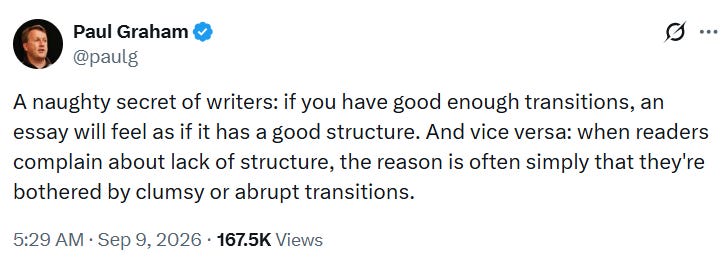
Yep, transitions matter!
🎧 1 long-form listen of the week
a. Invest Like the Best: Everything in Capital Markets is Downstream of Algorithms
This is a conversation between two Silicon Valley investors (Jeremy Giffon being interviewed by Patrick O’Shaughnessy) and provides a fascinating perspective on how the world is changing.
I like the concrete formulation of the power of ideas through the “Billion Dollar PDF”.
Storytelling ability is a key differentiator for funds, since their product—cash returns—takes time to be delivered:
Giffon: …in long-term private markets, the great filter so to speak for funds is their storytelling ability. Fundamentally, because their product – which is realised cash returns – takes a decade. And so the thing that you’re selling in the interim, whether it’s through a quarterly update or your event or just your one-on-one conversations with your LPs, is really just narrative.
I like how Giffon paints the picture of investors being like football players following the ball (the big idea or the “billion dollar PDF”) around the field:
Guest: Every once in a while someone basically crystallises a notion, right at the right time in the right way, that becomes the foundational viewpoint or opinion on a certain era. Everyone’s a little bit uncertain, everyone is a little panicked, they don’t know what’s going on – and someone just needs to sort of set the story and set the narrative. And it doesn’t even have to be right. But there’s just a sort of confidence of, this is what’s going on, this is happening, follow me almost. When those come together, they set a new narrative that everyone can rest on for a period – really until the next PDF comes along.
The billion dollar PDF thing is this idea that you can form billions of dollars of capital, in one way or another, around simply setting a new idea. You can think of capital as like ten-year-olds playing soccer – they all just follow the ball around. Capital just follows the billion dollar PDF around the field.
In this world of investing, journalism, entrepreneurship and technology, clearly X (Twitter) matters. Giffon here makes a strong case for its importance and why posting matters:
Giffon: What people don’t appreciate about X is that everyone gets served the same 500 tweets per day, and it’s hundreds of millions of daily active users. The thing that people who don’t post don’t realise is just how enormous the poster-to-lurker ratio is. It’s really hard to feel the impact unless you’re actually getting onto the feed and seeing all the people that you didn’t know were reading X all day commenting on your thing. I’m always surprised when I post a good tweet and whoever texts me about it – it could be someone I know well and I had no idea that they read Twitter all day. But everyone reads Twitter all day.
Guest: X is … probably is never going to reach the scale of the others, but it fills this vital role. It’s still sort of more important than ever – just a source of truth almost for the whole world. Everyone is reading the same thing. It’s the global newspaper. In the same way that people would talk about the latest article in the Journal 30 years ago, now it’s the latest tweet or the latest essay on X.
Guest: All the most important people in the world – at least when it comes to capital markets and politics and journalism and entrepreneurship and technology – they’re reading their daily paper every morning. And these things really form opinion, and they price securities, and they dictate where capital flows, and they certainly write policy. Your institution will only survive if it’s timeline-native.
Giffon calls posting the “last great meritocracy”:
Giffon: One of the things I get emails about the most is a comment I made somewhere about how posting is the last great meritocracy. I get emails about that because people are like, that really clicked in my head and I started posting – and posting changes your life if you’re good at it. That’s still true today, maybe more true than ever.
In the old times you had to grind away and build this huge following, and then by virtue of having a big following you could post a really inane tweet and it would be very popular. But that doesn’t happen anymore. Now you can literally be a new account and just write a good post, and the algorithm selects you and displays you in front of 500 million people.
What gets attention is the most compelling story:
When there’s uncertainty, people are just looking for – what is the story? What is the most compelling story? And the way it works on the timeline is it’s not this well-considered book that comes out that everyone talks about for a year. It’s what is the thing that sounds smart, feels good – and it has to be entertaining. Maybe that’s another change. A good post has to be very entertaining, because people are on the timeline to be entertained. They can lie to themselves and say they’re on it for other reasons, but it’s just to be entertained, and that’s obviously what the algorithms are selecting for.
The need to be seen and post online is also applicable to politicians:
Ben Sasse, the former senator, has this great notion that Washington is now mostly people who want to be TikTok and YouTube stars – that’s mostly what congressmen and senators want to be. And he condemns it, which is true in some very simple sense, because you would hope that congressmen and senators are primarily interested in governance. But they’re not.
Past administrations would be addicted to polling – which is all about understanding the wants and desires of the median, the average person. The timeline shifts back to a more Republican model, where you’re caring about whatever it is a few hundred thousand people who are influential think. The people who do well in politics now are just optimised for content. They’re basically content creators, because the polling is the timeline.
Giffon makes a strong claim—society keeps looking for high priests. From scientists that position moved to billionaires… and is now moving to content posters (also why many billionaires are creating content!):
Giffon: There’s always a role for priests in society, and we’ve been looking for new priests. We tried scientists as priests – the scientific project has fallen apart a little bit. We looked to physics as hopefully going to provide us meaning. It hasn’t. Physics has largely stalled since the war. So there’s this billionaire class that we’ve looked to as the new source of meaning. On its surface it doesn’t make a lot of sense that we would spend so much time caring about what billionaires think about physics or theology or health – topics unrelated to accruing a billion dollars. But the reason we do is that this is our new priestly class.
I think we’ve had enough of the billionaire. Part of it is that they’ve gotten way less scarce – state-of-mind billionaires have probably grown 100x in the last 20 years. This notion that I want to catch every podcast with this billionaire and study his routines and habits has come to full saturation. It feels unlikely that there’s a marginal billionaire I’m going to learn something very interesting from on a podcast. I don’t think that was the case six years ago.
You can always look at which class is subservient to the next, to see who’s next. The science class became subservient to the billionaire class – this is certainly the Epstein lesson, all the scientists clamouring around the money and glamour. And now I think the billionaire class has become subservient to the posting class.
I was at this thing a while ago and it was a bunch of billionaire investors, and they were all fighting over who could sit next to Tyler Cowen, because he’s the most interesting person there.
Because of short attention spans, content consumption is all going towards short takes:
Patrick: I heard this interesting story about a publication that has millions of readers, and the person behind it told me something like 95% of the readers are people that scroll through the quote highlights on Instagram. And they’re still a reader. To me it’s all quite depressing, that the world of posters and content has reoriented around this monolithic timeline and they’re all just feeding it what it wants. But that’s the game you sort of have to play.
Giffon: You can imagine a world where there’s a few clips from a podcast but no one ever listens to the podcast – and I don’t actually think that would diminish the value of the property. Everything is being processed and packaged for catching attention, but taking the least amount of that person’s time.
Why the very rich are now starting podcasts:
Giffon: One way you could look at it is that once you accrue wealth, you want to accrue fame. The other way of looking at it is that wealth is less valuable, and you actually realise that the scarce asset is attention and influence. So you’re almost hedging against the rapidly devaluing nature of your money and trying to switch to what is actually scarce.
This is a great framing of the impact of venture capital:
Giffon: Venture capital has created the biggest businesses in the world, and private equity has not. Where private equity has, it’s largely been through acquisition and financial engineering. So it’s inarguable that venture capital is a much better force for the world. It’s this tiny little asset class that has produced all the most important things in the world.
It’s also this sort of civilizational technology – which is, you’re willing to give young people millions of dollars to try a very speculative idea, with basically no retribution or downside if it doesn’t work. So it’s clearly this amazing force.
After speaking so much about X and other social media, Giffon shares that his own most important source for information is through conversations with people:
Giffon: For me, by far the most generative thing is conversations, which I guess are downstream of relationships. Part of the reason my book reading has gone down is I’m friends with a lot of people who read a lot of books. If I could only keep one thing, it would be conversations with people that I find interesting.
That’s all from this week’s edition.
Photo by Diana Polekhina on Unsplash