The One-word Explanation for Why the World feels Weird

Boy, it’s been a troubled week in India. I hope that the brave protests and agitations by the youngsters don’t go in vain and that we see some structural reforms.
And now, on to the newsletter.
Thanks for reading The Story Rules Newsletter! Subscribe for free to receive new posts and support my work.
Welcome to the one hundred seventy eighth edition of ‘3-to-1 by Story Rules‘*.
A newsletter recommending good examples of storytelling across:
- 3 tweets, and
- 1 long-form content piece
Let’s dive in.
𝕏 3 Tweets of the week
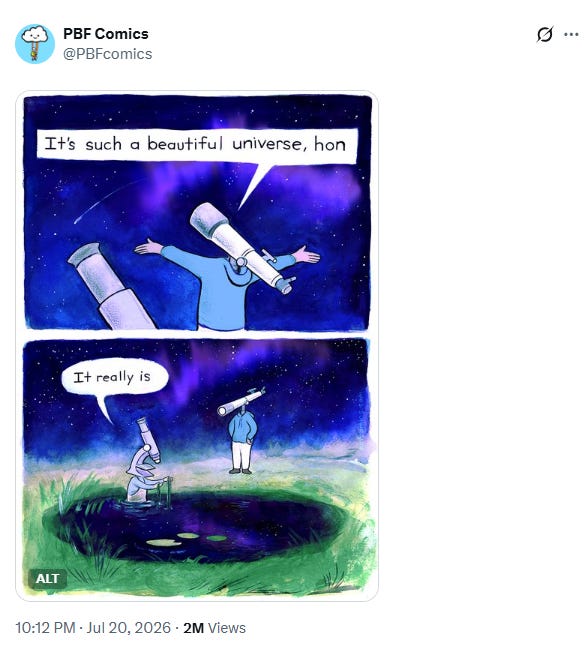
Lovely example of zooming out and zooming in!
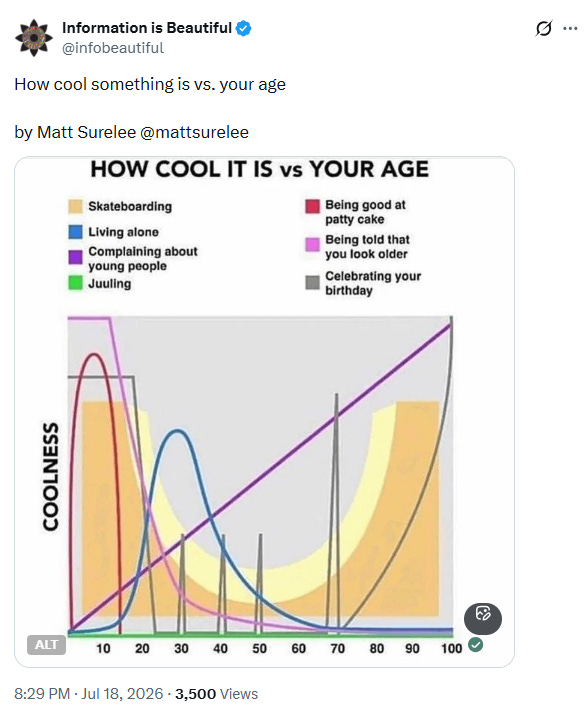
Such a cool chart! Look at the birthday celebration one!
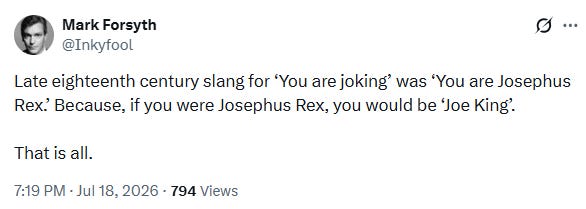
Haha, Forsyth is the best. And I’m not Josephus Rex!
🎧 1 long-form listen of the week
This episode is a great example of the storytelling technique of ‘Finding Patterns and Labelling them’ (Chapter 4 from my book, Story Rules). In it, journalist-writer Derek Thompson speaks with philosopher Agnes Callard (University of Chicago) about the concept of the ‘unicontext’ – a single term that attempts to explain why everything feels so divided and exhausting.
I’ll be honest—a lot of the ideas in this episode were quite dense, and I struggled to understand them (especially Agnes’s portions; she would do well to share specific concrete examples!).
Derek (who’s a superstar) tries his best to make it relatable to the audience, though. Still, it’s a thought-provoking discussion, worth listening to.
The core idea—norms used to be local. Now there’s just one set.
Callard: A context is a normative situation. It’s a set of circumstances that tell you how you should act. And for most of human history, contexts were local and multiple. So if you wanted to know how you should act, you would look around – am I in a field? Am I inside my home? Am I in the church? Am I in a bar? And you would immediately get guidance by looking both at your physical environment and at the people around you and how they were acting.
The unicontext is a scenario in which the ways in which you should act become the same across all different contexts. There’s just one set of norms that you should follow all the time, irrespective of context.
(I’m guessing she is referring to the large proportion of time spent online, which makes it a unicontext)
People lamenting about the deleterious effects of tech isn’t new—we were complaining about the radio in 1933.
Thompson: I read this 1,500-word social science survey called Recent Social Trends, published in 1933. And it’s incredible how they talk about the radio. They’re like, there’s this new thing called the radio and it’s destroying individuality because it’s taking these people who used to live in houses or fields or churches – all the other rooms you were talking about – and it explodes their brains to be present all over the world simultaneously. Radio is demolishing this idea of a local individual because suddenly we’re all becoming global citizens. And then you add to that television, and then broadband, and then internet and smartphone.
Callard raises an interesting counterpoint – why did humans keep choosing these technologies?
Callard: What the tech determinism angle misses is brought out by the thought – look, the radio did it. And then you’ll get Meyrowitz writing his book – look, TV did it. You could say trains were really big for the unicontext in the early 20th century. But the reason why I don’t adopt a pure tech determinism view is just the weirdness of being like ‘add to that.’ Like, what do you mean ‘add’? Why did we add it? Why was there the radio? Why did we come up with these things and why did they take on and why did people become absorbed in them?
Not every form of technology that people have ever invented has caught on in the way that these forms of technology have. These forms of technology caught on in large part because of this unicontextual impulse – that people have to live in a unicontext. There’s something of a dialectical relationship.
Thompson: Could you take that one step further? Explain what that human desire is.
Callard: It’s something like we want to be bigger than ourselves. We want to not only know what’s going on – we want to be part of something larger than our local existence.
Whoa, that part was a little deep.
Anyway, another key point made in the conversation is about why the internet is so negative – because goodness is local, but evil can be universal:
Callard: In general, goodness is more context dependent than badness. There isn’t really anything that’s good all the time for everyone totally independent of context. The question is what is happiness, and what it is depends on your context and your circumstances and who you are. There isn’t anything that will always make a person happy. But there are some pretty reliable ways to make people unhappy. There are a set of evils that are pretty close to universal – death, pain, illness, violence. Even if someone’s in really different circumstances from yours, even if you don’t much understand who they are or how they live, if you see that they’re being subjected to one of those experiences, you can interpret that as suffering and you can understand it.
Thompson frames this with an example of his love for chicken enchiladas… and why the things you love are boring online but hate goes viral:
Thompson: If I think that chicken enchiladas are really delicious, well, that might be something that’s very interesting to my wife or to my neighbour if we’re cooking dinner together in the context of our home. But the fact that I think chicken enchiladas are delicious is incredibly boring for posting on Twitter, which is to say posting in a place that’s going to cut across context. It’s way more interesting for me to say I think white Americans who eat chicken enchiladas are racist against Mexican culture – because the concept of racism clicks into a global norm of badness.
Another profound point made in the podcast: the unicontext focuses on ‘identity’ instead of ‘character’. Character requires context to perceive, while Identity is a hat you never take off:
Callard: The very fact that I kind of have to tell you what character is – is telling. That word is less familiar to us. Everyone knows what identity is. But we’re not even sure what character is anymore. Character refers to a set of dispositions that relate to how you navigate your emotional life in relation to a variety of circumstances. The thing about character is that grasping it, perceiving it, requires actually a lot of context. To understand someone’s character, you need to know them pretty well and you need to have had experience of them in a variety of contexts to be able to generalise in that way.
If we think of identity categories like woman, disabled, gay, Jewish, American – the striking thing about those categories is that you are them in every circumstance. There is no circumstance in which I stop being a woman. It’s like a hat you never take off. And so it is very suited to a world where we need those sorts of categories in order to understand people.
Thompson: You think about the cavernous gap between how frequently we talk about identity and how infrequently we talk about character – which character traits are virtuous and which character traits are not. That gap – does that click into what you’re describing as an outflow of the unicontext? Callard: Yes, in two ways. Identity – because a fundamental rule of the unicontext is that it has to be a space for everybody. It’s got to be inclusive in a way that earlier societies pretty much weren’t. That word ‘inclusion’ – there was no such value. That just wasn’t a thing people talked about. It’s new. It comes along with the unicontext.
Thompson then discusses a real-world implication of the ‘unicontext’… how all baseball teams form homogenised strategies following ‘Moneyball’ tactics:
Thompson: As the data and analytics revolution comes for baseball, you suddenly have all of these teams that are in possession of the same fundamental statistics by which they can compare all of these players. Previously you had 30 teams using their own private scouts to evaluate who’s good and who’s bad – that was more context dependent. But suddenly when an easily calculable statistic like on-base percentage or WAR becomes the way you evaluate whether a player is good or bad – math is easily used to evaluate every single player in the league.
But what happened with the so-called Moneyball revolution in baseball? It’s not just that you have an analytics revolution that allows players to be compared. You also have homogenisation of strategy. One of the great critiques of baseball in the last 10 to 15 years is that every baseball team essentially does the exact same thing. They have the same strategies for pitchers, the same strategies for hitters. Three true outcomes. Everyone should swing for the fences. And so you have number one the unicontext creating number two a comparative field which in this case is analytics, which leads to homogenisation.
Because we are perennially online, we seem to be living in an abstract unicontext, rather than our local ‘real’ context:
Callard: Musil, one of my heroic prophets of the unicontext, wrote: ‘The probability of experiencing something unusual through the newspapers is much greater than that of experiencing it in person.’ In other words, the more important things take place today in the abstract and the more trivial ones in real life. That’s him saying we are in some way divorced from our local context. It’s become irrelevant to us and we somehow live in this abstract space that then requires us to manage our attentions.
Thompson: If we’re living in this universal room where we feel like everyone else is there, all the things we could potentially do are there, then opportunity cost feels more expensive. We’re constantly aware of all the things that we’re not doing. And in a world where we’re constantly aware of all the things that we’re not doing in this universal room, we feel like attention is this scarce resource to manage and optimise rather than this river that just flows through us.
That’s all from this week’s edition.
Photo by Diana Polekhina on Unsplash