How Metaphors Impact Us

Progress on the second book is slow and steady. But I am enjoying it!
I am most excited when I list all examples (that I have researched) for one chapter in a notebook, and sit down in a quiet place trying to organise them into the right flow for the chapter. Great fun.
The actual writing is the part when it gets slow… especially doing the fact-checking, researching the right sources, and constantly fighting questions in my mind on “does this example fit well here?”
But overall, it’s super fulfilling!
And now, on to the newsletter.
Thanks for reading The Story Rules Newsletter! Subscribe for free to receive new posts and support my work.
Welcome to the one hundred seventy-seventh edition of ‘3-to-1 by Story Rules‘*.
A newsletter recommending good examples of storytelling across:
- 3 tweets, and
- 1 long-form content piece
Let’s dive in.
𝕏 3 Tweets of the week
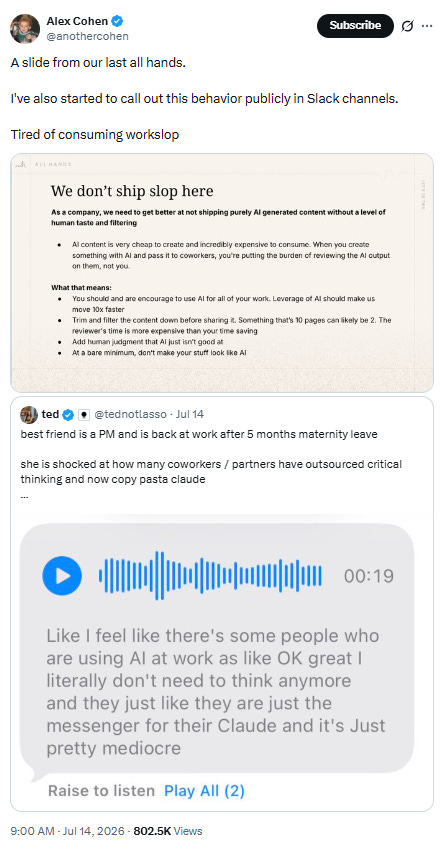
Yay for Alex! May his tribe increase!
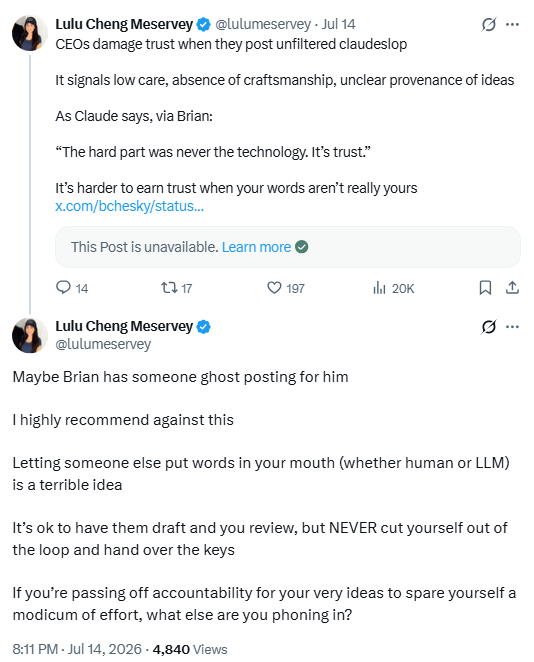
Good advice from Lulu. Do not let someone else put words in your mouth.
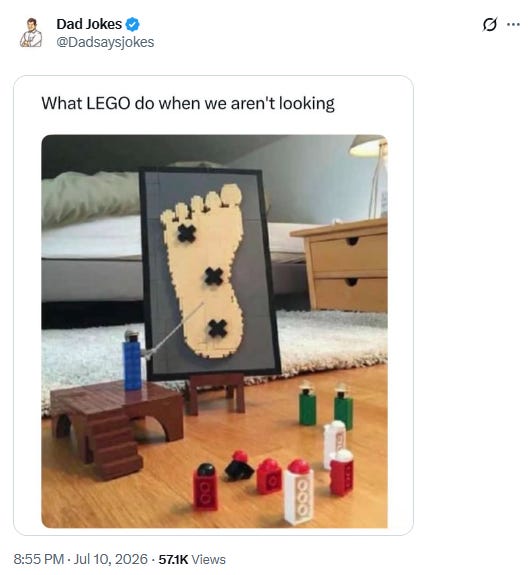
Hahaha, took me a few seconds to understand… but this is brilliant!
🎧 1 long-form listen of the week
As part of my research for my book on framing, I came across this podcast conversation about the importance of metaphor and how it’s all around us, but we don’t notice it.
It features Dr. Stephen Flusberg, who runs the FRAME (Framing Reasoning and Metaphor—such a cool acronym!) Lab at Vassar College in the US, being interviewed by host Kenzie Cooper Ryder of the Many Minds podcast
The conversation covers what metaphors actually are, why they’re far more than literary techniques, and how the wrong metaphor can impact millions.
Metaphors are all around us:
Ryder: We are, as language users, as communicators, faced with choices about whether we want to say things in dry, concrete, literal ways or whether we want to spice things up, add a little more imagery, a little more figurative language.
Flusberg: Even when you were just describing the optionality of metaphor, you said things like we can choose to ‘spice things up.’ So that’s itself a metaphor from cooking, from tasting. And you’re also saying prose can be ‘dry.’ Well, it can’t be literally dry because it’s not a surface. Those metaphors are kind of baked into the English language.
A metaphor is a bridge—helping the audience understand a lesser-understood idea by connecting it with a better-understood idea:
Flusberg: Typically with a metaphor, you have the source domain – that’s sort of the thing that you and your interlocutor know about. It’s more common knowledge, more familiar, often very much more concrete information. And because it’s something that you and I know about, I can now evoke your knowledge of that by using the metaphor, which encourages you to apply what you know figuratively to the target domain, to the thing we’re talking about.
If you’re talking about your life, your career, your relationships, then using a journey metaphor can be really useful because we all know about how journeys work. So I could talk about facing obstacles on the road, or coming to a crossroads in my life. That doesn’t mean literally I had to go left or right. It means I was faced with a decision to metaphorically go one way – maybe continue down the path I was going in my career versus veering off and choosing another option.
Mapping or connecting the two domains is always partial:
Ryder: One thing that becomes clearer when we spell out what a mapping is – we start to notice that not everything in the source domain gets carried across, transferred over, mapped to the target domain. So metaphors are always kind of partial mappings.
Flusberg clarifies the difference between analogy and metaphor—with analogies being a subset:
Flusberg: I think about analogies kind of as a subset of metaphors. So metaphor is a very broad category of this kind of comparison between source and target domains, and they could be anything from comparing two things just based on very surface level features. So we might say the moon is a pearl. Well, why? Because it looks like one – it’s spherical and kind of white and shimmering. That’s a metaphor but not really an analogy, because an analogy is a kind of metaphor where what you’re comparing is those more structural elements.
When you talk about life as a journey – yeah, that’s a metaphor. But I would say it’s really an analogy because it involves that mapping of structure from one thing onto another.
Metaphor experts claim that they aren’t just decorative language; they’re how we actually think:
Flusberg: This is the point modern metaphor studies usually traces back to – the book ‘Metaphors We Live By’, by the linguist George Lakoff and the philosopher Mark Johnson, published in 1980. That’s the book that got me into thinking about all this stuff. It kind of blew my mind in college when I read it and set me on my career journey.
Their whole argument is – look at the way we use metaphors and see how systematically they come up and how unavoidable they are when we’re talking about different topics, especially abstract topics like our life. And really what they argued is that this is how we think. We think about life like a journey. It’s not just words, it’s actually how we conceptualise and make decisions. It’s actually how we live our life – in terms of journeys, or what we know about journeys.
For example, we talk about arguments as wars, and that influences how we actually argue. Instead, what if arguments were treated as a dance:
Flusberg: One of the first examples in the book is that in English, we talk about arguments as if they’re wars. So we say things like ‘I’m going to attack your position. I’m going to bombard you with facts until you’re on the defensive, then I’m going to destroy your argument. I’m going to target the specific weaknesses in your defences, and I’m going to defend my own claims until I win and destroy you.’
Their point was, it’s not just that we talk about arguments as kind of wars. It’s that that’s what arguments are in our culture. You really literally can win or lose an argument. And they contrast it and say – maybe in another culture, arguments aren’t wars. They’re a kind of dance where there’s mutual coordination, there’s fun and joy. No one wins, no winners or losers.
They say – look, that means you might not recognise what those other people are doing as arguing. So that’s the deeper point: for us, arguments have become wars. We live by that metaphor.
Flusberg claims that some metaphors—like the carbon footprint one—were deliberately crafted to shift blame:
Flusberg: A metaphor you’re probably familiar with is a carbon footprint. It’s sort of the amount of greenhouse gas emissions that an individual or maybe a company or organisation leaves behind. So if you’re someone who flies on private jets every day, you have a higher carbon footprint than someone who just stays in their house. This seems like an apt metaphor. It’s really familiar, it’s convenient, it’s efficient.
But it’s been critiqued by some journalists, some climate activists, because if you look into the history, it was originally promoted by the British oil company BP maybe 20 years ago as a kind of strategy to shift the responsibility for addressing climate change onto individuals. ‘Hey Kenzie, you need to lower your carbon footprint.’ Whereas the best solutions for reducing climate emissions are much more systemic – transnational policy agreements or even just national policy agreements about how many emissions a company should be allowed. So a lot of people said it’s kind of cynical – it’s confusing you. It’s making you think climate change is your fault.
The ‘war against COVID’ metaphor might have been effective at first, but turned out to be counterproductive:
Flusberg: At the beginning of the COVID pandemic, a lot of world leaders used this war language. I think Donald Trump even said ‘I’m the wartime president’ and a lot of leaders around the world invoked war metaphors. And I think it was an effective metaphor at first. It led people to think this is really urgent. We’ve got to win. We’ve got to support our troops – who were the frontline soldiers in the battle, the doctors and the nurses. And we have to sacrifice. We’re going to stay home. We’re going to wear masks, just like you would in a real war.
The problem is – well, how do we win? It wasn’t just creating a vaccine. There’s no real winning. And the more it dragged on, people were sick of it. Plus the behaviours we were asking people to engage in – ‘don’t do the stuff you normally do’ – it’s too passive. To win a war, you’re supposed to be out there fighting. But if you’re just told ‘stay home and log onto the internet’ – that doesn’t really feel like what we do in war.
I think that metaphor failed quite quickly and may have caused some of the very rapid unrest that people felt all over the world with how their governments were responding to the pandemic.
War metaphors are overused—and can be useful in some domains, while counter-productive in others:
Flusberg: You just Google ‘war on blank’ and you find a million articles. It’s this almost absurd trope, at least in American media, where anytime you find a situation that could be construed as having opposing sides, people just default to a war metaphor framing. Go to Amazon and just type ‘war on’ and hit enter. You will find dozens of books. The war on Ebola, the war on girls, war on guns. It’s just this common framing.
In the United States, the war framing has been used to set policy for a long time. Lyndon Johnson declared war on poverty, Nixon declared war on cancer, there’s the war on drugs, war on crime. And these actually motivate giant policy shifts in how we engage in research, engage our law enforcement resources. Declaring a war on poverty – some people have said that was actually a really useful endeavour because it drew attention to this issue and led to increased support for social welfare programmes. Similarly, a war on cancer actually led to increased resources devoted to cancer research, and since 50 years ago, the ability to treat cancer has improved immeasurably.
Within more specific domains, it can have nuanced effects. People in the medical profession talk about how often we use war metaphors for disease – ‘she’s fighting hard, she’s battling this disease, support her in her fight, she’ll win.’ On the one hand, the war framing is maybe useful – we have white blood cells and defence mechanisms that battle the invading cells. But for some people, the war metaphor has negative consequences. If you’re a patient getting treatment, ‘you fighting’ doesn’t really mean anything. And there’s evidence that it makes them feel guilty that they’re not doing more. One part of the war metaphor that gets mapped onto a disease context is surrender – and there’s at least one study showing that when you use war metaphors for cancer, people express more fatalistic attitudes compared to a journey framing.
That’s all from this week’s edition.
Photo by Diana Polekhina on Unsplash