
The Story of Falling Global Fertility

Phew, we saw a lot of (much-needed) rain in the last week in Mumbai and Pune!
Somehow, I still managed to travel for three sessions (one to Karjat, one in Hyderabad and one to Lonavala) without getting stuck.
God has been kind!
And now, on to the newsletter.
Thanks for reading The Story Rules Newsletter! Subscribe for free to receive new posts and support my work.
Welcome to the one hundred seventy-sixth edition of ‘3-to-1 by Story Rules‘*.
A newsletter recommending good examples of storytelling across:
- 3 tweets, and
- 1 long-form content piece
Let’s dive in.
𝕏 3 Tweets of the week
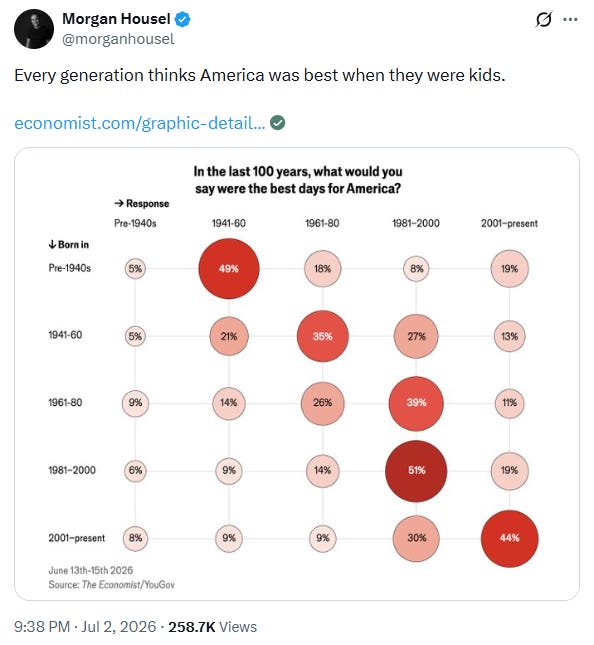
Not surprising as a finding…! But great chart.

Ouch. A favourite quote I read somewhere is, “With AI, you can outsource the writing, but you cannot outsource the understanding”.

Hahaha, brilliant.
🎧 1 long-form listen of the week
Two of my favourite data storytellers—Ed Conway from Sky News and John Burn-Murdoch of the Financial Times—get together in this video where they discuss the biggest silent crisis the world is facing: falling fertility.
Watch it on YouTube to see how they tell a compelling visual story. A masterclass in visually controlling the release of information.
Did you know that Mexico now has a lower fertility rate than the US?!
Burn-Murdoch: Mexico, the US’s southern neighbour, significantly less economically developed. Historically, we would always have thought that poorer countries would have higher birth rates because so much of low birth rates was about economic development. But what we’re now seeing, not just here but in other examples, is that poorer countries are suddenly seeing these very steep declines to lower birth rates than we see in rich countries. I talk about this as countries getting old before they’re getting rich.
An unlikely possible driver of fertility decline—child car seat mandates:
Conway: There’s this really interesting paper out a few years ago basically showing that as extra rules came in in America in particular that raised the age at which children still had to be in their car seat, it potentially pushed down fertility rates. Basically, the more children you have, the more you have to shove into a car at one time. They reckon that if you were to change the age at which you had these mandates for car seats – maybe it’s age seven, maybe it’s age six, maybe it’s five or four – you can see as those changes would come in, they think the fertility rate would go up and you would have tens of thousands more children being born.
When surveyed, most people indicate that they want 2 kids… but there’s a wide and growing gap between that intention and the reality:
Burn-Murdoch: What we see in many places is there has been a slight shift in aspirations or priorities recently. People maybe now say they want to have slightly fewer kids than they used to. But then if you look at the actual number of kids those same people have – it’s lower, and that line is going down even faster. And for me, that’s telling us that at least part of what we’re looking at here is some friction or barrier that comes between the family situation people would ideally be in and the one they end up in.
Conway: There are various impediments for potential parents that are potentially making it so they don’t have more children.
The fall in home ownership (especially in the UK) is part of the explanation:
Burn-Murdoch: If you think about the stage in your life you want to be at when you make big decisions like settling down, having a family, having kids, it’s when you’ve got long-term stability of your housing as well. So I looked at what’s happened to birth rates in reality and then what would have happened if the rate at which people in their 20s and 30s own homes had not fallen. People who own their homes have more kids than those who rent.
Over the last 10 years, even among homeowners, birth rates are going down. Among renters, they’re going down. So housing – if everyone could still own their own home, birth rates would be higher, but they would still have been falling for the last 10 years.
Another factor has been a collapse of socialising – from two-thirds of free time spent with others to below half:
Burn-Murdoch: This is detailed time-use diaries where people are asked to track what they’re doing throughout the day. It used to be the case, only 20 or so years ago, that two-thirds of people’s free time was spent hanging out with other people. This is young adults we’re talking about. Now, that has dipped recently below a half. So there’s been this big decline in just hanging out, getting together with mates or with potential partners.
Smartphones look to be a key driver of this fall… they show a striking chart wherein, after smartphone adoption, fertility rates fell across countries:
Burn-Murdoch: I’ve taken the total fertility rate in a range of countries – from rich countries like the US and Australia, to middle-income Mexico and Indonesia, to slightly poorer Egypt, Iran, and Senegal. And instead of having years across the bottom, it’s the number of years before or since smartphones really took off. UK, US, Australia – that’s sort of 2007-2008. Mexico, Egypt – that is happening about 2012. Senegal, 2015.
In the decade up until that period, rates were fluctuating but they were relatively stable. Whereas if we now draw in what happened after smartphone usage really took off in each of these countries, you see this now sort of synchronised decline. You see it in Australia, you see it in Senegal, you see it in the US. Not that we can say it is definitively this, but that is a striking coincidence.
That’s all from this week’s edition.
Photo by Diana Polekhina on Unsplash