An Optimistic Take on the AI-jobs debate

Good to see the rains arrive (at least in some parts of India)!
On the flipside, I was in Bangalore and Mumbai last week and got stuck in heavier-than-usual traffic (I’m guessing due to rains?).
Speaking of weather, this week’s podcast episode is like a glorious ray of sunshine amidst the doom and gloom. Do listen.
And now, on to the newsletter.
Thanks for reading The Story Rules Newsletter! Subscribe for free to receive new posts and support my work.
Welcome to the one hundred seventy-fourth edition of ‘3-to-1 by Story Rules‘*.
A newsletter recommending good examples of storytelling across:
- 3 tweets, and
- 1 long-form content piece
Let’s dive in.
𝕏 3 Tweets of the week
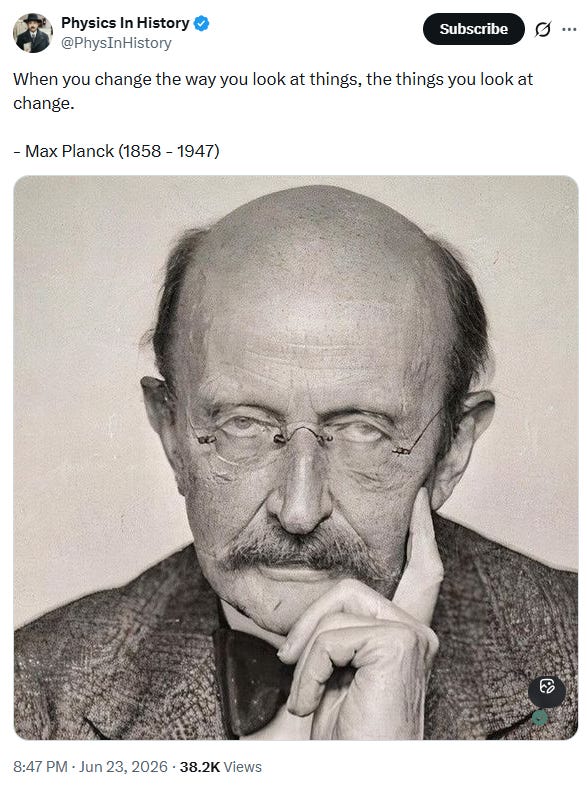
Ooh, that’s a good one.
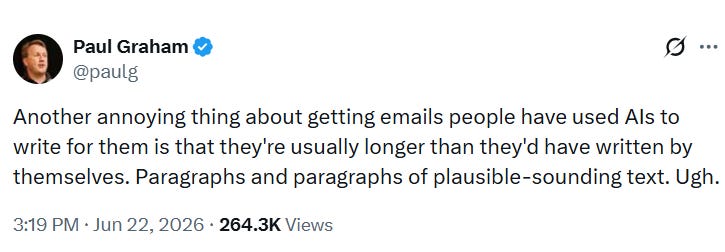
Editing AI-generated text is a key responsibility of the writer.
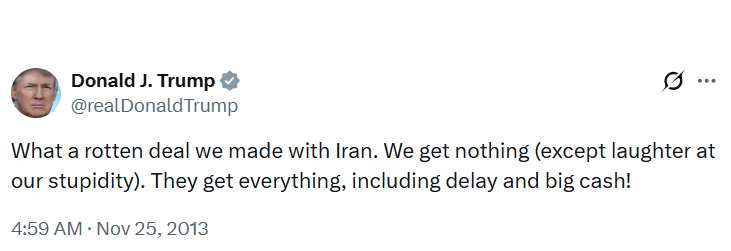
Look at the date of the tweet
🎧 1 long-form listen of the week
Tyler Cowen and Alex Tabarrok are well-known economists at George Mason University. In this chat, they bring hard data, several historical references and a whole lot of infectious optimism to the AI’s-impact-on-jobs debate.
Key point: Focus on growth and redistribution will be easier.
Cowen identifies several sectors where many new jobs will be created:
Cowen: Just a few areas where I think AI will create or already is creating a lot of new jobs. One area is generally energy, electricity, the grid. Alex himself has written a lot on the United States electrical grid. It’s completely screwed up. It will take 20 years, 30 years, 40 years to fix. The AIs cannot do that on their own. That’s a good deal of jobs right there.
The biomed sector and medical trials – there will be many, many, many more ideas to test. AIs will help with the testing, but I don’t think pure testing by simulation will be possible anytime soon. And in any case, the law requires testing on actual humans. So that’s another growth sector.
Simply care for the elderly. There will be robots, personal companions. We have this already. But the elderly also will want human care. It wouldn’t surprise me if in the future, 15-20% of all jobs were elderly care. That’s a growth sector. Will not be taken away by AI.
He then makes the case for “messy jobs” – the ones that are hard to describe and harder to automate:
Cowen: Luis Garicano had an excellent online essay. He referred to what he called messy jobs – jobs where it’s hard to explain exactly what the job is, but on a given day, you’re doing 11 different things and it requires coordination and figuring out what you ought to do next and getting other people to help you. So Garicano says: ‘Tell your kid to go into messy jobs.’ They’re hard to describe, harder to name. But again, there’s a real future in messy jobs.
Historically, even the smartest people have not been able to predict what new jobs will emerge:
Cowen: I have a running segment on the Marginal Revolution blog called ‘new service sector jobs.’ You can type that into the search function and there’s about 150 of these posts. All the new little weird jobs that pop up when a society gets wealthier. You don’t really think of them much in advance.
If you go back in time, the great economist David Ricardo, one of the smartest humans when he was alive in 1817, he wrote an essay called ‘On Machinery.’ He was worried machines would put people out of work. That was on one hand a fair worry. But when David Ricardo sat down and tried to think about what the new jobs would be, he actually had no idea. He couldn’t think of them and he was one of the smartest people of his day. So most new jobs in fact will be things that very few individuals can think of in advance.
Cowen makes a fascinating counterintuitive argument – faster disruption actually means faster adjustment:
Cowen: Many people believe, in my view correctly, that the AI revolution will be much quicker than the industrial revolution. That will probably ease job adjustment, not make it harder. You see in the data, when sectors change – like manufacturing declines – people hang around the old town or the old job or the old company hoping it will come back and there’s a slowness of adjustment. If there’s a decisive change more quickly, I actually think adjustment will be quicker as well. It might be more disorienting, but the new jobs will be created more quickly.
He then dismisses the doomsday scenario painted by the Citrini Research report:
Cowen: There was a scenario online about three weeks ago – this claim that because of AI there’s going to be a great depression again and all the purchasing power will be sucked out of the economy. That came from a group called Citrini Research. That’s a view that all economists think is wrong. It’s not really a matter of opinion. The notion that all the money gets sucked somehow into an AI company and no one has any money – it’s not an equilibrium. There’s only huge profits at the top if there’s people at the bottom buying the product, spending money.
Alex Tabarrok puts the focus on the amazing track record of productivity growth by the world, from half the world in poverty to under 9%:
Tabarrok: Productivity just means getting more output from the same inputs, and productivity growth is really the entire secret to economic growth and to improving the standard of living. In 1970, not that long ago, half of the world’s population was living in extreme poverty. That means less than $3 per day. Half of the world’s population. Today that number is eight and a half percent and it’s falling. And that’s what productivity growth did. It has eliminated or greatly reduced extreme poverty.
There’s a LOT of room for further growth–even in the richest country in history.
Tabarrok: The median American today has more income than roughly 93% of the world’s population. Now, that tells you how advanced the United States is, but also how much the rest of the world has to go to catch up. And even in the United States, the richest large country in history, there’s a lot of room for improvement – and not just in producing more goods and services, but in creating longer and healthier lives. An extra year of healthy life gets more valuable the more goods and services you have already, because you really want to extend your life when your life is already good.
A brilliant reframing – Socrates on social media, or rather, on writing.
Tabarrok: Here is a perceptive critic on social media. The critic says: ‘The problem with social media isn’t that it stores information. The problem is that it stores information instead of you storing the information. Every time you screenshot something instead of thinking, every time you share instead of reflecting, you are training yourself to be a little more hollow. You don’t remember things anymore. You just know where to find them.’
Now, who said this? Was this a concerned parent, a technology critic, somebody in the Senate hearings? This was actually Socrates. Only slightly paraphrased. Socrates was worried about writing. He was worried about writing.
How many accountants lost their jobs to Excel?
Tabarrok: How many weavers did the Jacquard loom permanently put out of work? How many farm laborers did the tractor put out of work? How many accountants did Excel put out of work? The answer, basically to a rounding error, is zero. A big fat zero. The creation of Excel did not put accountants out of work. It actually further increased the demand for accountants. And I think the same is going to be true for AI.
Another cool reframe – instead of 50% unemployment, think of it as working just 50% of the time:
Tabarrok: Suppose I tell you that AI is going to create 50% unemployment. Half of the people in the workforce will lose their jobs. That sounds terrible. That’s catastrophic. Suppose however that I tell you that the work week will be cut in half. People will do half as much work. That actually sounds glorious. And yet these are almost the same thing.
At the beginning of the industrial revolution, 1850-1870, the number of annual work hours was 3,000 hours a year. Today that number is half – 1,500 hours a year. In 1850, half of a person’s entire life was spent working. Basically you worked, you slept, and then you died. Today we’re talking about 10%.
Vacations, weekends, retirement – all of these are inventions post the modern era:
Tabarrok: Instead of permanent mass unemployment, we have had shorter work weeks, fewer hours, a longer childhood, and a bigger retirement. In fact, many of these things we call leisure, they’re inventions of the modern era. The vacation was a 19th century invention of the rich which became democratized in the 20th century. The two-day weekend – it’s a 20th century invention. The very idea that somebody of working age would stop working before their body gave out and spend 15 to 20 years enjoying leisure – that would have blown the minds of almost anybody at the turn of the century. The very idea of retirement is a new idea for most people.
Ricardo’s comparative advantage – why it applies even if AGI can do everything better:
Tabarrok: David Ricardo’s most famous contribution to economics was the idea of comparative advantage. And what comparative advantage says is that even if somebody is better than you at everything, there are still opportunities for trade so long as there is some limit – like a time limit – on what they can do. I work with Tyler – he’s better than me at just about everything – but yet we are able to complement one another because Tyler only has 24 hours in a day. So it might be that the robots are better, but for the scenario where they take all jobs, you need more than that. You need that they’re so cheap and so replicable that there’s no constraint – no capital constraint, land constraint, time constraint, energy constraint on the robots.
The single most important line – distribution is only hard when growth is zero:
Tabarrok: I’m much more worried, not because of AI, just in general, about low growth or zero growth. Because when you have low growth, then the only way to get rich is at somebody else’s expense – a zero sum society. I think that’s responsible for a lot of the problems that we’re facing now, that growth has slowed down and we’ve become much more divisive because it’s becoming more of a zero sum society. If we are growing the pie and we’re growing the pie at tremendous rates, we can figure out distribution. Distribution is a hard problem when it’s zero sum. When what I get comes at your expense, it’s a much, much easier problem when the pie itself is growing.
That’s all from this week’s edition.
Photo by Diana Polekhina on Unsplash