How to Influence CXOs

After a long time, I spent the entire week at home. It was great! Got some crucial writing done. Will share about it soon.
And now, on to the newsletter.
Thanks for reading The Story Rules Newsletter! Subscribe for free to receive new posts and support my work.
Welcome to the one hundred seventy-third edition of ‘3-to-1 by Story Rules‘*.
A newsletter recommending good examples of storytelling across:
- 3 tweets, and
- 1 long-form content piece
Let’s dive in.
𝕏 3 Tweets of the week

Agree.
And how do you get better at it? By getting better during non-extemporaneous situations. By reading well, writing well and practising speaking as much as you can.
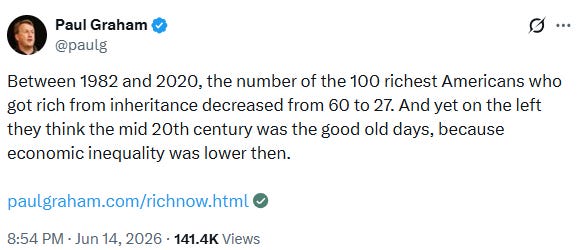
Very interesting stat. Paul G always tries to bring calm stats and logic to the emotional discussions around anti-rich sentiment.
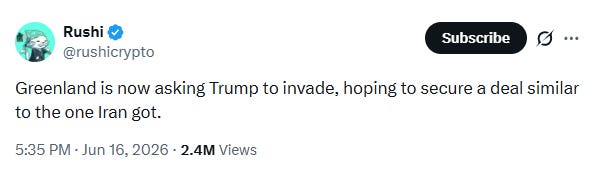
Hahaha, hilarious.
🎧 1 long-form listen of the week
Lenny Rachitsky has the knack of inviting some really good guests and asking some smart questions. In this one too, they get quite tactical on how you can influence senior stakeholders. The conversation talks about the importance of setting context, being clear, keeping the audience’s interests in mind, and doing a lot of background research.
The guest is Jessica Fain, who’s has been a product leader at companies like Box, Slack, and now Webflow. She served as chief of staff to two CPOs at Slack and has had a ringside view of how senior executives make decisions.
Here are some of the most insightful portions from the episode.
As a storyteller, the most common mistake is to make the presentation about you and your project when instead it should center around your audience and their priorities:
People completely misunderstand how executives make decisions – what is going on in the heads, in the calendars, in the incentive structures of executives. And instead of really understanding where that exec or stakeholder is coming from, they center themselves. They center their own desires, their own motivations, their own slice of the world, and they end up just not being as successful both in their career, but also in the types of products that they’re building.
Executives’ calendars are busy and action-packed …
I describe an executive’s calendar as like a strobe light going off. You wake up at 8 a.m., you’ve already got a huge list of urgent things going on. You go from a meeting with finance on a budget to an interview for another executive to a people problem to a legal problem to a product review. And the product manager coming to that product review thinks I’ve been prepping for this meeting for two weeks, three weeks, maybe six weeks since we last spoke. But the executive coming into that session hasn’t thought about you since. They may not have gone to the bathroom today.
… And so, it’s useful to spend 30 seconds at the top setting context:
One of the biggest tactics I think is so important is just take 30 seconds at the top of a meeting. Why are we here? What happened the last time we talked? Why is this important to you? Why is this meaningful? And really remember that they are not thinking just about you. They are optimizing for a global maximum and not for the local that you’re optimizing for.
Speak in the language your leader prefers/understands:
We as product leaders have to be communication chameleons. We have to be speaking their language – like love languages, but appropriate for work. And you have to think about: do they really turn a spark with a design, with a customer story, with a dashboard, with an experiment? How do you understand how their best brain, how their best expertise gets turned on to give you the best of themselves?
This is a critical point – your objective is not to get your plan approved. It’s to get the best outcome for the organisation:
One of the most disastrous things you can do is going into a meeting just looking for approval for your plan. Instead, if what you go in with is ‘how can I learn, how can I strengthen this plan, how can I use the domain expertise, the context, the experience that this person brings to the table and imbue that into my product work’ – both the executive will like you better because they will feel like you have actually built product alongside them, but you will also end up with a better product.
If we treat our stakeholder conversations as discovery interviews, as a way to strengthen our ideas, then we end up in a much, much better place.
Many people conflate influencing with politics. But a crucial distinction is whose gain are you maximising:
When people frame this as politics, they’re completely missing the point. Politics is manipulating outcomes in people for your own gain. Influence is about increasing the odds that your good ideas survive. This isn’t politicking. This is learning.
If you hear someone say something outrageous, instead of disagreeing or ridiculing them, here’s a good follow-up question:
A guy on my team does this super well right now. He’ll hear something that flies in the face of the data he’s seeing, the insights he’s gotten, his experience and domain expertise, and he’ll say: ‘That’s so interesting. What led you to believe that?’ That kind of question is actually curious – this person said something that I think is dumb, but there must be something behind it. And what you end up doing with that question is co-creating with the person who offered the opinion in the first place.
If this is someone who also has a growth mindset, then if you are able to help them unpack why they believe something and then respond with your own domain expertise, you are able to get to a better solution together.
Use the people around senior leaders – the EA, the chief of staff, the peers who’ve pitched successfully before. It’s rarer than you think:
I can count on one hand when I was chief of staff how many people asked me for advice before going into our product review with our CPO or other executive team. Use the people around them – their EA, their chief of staff, the people who have successfully pitched ideas in the past – and say: ‘What worked? What do you think they’re worried about? What are the risks?’
Often, leaders share their needs through subtle hints, not clear orders:
Something I see people miss often is they don’t follow the subtle threads that executives lead them, the sort of breadcrumbs of opinions. In a more clear-cut scenario, your leader will say: ‘I’d like a brief on exactly this thing. Write it generally this way. Let’s review it in a week.’ But very often the asks are more subtle. ‘I wonder if… I’m thinking about… Have you considered?’ And what I find is that people don’t take the bait. And the best people do.
Rachel, our CPO, said: ‘Hey Kev, we’re going to have to think about design reviews at some point.’ And within an hour, Kev had a Loom put together of ‘Here’s a framework of high-risk design changes, low-risk design changes, blast radius, release processes.’ She didn’t ask him to do that. He didn’t need to follow up in that time frame. But he recognized the thread and he took it.
Connect your work to a business outcome the CXO would care about:
So many times I see docs that are like ‘Our KR is to ship this thing’ and I’m like – why does that matter? Does anyone care? You have to tell a story. Even if shipping is the goal – why are you doing that? What is the outcome for the business? Why would the CEO be excited about shipping that? It’s usually because of some business outcome or user outcome that you have to tie back to their perspective.
And the flip side is: if you’re working on something that doesn’t shift one of those outcomes or isn’t urgent for the business, do you need to change course? One of the biggest things you can do to build trust is kill things. Deprioritize things. Think like a CPO. Put yourself in their shoes.
That’s all from this week’s edition.
Photo by Diana Polekhina on Unsplash