
Insights from Silicon Valley’s PR Expert

Alright, now back in the saddle at work now!
I write this from green and rainy Thiruvananthapuram, where I did a session for a bunch of enthusiastic tech leaders.
Today’s podcast is a fabulous one; make sure you listen to it!
And now, on to the newsletter.
Thanks for reading The Story Rules Newsletter! Subscribe for free to receive new posts and support my work.
Welcome to the one hundred seventy-first edition of ‘3-to-1 by Story Rules‘*.
A newsletter recommending good examples of storytelling across:
- 3 tweets, and
- 1 long-form content piece
Let’s dive in.
𝕏 3 Tweets of the week
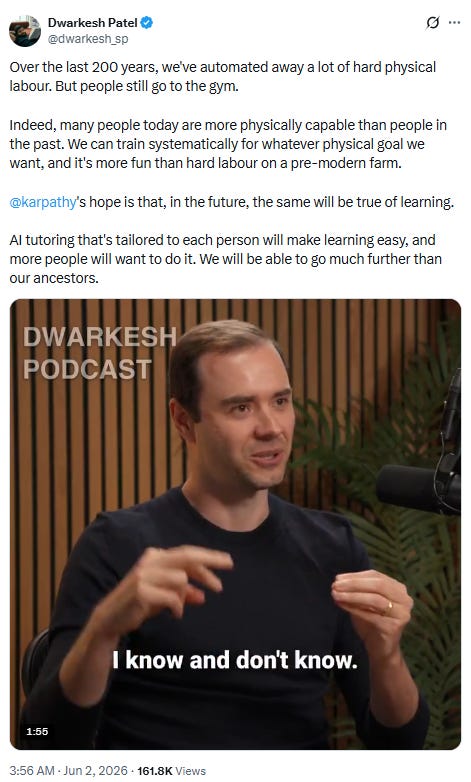
Fascinating perspective by Andrej Karpathy… Just like we go to the gym to deliberately do physical activity, we will figure out ways to engage in mental exercise in the AI-age.
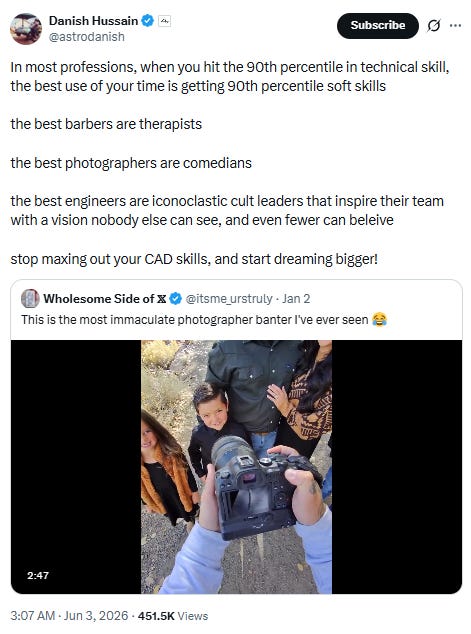
This is a great tweet about the need to build your unique skill stack.
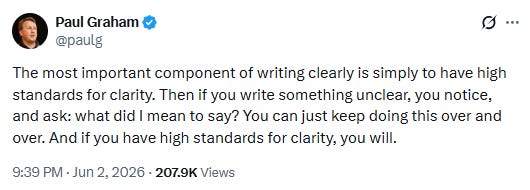
I also call this cognitive empathy towards the reader.
🎧 1 long-form listen of the week
a. How to Start a Cult: Tai Lopez in conversation with Lulu Cheng Meservey
In the world of communications, PR expert Lulu Cheng Meservey (a much-wanted comms advisor for the who’s who of Silicon Valley) probably has the highest signal-to-noise ratio when she speaks.
This conversation (like most others featuring Lulu) is packed with rich insights and frameworks for leadership communication.
It features diverse examples—from Napoleon to Cicero to Jensen Huang. Her argument is that if you’ve started a company, you’ve signed up to be a cult leader. Act like one.
Founders have the toughest comms jobs in the world, getting others to believe in their (mad) vision:
Meservey: Recruiting the first few members is the hardest thing you will ever do because you’ve got nothing and you look crazy. If you were going to do something normal, you wouldn’t be starting a cult. You’d be getting a freaking job. There is no shortcut – you sit across from someone, be willing to sound like a madman, and be so committed to the bit that you’re going to look them in the eyes and essentially swear on your life that the thing you’re telling them is possible, can be done, must be done, and will be done by you.
I loved the magnet analogy—be your authentic self and those who are attracted to you will find you:
Meservey: People are themselves because who the hell else could you possibly be? Sometimes you see someone try and it’s really cute, but it’s not going to work. It’s never worked. You can’t lie to everybody around the clock forever. But what you can do is be yourself but more. You can really unleash yourself. And if you unleash yourself, it might not be popular at that time and in that place, but eventually it’s like if you put a magnet in a bunch of filings, it doesn’t immediately just attach everything. Things gradually orient themselves the right way and then the things that were going to come start to come. That’s how it is with your people and your following.
The Domino’s Pizza Tracker is a great analogy for communication for long projects:
Meservey: If you care about reminding people that from here to there, there is an ultimate destination past the chaos phase, I strongly recommend giving people the Domino’s pizza tracker. You have to tell them what is the finished pizza and you have to remind them constantly. Just constantly remind people: we are here, this is the finished pizza, this is the finished rocket, this is the finished plant, whatever it is. And here’s where we are. Give them constant updates on where you are.
Founders cannot delegate the communication function—they have to put themselves out there:
Meservey: When people think, okay, I’m the founder, I’m the cult leader, I need to put myself out there – that feels bad. I’d rather just sit in my room and code. I’d rather just quietly go about my day and not expose myself to the tomato throwers of the global town hall. You can’t think of it as how will people react to this thing I say or this thing I do. It is: how will people care about what we’re doing if over the next year, five years, ten years I’m not giving them a reason to follow along with the story.
Superb example of reframing from Napoleon—and how it got people to willingly sign up for a suicide mission:
Meservey: Napoleon had these guys guarding a cannon that was within gunshot range of the Austrians. The people guarding this cannon had a 100% casualty rate. Not that they all died, but they all got shot. So he needed to replenish guys to go guard this cannon. Imagine you’re going to go to your troops and be like, ‘Who wants that job?’ It’s like something out of the Simpsons. What he did was he gave this group a name and he called them Les Sans Peur – the men without fear. So instead of saying ‘would you like to go get shot guarding this cannon,’ he said ‘who are going to be the next batch of the men without fear’ – and he filled it with volunteers.
Interesting pov—why it is ok to sometimes ‘overreact’ to one bad instance: you’re not reacting to that one thing; you’re reacting to the hundred things that now won’t happen.
Meservey: The essential lesson is don’t be afraid to be seen as if you’re massively overreacting. If one person does one small thing and then you react with overwhelming force, it can look like a massive overreaction. But what you’re doing is actually you’re reacting to the hundred things that would have happened. You’re not reacting to the one thing. You’re reacting to the hundred things that would have happened that now won’t.
How a simple act can send a powerful message:
Meservey: The way you communicate is through what you say, what you do, and then also visuals. When the German Chancellor Willy Brandt went to visit Warsaw and he went to see the monument honouring the Jewish people who had risen up, he stood there and then he just silently dropped to his knees. And that statement said so much about him representing the German people and how they viewed the Nazis’ actions. It really helped reshape relationships between Germany and Poland. It did so much and it was just the visual of this man on his knees saying nothing.
Jensen Huang’s genius for language that cuts through technical complexity.
Meservey: When Jensen was unveiling the DGX-1, he said that if you were using Intel equipment, training AlexNet would take 150 hours, whereas using his gear it would take 2 hours. And in the same launch, he called it a data centre in a box. Now there were all these technical specs he could have gone into, and they did. But ‘data centre in a box’ just shortcut through all of that. It became the thing that people remembered. That is so much more powerful than saying ‘we are faster, we’re better’ – all these subjective things that people just discount because it’s you saying it about yourself.
Another great food-related analogy (maybe Lulu was hungry?!)—Distribution is like plating; it cannot save a bad dish:
Meservey: Think of it like a dish. First you’ve got the ingredients – you have to pick what you’re cooking. Then you have the preparation. And then you have the plating. Distribution is the plating. And so if it’s plated crappy, people are not going to want it. That can undermine a really good dish. But if the dish is good enough, it can overcome bad plating. And good plating can’t save a bad dish.
A story about how Roman leader Cicero convinced a corrupt and sceptical jury to punish a tyrant:
Meservey: Cicero took on this case that seemed absolutely impossible. His job was to get a jury to find guilty the governor of Sicily who had abused his power blatantly. The reason it would be very difficult is that the jury who would decide would be made up of people who hated Cicero, loved the governor, or had been bribed.
What he did was he used his speeches to turn it into a trial of the jury. He said, ‘This is not about trying this man. Everyone knows he’s guilty. Who’s on trial is you – and it’s whether you can be bought, and whether you will let innocents suffer so that you can protect your friends.’ He completely flipped the incentives for them. Now they’re voting for themselves.
That’s all from this week’s edition.
Photo by Diana Polekhina on Unsplash