Clear Thinking about AI Hype

This week’s podcast episode is a must-listen one by the thoughtful Benedict Evans on the real impact of AI.
The week was a regular work week for me, with some writing and a fun 2-day workshop with a bunch of partners at a Big-4 firm.
Also, can’t wait for the rains to begin in Pune!
And now, on to the newsletter.
Thanks for reading The Story Rules Newsletter! Subscribe for free to receive new posts and support my work.
Welcome to the one hundred seventy-second edition of ‘3-to-1 by Story Rules‘*.
A newsletter recommending good examples of storytelling across:
- 3 tweets, and
- 1 long-form content piece
Let’s dive in.
𝕏 3 Tweets of the week
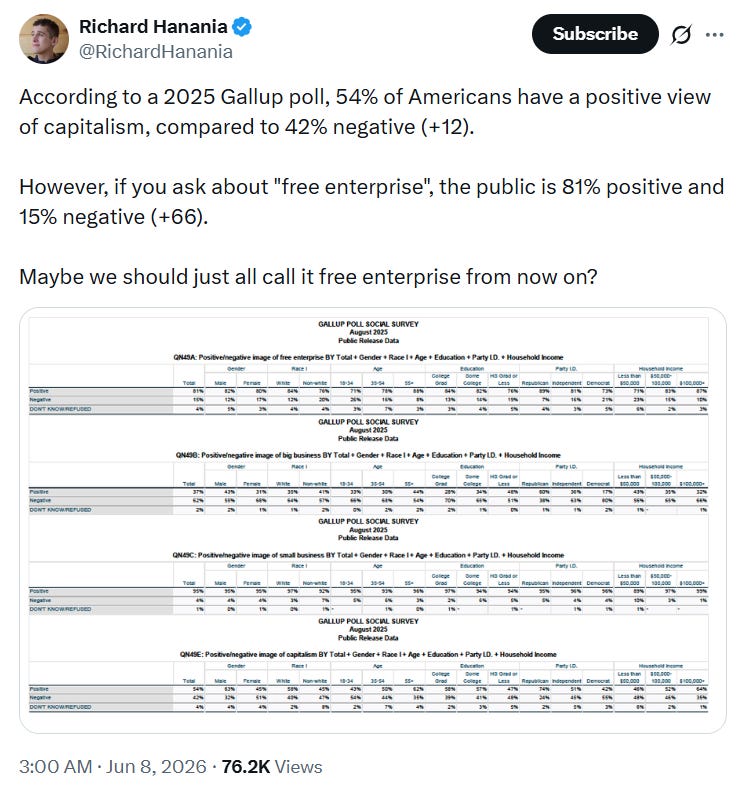
Sometimes the label itself has so much meaning.
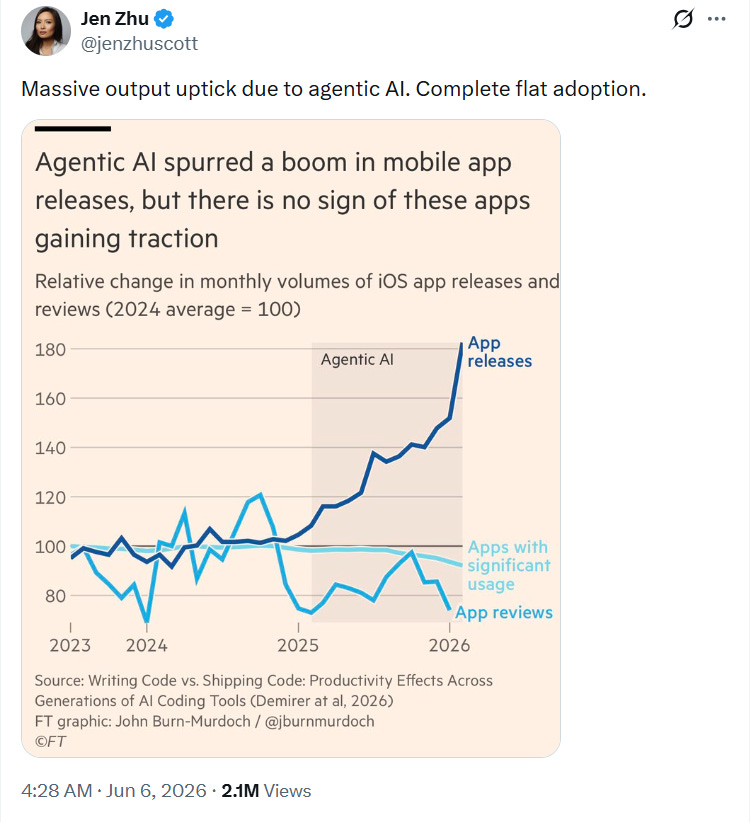
Fascinating chart. You can build, but will they buy?
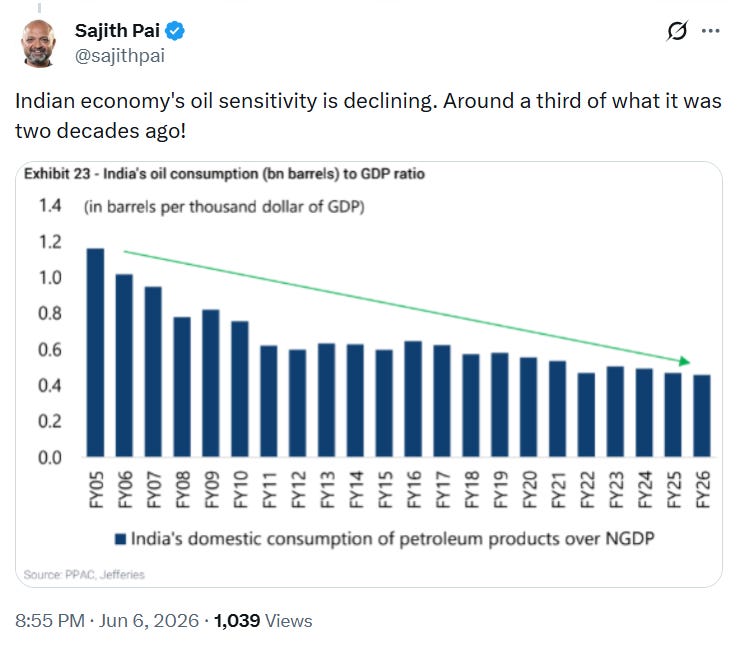
That’s a great metric to track… And good to know!
🎧 1 long-form listen of the week
Ben Evans is a clear-thinking technology expert and, in this conversation, offers a superb masterclass on placing AI in historical context.
He uses several historical examples from databases to Excel spreadsheets and the internet… and leaves everyone less worried about the potentially catastrophic projections of AI’s impact on jobs.
AI is as big a deal as the internet and mobile – and only as big a deal:
My most controversial opinion is that I think that AI is as big a deal as the internet or mobile and only as big a deal as the internet or mobile. Because clearly there’s a bunch of people in tech who think no, this is more like the industrial revolution or something. And there are a whole bunch of people underneath saying, well, he thinks this is just as big – does he not understand how big this is? And I’m like, smartphones were quite a big deal. The internet was quite a big deal. We wouldn’t be doing this if it wasn’t for the internet.
If you’re going to make the internet comparison, it’s like we’re in 1997. It’s very exciting. Most stuff kind of doesn’t work yet. Most of the stuff that people are going to do hasn’t been built yet and it’s not really clear how any of it’s going to work when it does work.
There’s a wide distribution in AI usage:
You’ve got this kind of very wide distribution. There’s people in tech who bought their cluster of Mac Minis and don’t use Google anymore. And then you look outside tech – most people who are using this are using this every week or two maybe. Even if you look at 13 to 18 year olds, it’s still like kind of 15-20% of people are daily active users and another 20% are weekly active users and then the other 60% say they are not using this. So there’s a very wide spread of adoption and that spread of maturity of how well this works.
When spreadsheets came, accountants were thrilled… but not the professions who didn’t work a lot with numbers:
Imagine you’re an accountant seeing the first software spreadsheets in the late ‘70s. This is mind-blowing. You change the interest rate here and all the other numbers change and it does a week of work for you in like 30 seconds. But if you were a lawyer looking at that or a journalist looking at that, you’d think, well, that’s very clever and my accountant should see this, but that’s not what I do.
You need a word processor, which actually came very shortly afterwards. And so that’s sort of the moment that we’re in – there’s some people like software developers who are the accountants seeing VisiCalc, like oh my god this changes everything. A lot of other people are picking it up, using it to varying degrees, but slightly puzzled.
This is a nice analogy: Software developers are to AI what accountants were to spreadsheets – the first group to have their minds blown.
Software developers are the accountants seeing VisiCalc – like oh my god, this changes everything. Before Claude Code and after Claude Code. A lot of other people are picking it up, using it to varying degrees, but slightly puzzled. If you’re a software developer, a lot of other people were like – people are having that moment, or they’re not. We’re in that kind of 1997 moment.
If you think AI could replace consultants, you are wrong:
You’re supposed to completely reimagine all of the internal workflows of your company and work out which of them could be automated really quickly with AI. That’s a project. That’s a project that needs like five or ten people to sit down and spend a month or two working it out. And then actually doing it is another project. We need to plug these three vertical systems into these two horizontal systems and build in a bunch of new workflows and train people to do that. Well, guess what? Who’s going to do that? Because you don’t have a bunch of people sitting around not doing anything.
What’s really just funny about this trend is you would think AI is going – like consultants were going to be gone. No, we don’t need all these people anymore. AI is going to do their work. Instead, the most cutting-edge AI labs are the ones most investing in these folks.
The Jevons paradox in action – from investment banking hours to iPhone apps.
What happens much more – and this is why people talk about the Jevons paradox, which is just price elasticity – if you make it cheaper to do something, what happens? Do you do the same for less money or do you do more for the same amount of money or do you do more for more money because you’ve got new ROI?
This is a joke I made on Twitter back when it was Twitter – young people won’t believe this, but before Excel, junior investment bankers worked really long hours. And now thanks to Excel, Goldman’s associates all leave at lunchtime on Fridays. Well, why is that not what happened? You could make the same point in software development. Before IDEs and libraries and operating systems, developers had to write all the code. Now, if you write an iPhone app, 90% of the code is written for you by Apple. Apple wrote the modem driver and the graphics drivers and the file system. You don’t need to write any of that. So we’ve got like a tenth as many engineers now? Well, no.
You don’t pay McKinsey for their slides – which is why Claude can’t replace it:
Why do you hire McKinsey? Are you hiring them to get a 75-slide deck? Well, narrowly, Claude Code will make a really, really crappy version of that. And you’ll get all these kind of AI grifters on LinkedIn and Twitter saying, ‘Hey, I made a McKinsey deck with Claude.’ And you look at it and you think, ‘Yeah, that’s a bunch of dog crap. That’s not what you’d get from McKinsey.’
But even if it was, that’s not what you paid them for. What you actually pay Bain to do is to go and walk all over your enterprise, your company, and work out – yes, but why is it that you didn’t do that? And how do the politics of this work? And what do you actually need to do? And let’s go and talk to your customers and work out what they actually think as opposed to what’s on the first page of Google.
The task versus the job – and why automating the PowerPoint misses the point.
One of the strands I tried to pull together is – what’s the hard part of the job? Is the hard part of the job writing the code line by line? Is the hard part of the job making the PowerPoint? Or is the hard part of the job something else? Is it the task or the job? Sometimes the task is the job – like an elevator attendant. But often you kind of can’t decouple that, or that wasn’t really the problem.
The PowerPoint is just like the task, but that’s not what you hired them for. The same with Amazon versus the retailer, the same with software development. Claude Code can write you the code, but what code do you want? It can make you the features, sure – but what features do you want? Who’s your customer? What’s the right product for that customer? How are you going to take it to market?
AI adoption is faster because it is standing on the shoulders of giants:
The adoption of AI is quicker than previous technologies, but this is kind of because you’re standing on the shoulders of giants. You don’t need to wait for everyone to buy a piece of expensive hardware – to buy a phone or a PC or wait for the telco to deploy broadband. It’s already there. So of course ChatGPT can get 900 million users because there’s already 900 million people on the internet. When Marc Andreessen launched Netscape in ‘93-’94, there were like 50 to 100 million PCs on Earth. But he didn’t need to wait for phone networks or microchips, and before that you didn’t need to wait for electricity. There’s always a compounding effect.
Enterprise adoption is really slow, and people will get time to adapt:
You talk to these doomers on Twitter and they would act like every big company is going to buy ChatGPT tomorrow and then in two weeks’ time they’ll fire all their staff. And these people are morons. A complete failure to understand the way the world works. Typical big company – enterprise software sales cycle, you’ll know this better than me – is like 18 months if you’re lucky.
No, people aren’t just going to tear out SAP and replace it with XYZ. Maybe in three, five, ten years, yes – that whole estate will look radically different and all those jobs will have changed. But it will take three, four, five, ten years and it will take time sector by sector, and it will take time for people to work out – oh, you could do that thing with this.
A superb historical parallel – an IBM ad from the 1950s (that could be a pitch deck slide for any AI company today!):
There’s a slide towards the end of the presentation – it’s an IBM ad from the ‘50s with this sea of white men in white shirts and ties all holding up slide rules. And the slogan on the ad says: ‘An IBM electronic calculator’ – this is before it was called a computer – ‘is like having 150 extra engineers.’
How many people listening to this – like, their company’s slogan is basically ‘we’ll give you 150 extra engineers.’ I mean, isn’t that like the whole pitch of Claude Code? 150 extra engineers, for free – or not free. That’s like a lot of money. And yes, we keep going through this over and over and over again.
The electricity analogy – and why Sam Altman’s ‘selling intelligence on a meter’ misses the point.
The useful analogy to the electricity industry is just saying how electricity became part of absolutely everything. Software has been kind of slowly working its way out. Electricity in factories and then electricity sort of slowly spreads out – and so that would be the point, that it slowly spreads out to do more and more things, a bigger and bigger contribution to the economy.
There’s this quote from Sam Altman where he said, ‘We’re going to be selling AI intelligence on a meter, like water or electricity.’ And you look at this and think – my dear sweet child, you need me to explain the margin structure of the utility industry to you? Because guess what – when you watch television, the TV company isn’t paying a percentage of your monthly bill to the electricity company. When you wash your clothes, Bosch isn’t paying a percentage of the price of the washing machine.
Did you know that there was panic in the 1970s around… databases?
I remember in the whole wave of panic around social media, I dug up a whole bunch of books in the late ‘70s about databases. There was a whole panic about databases – and again, half of it was true. If everybody’s police records and arrest records and all government records are online, then that’s different.
Every wave of technology comes with ways that you can ruin people’s lives, either deliberately or by accident. Chinese mass surveillance is deliberate. The Post Office scandal – maybe people should go to prison, maybe not. But we have this with every technology. We have a bunch of ways that you can ruin people’s lives and you have to be conscious of that and also kind of not panic about it.
The closing vibe – it’s probably going to be okay.
Lenny: I like that your just general vibe is – it’s going to be okay, guys. It’s going to be okay.
Evans: Yeah. I think if you – maybe this is because I’m British and we haven’t had political violence in 500 years. I think there’s a layer of – yes, this will change a bunch of stuff and we’ll need to worry about it, but that’s kind of a constant. We’ve always had that.
Lenny: It’ll probably be okay.
Evans: Yeah. Okay. That’s the vibe.
That’s all from this week’s edition.
Photo by Diana Polekhina on Unsplash